

Look, no batteries: General Industry Coverage
A machining sensor system integrated with the toolholder and spindle provides a host of benefits, such as solving chatter problems, helping with tool selection and process setup, and monitoring tool performance, according to Christopher Suprock, principal/founder of Suprock Technologies LLC.
A machining sensor system integrated with the toolholder and spindle provides a host of benefits, such as solving chatter problems, helping with tool selection and process setup, and monitoring tool performance, according to Christopher Suprock, principal/founder of Suprock Technologies LLC. To achieve that, the company developed the Intelligent Tool machining sensor system, which is powered wirelessly and without batteries.
Suprock explained that batteries present several problems when powering devices on rotating components, such as a high-speed toolholder. Users have to recharge batteries and batteries have a limited number of recharging cycles, which can be problematic when toolholder life is considerably longer than battery life. When a battery dies, it has to be replaced, ideally when changing a tool, which can be difficult to predict.
In addition, a toolholder rotating at a high speed should not have a battery inside to power the machining sensor system because rotational acceleration causes the cells inside the battery to contact each other and damage the battery, Suprock noted. Finally, with electrolyte-based batteries, the electrolyte can move to one side of the battery and throw the tool off balance like a centrifuge. “Batteries limit the rotational speeds at which you can run the tool without risking battery damage,” he said. “Batteries also require recharging and have a limited lifespan.”
The machining sensor system includes a spindle-mounted power transmitter and a single toolholder-mounted transceiver or multiple transceivers that go around the holder like a halo, according to Suprock. Although beaming power through a large piece of tool steel, such as a spindle, usually disrupts the energy transfer, he noted that the company developed a method to circumvent that challenge. The power transmitter operates at frequencies that are more efficient in the presence of steel.
The sensor system sends data to the control, such as for processing the tool torque in order to monitor wear. “We look at the torque signal at 32 kHz,” Suprock said. “That’s a lot faster than many other sensors.”
The high sampling rate enables a user to see the torque profile in a tool as it moves across the workpiece surface and the waveforms that correspond to that surface, he explained. “That’s valuable for somebody who wants to understand what the surface looks like because even if the cut sounds good, it may not impart a good surface finish,” Suprock said.
Because users often require a machining sensor system to be compatible with shrink-fit toolholders, Suprock pointed out that his firm developed “hardened electronics” to withstand the 15kW magnetic field the heat-shrink process generates. When the electronics sense a large magnetic field is being initiated, they go into self-preservation, or “turtle shell,” mode and disconnect internally so there’s no current flow in the circuits on the board, he explained. “The electronics are smart enough to protect themselves.”
Review the print ads from this magazine to continue
This quick advertiser review unlocks the rest of the article and keeps the full-screen reader focused on the ads instead of the page chrome.
Advertisers included in this article experience
Print placements connected to this article
Visit tkpromo.secotools.com or scan
LET SCIENCE REDEFINE YOUR CAST IRON
TURNING APPLICATIONS TRY THIS SECO INNOVATION FOR YOURSELF. this QR code to request your free TK Grades sample insert. Seco’s new TK1001 and TK2001 Grades inserts incorporate the hard science of our DURATOMIC® coating technology to deliver a uniquely effective approach to cast iron turning. Through manipulation of aluminum and oxygen at the atomic level, the DURATOMIC process creates.
LET SCIENCE REDEFINE YOUR CAST IRON TURNING APPLICATIONS TRY THIS SECO INNOVATION FOR YOURSELF. Visit tkpromo.secotools.com or scan this QR code to request your free TK Grades sample insert. Seco’s new TK1001 and TK2001 Grades inserts incorporate the hard science of our DURATOMIC® coating technology to deliver a uniquely effective approach to cast iron turning. Through manipulation of aluminum and oxygen at the atomic level, the DURATOMIC process creates
Visit Visit tkpromo.secotools.com or scan View this placement in the issue recordPrint ads from this magazine
TURNING APPLICATIONS TRY THIS SECO INNOVATION FOR YOURSELF. this QR code to request your free TK Grades sample insert. Seco’s new TK1001 and TK2001 Grades inserts incorporate the hard science of our DURATOMIC® coating technology to deliver a uniquely effective approach to cast iron turning. Through manipulation of aluminum and oxygen at the atomic level, the DURATOMIC process creates.
LET SCIENCE REDEFINE YOUR CAST IRON TURNING APPLICATIONS TRY THIS SECO INNOVATION FOR YOURSELF. Visit tkpromo.secotools.com or scan this QR code to request your free TK Grades sample insert. Seco’s new TK1001 and TK2001 Grades inserts incorporate the hard science of our DURATOMIC® coating technology to deliver a uniquely effective approach to cast iron turning. Through manipulation of aluminum and oxygen at the atomic level, the DURATOMIC process creates
Continue reading
February 2012
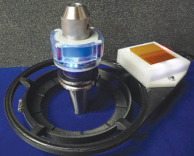
Courtesy of Suprock Technologies
The wirelessly powered Intelligent Tool machining sensor system from Suprock Technologies includes a digital radio transceiver on the toolholder.
Because the sensor is embedded in the toolholder, the sensor system does not require any changes to the machining center or spindle. It was developed to be compatible with the TMAC 9 (Tool Monitoring Adaptive Control) system from Caron Engineering Inc., Wells, Maine. TMAC 9 protects a CNC machine while providing information about the cutting process to reduce cycle times and optimize cutting conditions, which extends tool life, according to Caron Engineering.
“If somebody has TMAC 9, he can take our sensor integrated tool, plug a USB cable into the power transmitter and stream cutting data to TMAC for tool monitoring, which reduces setup time and complexity,” Suprock said. He added that a user could also stream the data to a computer and save it as a spreadsheet file when collecting data for setup, process or QC.
Suprock indicated that the company is seeking to license the technology to make it commercially available because it is only able to produce the sensor system in small volumes.
For more information about Suprock Technologies LLC, Exeter, N.H., visit www.suprocktech.com or call (717) 634-0883.
Glossary terms in this article
Related



Subscribers can use MFGAxis notes, saves and discussion tools with their innoNET account.


