

MTU America: Machining parts for large diesel engines
Shop Profile: MTU America machines parts for large diesel engines while helping fill the skills gap.
Eight machining centers steadily crank out parts in a former bearings factory that, today, is home to MTU America Inc. When the company moved its manufacturing operations from Detroit to the factory in Graniteville, S.C., in 2010, the area now occupied by MTU’s machining department had a dirt floor.
“We gutted it completely and put in all new infrastructure,” said Jeremy Diebel, senior manager of machining and apprenticeship coordinator for MTU.
The 320,000-sq.-ft. facility houses the only North American machine shop operated by MTU—the Friedrichshafen, Germany-headquartered manufacturer of diesel and other engines for off-road and stationary applications, such as mining equipment, tanks and standby power sources.
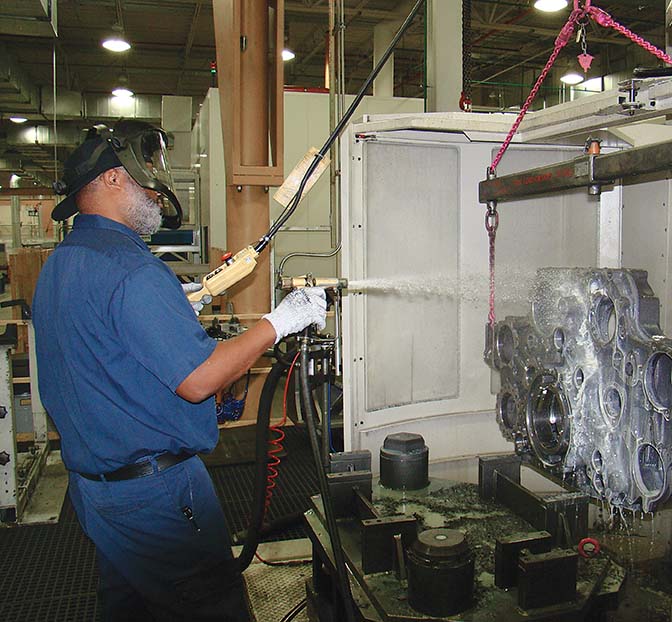
A machinist cleans a freshly machined part for a diesel engine at MTU America. All images courtesy of Alan Richter.
Because North America is one of MTU’s largest markets, Diebel said, the company wanted to have a manufacturing presence on the continent and brought production of “high-running” parts to the U.S. He considers a part to be high running if it requires at least 100 machine hours per year.
MTU America initially made only the same parts for the same engine models that MTU Friedrichshafen GmbH did. About 2 years ago, however, the South Carolina plant began producing some parts that were not made in Germany, Diebel said. From product concept to delivery consumes about 10 months, but one project had a 4-month timeframe—”and we did it.”
Highs and Lows
The low-volume, high-complexity parts that MTU machines are primarily made of cast iron. Most castings come from Europe. The low volume creates a challenge when a manufacturing change is required, Diebel pointed out. In a high-volume application, the response to a change is almost immediate—parts are produced in rapid-fire succession and a manufacturer can quickly determine whether a part is good or bad after a change occurs.
In contrast, the cycle time for, say, a power takeoff unit at MTU is 3 hours, followed by up to 3 hours more for the part to be washed and then inspected on a coordinate measuring machine. That means up to 6 hours pass before the change is determined to be successful or not.
“As lean as we are, with one-piece flow in sequential production, there are some parts where, if we make a small change, we may be on a totally different part number by the time we get a response from the CMM lab,” Diebel said. “That adds complexity because now the fixture is off the machine or the tooling was changed. We have variables that weren’t there before.”
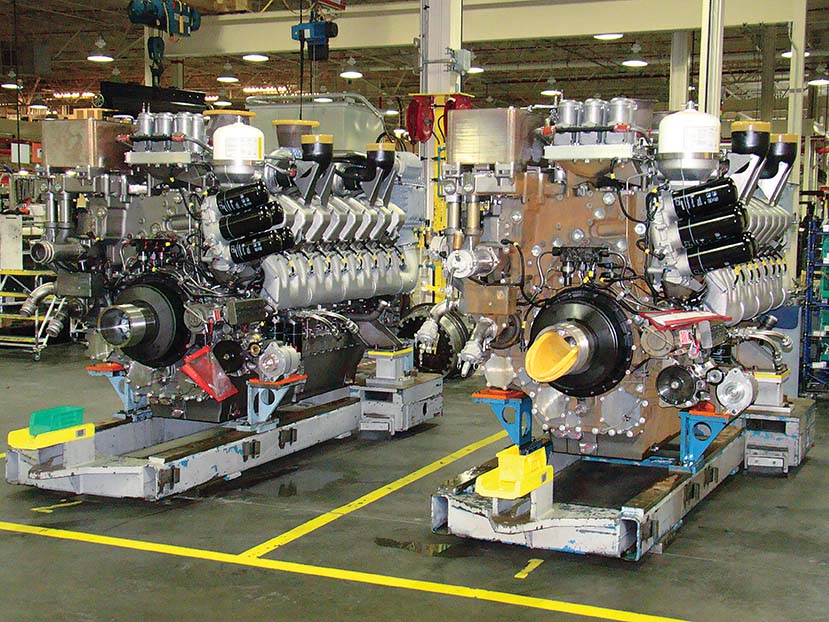
Assembled diesel engines wait for the next step in their journey.
Diebel said the alternative, which occurs when a change is critical enough, is to run one part, stop production and wait for the CMM results. But with the company’s focus on achieving just-in-time deliveries, MTU tries to avoid taking that route as much as possible.
Cutting tool changes are sometimes made to achieve the company’s annual goal of reducing standard machining times by 3.5 percent, Diebel said. “Last year, a very large percentage of that 3.5 percent was from one change, going from a gundrill to a carbide-tipped drill,” he said, adding that the switch reduced a 14-minute cycle by about 2 minutes.
In another switch, he noted MTU cut multiple minutes out of a cycle time with a new milling cutter. “That thing screams,” Diebel said. “We are always looking for new technologies.”
When considering a new cutting tool, MTU first discusses a specific part feature it is targeting with a manufacturer or OEM, explained Darrell Miller, manufacturing engineer at MTU. The sales and application engineer then recommends a tool that best matches the application, based on its geometry and recommended machining parameters. Next, MTU schedules a date to test the tool by cutting the targeted part feature in one of its machining centers and checking the part with a CMM.
“If successful, we will run the tool till it wears out, which is determined when part dimensions cannot be held,” Miller said, adding that the life of the new tool is compared to the previous one.
Nonetheless, Diebel emphasized that those technologies must create capacity on MTU’s machine tools by significantly reducing cutting times rather than, say, cutting a 30-second tool-change time in half. “That’s not something we need. We have 30 seconds for a scheduled tool change outside the machine.”
Diebel added that the company’s cutting tool cost is about 1 percent of a part’s total cost, compared to an industry average of around 3 percent.
Built on Lean
A cultural transformation built on lean manufacturing principles has led to new growth opportunities at MTU America’s South Carolina plant, enabling workers to provide customers with the highest-quality product, on time and at the lowest cost, the company reports.
Diebel pointed out that producing the highest-quality product requires implementing a production system—the MTU Production System—that includes its guiding principle of having zero defects. This principle is essential because many of the engines MTU manufactures are in mission-critical applications, such as providing backup power for hospitals and rescue ships. “If somebody is in the operating room and the power were to go out, the engine needs to go to rated power within a few seconds and start feeding into the grid,” he said. “There is no acceptable failure rate when it comes to peoples’ lives.”
Review the print ads from this magazine to continue
This quick advertiser review unlocks the rest of the article and keeps the full-screen reader focused on the ads instead of the page chrome.
Advertisers included in this article experience
Print placements connected to this article
Ceratizitpromos
RELIABILITY
MATTERS Depend on carbide solutions from CERATIZIT: For an extensive range of standard sizes and cut-to-length rods As a dependable source of superior carbide rods and preforms For quick quote turnaround For high percentage of on-time delivery For innovative custom solutions with ROI you can trust To view the catalogs and video.
RELIABILITY MATTERS Depend on carbide solutions from CERATIZIT: For an extensive range of standard sizes and cut-to-length rods As a dependable source of superior carbide rods and preforms For quick quote turnaround For high percentage of on-time delivery For innovative custom solutions with ROI you can trust To view the catalogs and video,
Visit Ceratizitpromos View this placement in the issue recordPrint ads from this magazine
MATTERS Depend on carbide solutions from CERATIZIT: For an extensive range of standard sizes and cut-to-length rods As a dependable source of superior carbide rods and preforms For quick quote turnaround For high percentage of on-time delivery For innovative custom solutions with ROI you can trust To view the catalogs and video.
RELIABILITY MATTERS Depend on carbide solutions from CERATIZIT: For an extensive range of standard sizes and cut-to-length rods As a dependable source of superior carbide rods and preforms For quick quote turnaround For high percentage of on-time delivery For innovative custom solutions with ROI you can trust To view the catalogs and video,
Continue reading
April 2017
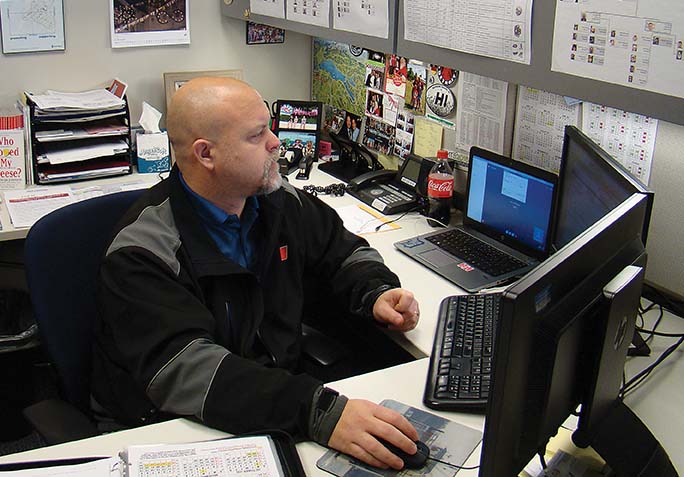
In addition to being MTU America’s senior manager of machining, Jeremy Diebel is also the company’s apprenticeship coordinator.
According to the company, the backbone of the MTU Production System consists of standard lean tools and concepts. It is bolstered by visual triggers, a standard problem-solving technique and a coaching routine that promotes development of thinking skills.
Diebel said one such lean tool that MTU America employs is “kata,” which is based on a Japanese system of repetitive movement. In an industrial production environment, a coach uses the tool to ask questions and develop employees in a way that optimizes their brainpower. The coach takes deliberate steps, via the questioning process, to allow employees to work through the process, creating a series of “ah-ha” moments until they reach the goal, or North Star. The coach might ask about defining the challenge and current and target conditions, the obstacles that are preventing an employee from reaching the target condition and the expected next step in the process. Ultimately, this process helps employees solve problems themselves instead of simply receiving directions from a supervisor.
“Kata creates muscle memory, where the brain is the muscle,” Diebel said.
Continuous improvement at MTU also involves questioning whether a production deviation should be accepted as a new production standard. It is, if the deviation proves to be beneficial and sustainable.
For example, Diebel said an end-of-the-day goal is to have one day’s worth of inventory ready for the assembly line, which equals about 52 to 56 cylinder heads. However, at one point this year, there was no inventory for about a week, and there were no negative consequences. Jöerg Klisch, vice president of North American operations at MTU America, wondered why the goal shouldn’t be zero and be extremely just-in-time instead.
“That’s his way of challenging and pushing us,” Diebel said. “What I see as a negative, he sees as a positive: we have less inventory.”
A German Flavor
In 2012, MTU America launched its apprenticeship program, modeled after an approach to European vocational training, including the apprenticeship program its German parent company has successfully employed for more than 30 years. The program enables high school students to develop work skills sought by MTU, and other employers, while earning money. Diebel said graduation from the program requires students to complete 600 hours of classroom training at the Aiken County (S.C.) Career and Technology Center and 1,000 hours of paid work at MTU’s machine shop.
MTU reports that the process begins with teachers at Aiken County high schools nominating sophomores, with six selected each year based on math assessments and interviews. In 2016, 28 students applied for the six positions. As high school juniors, students work 2 days at MTU, attend classes at their high school half a day 3 days a week and attend classes at the technology center the other half days. Apprentices work full-time at the plant during the summer. As seniors, the schedule is the same, but apprentices rotate through various MTU departments to increase their knowledge of the company’s operations.
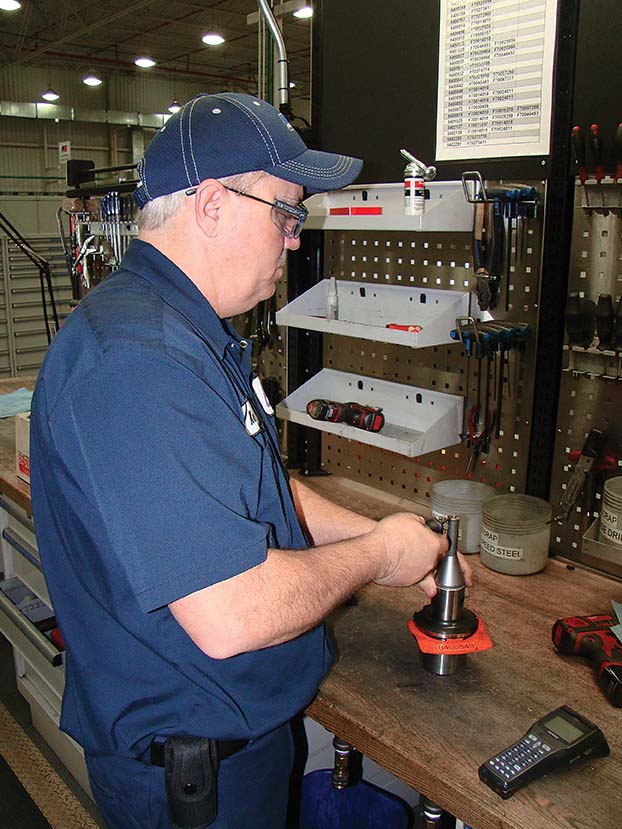
Inserts being indexed at MTU America. The company sometimes changes cutting tool to achieve its annual goal of reducing standard machining times by 3.5 percent.
Upon completion of the program, students are certified as basic industrial mechanics. Those who also successfully complete the optional final practical, written and oral exams receive certification as a skilled metalworker, which is recognized in both Germany and the U.S.
After the apprentices graduate from high school, MTU America does not guarantee or require employment at the company, but one graduate did work full-time for a couple of years at MTU before challenging himself by taking a position at another area manufacturer. Another works part-time while studying mechanical engineering at a local technical college, Diebel said. “We also started a second complementary program filled by two recent graduates of the youth program.”
He explained that MTU doesn’t put a high emphasis on selecting students who specifically want to pursue a career in manufacturing. Many are undecided at that age or want to earn a degree from a 4-year college or university. [Editor’s note: In May, after 15 years working in manufacturing, Diebel will receive his Bachelor of Science degree in organizational administration from Central Michigan University, via the school’s online program; it was paid for by the MTU tuition-assistance program.] “We have a lot of success stories outside of us hiring them,” Diebel said. “It’s a long-term vision.” In addition, a downturn in the markets MTU serves, particularly oil and gas, has limited the number of available positions.
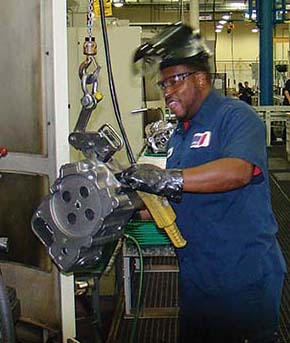
A machinist moves a workpiece into position for machining.
“We also see the advantage of them going through this program and then, in their junior or senior year of college, coming back and doing an internship with us,” Diebel said, adding that MTU employs about a dozen interns at any given time.
Although there are some up-front costs to establishing an apprenticeship program, such as equipment and human resources, Diebel pointed out that MTU doesn’t employ an independent trainer to conduct classes for the students. Instead, shop employees provide the primary training. In addition, the company brings a lead trainer from its German facility to conduct about 4 weeks of training.
On the flip side, having an apprenticeship program enables MTU to avoid the expense of recruiting someone from a shallow skill pool, and the starting wage for a graduate is less than a skilled mid-career employee, Diebel said. As a result, he noted, a manufacturer can see up to a 36 percent return on its investment from apprentice training.
“It’s also better from a development standpoint to be able to bring them in at that stage and mold them to your company’s culture,” he said.
For more information about MTU America Inc., call (248) 560-8888 or visit www.mtu-online.com.
Glossary terms in this article
Related




Subscribers can use MFGAxis notes, saves and discussion tools with their innoNET account.


