Skip to content
Browse

Articles

Select one or more.
Select one or more.
Select one or more.
Select one or more.
Select one or more.
Reset

Latest Articles

Thread Rolling on CNC Machines
Article August 1, 1995 Al McBride
Thread Rolling on CNC Machines
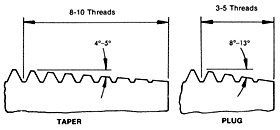
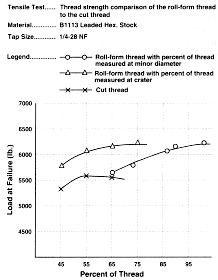
Thread rolling produces external threads by forming the profile instead of cutting it. This guide covers where CNC thread rolling fits, why it can outperform cutting, and what shops should watch in setup.
PCBN Turns the Hard Stuff
Article June 1, 1995 Alan Carius
PCBN Turns the Hard Stuff
This article compares hard turning to grinding for finishing hardened steel parts and discusses which operation would be more appropriate for various situations. The article also looks at the machine tool, insert and cutting parameters required during hard turning.
Cracking the Code: Turning Performance
Article June 1, 1995 Richard Thalmann
Cracking the Code: Turning Performance
This article reviews the nomenclature that toolmakers use to identify inserts. Both ANSI and ISO codes are described character by character. A chart lists all of the possible choices for each position in the code and what each code letter or number signifies.
Harder Than Anticipated: Turning Performance
Article June 1, 1995 Kevin Ackman
Harder Than Anticipated: Turning Performance
A shop supervisor and education manager recount the evolution of a job that didn't proceed exactly as planned. Because the powder-metal part was harder and its as-pressed dimensions were not as accurate as originally expected, adjustments and improvisations were needed to produce the finished parts as quickly and as cheaply as quoted.
Optimal Automation
Article April 1, 1995 Anders Utterstrom
Optimal Automation
The efficiency of a die-sinker EDM operation can be enhanced by automating at least part of the work handling or tool handling. This article describes the automation that is available, from the simplest electrode grippers to fully automated toolchanging systems.
Barfeeding Advances: Drilling Performance
Article April 1, 1995 Dave Poling
Barfeeding Advances: Drilling Performance
According to this article, the short-bar barfeeders that are on the market today are not plagued by the drawbacks that have become associated with barfeeding. The units load 5-foot bar stock into a lathe rather than the longer stock loaded by earlier units.
Honing Comes Full Circle: Turning Performance
Article April 1, 1995 Guy Carmichael
Honing Comes Full Circle: Turning Performance
Honing was originally a surface finishing operation that did not remove significant amounts of material. This article discusses brush honing, a process the authors say produces results similar to what honing was originally intended to produce. Proper boring is also discussed, because, according to the authors, a properly bored hole will not require further correction through modern aggressive stone honing techniques.
A Simple Groove: Turning Performance
Article March 1, 1995 Roy Leverenz
A Simple Groove: Turning Performance
This article discusses the trend among insert makers to consolidate chipbreaker designs and carbide grades. The result is the three-chipbreaker/three-grade matrix many insert makers have adopted in some form. The evolution of the chip-forming groove is also traced, and an ANSI proposal for a grade identification system is described.
Saving Saw Bucks: People & Companies
Article March 1, 1995 Ann Marie Rooke
Saving Saw Bucks: People & Companies
Advancements in bandsawing are allowing shops to closely control the cost and precision of the operation. This article looks at such innovations as informational computer programs that provide advice on workpiece positioning and machine settings. Improvements in blade design and the applicability of these new blade geometries is also covered.
Carbide Coatability: Trade Shows & Events
Article March 1, 1995 Stanley Biernat Jr.
Carbide Coatability: Trade Shows & Events
A clear and intact substrate surface is important to the success of a coating deposited on a carbide insert. This article looks at the surface problems and contamination, introduced by the insert manufacturing process, that the coating company or insert user must correct before the insert is ready to be coated.
Squared Straight
Article March 1, 1995 Mike Sasnett
Squared Straight
Three different problems can cause a laser to make beveled cuts. As these problems interact, they create distinct patterns of bevel angles that require sophisticated mathematical analysis to sort out. This article discusses an experiment using Fourier analysis to determine which combination of problems caused the cyclical variation that was observed in the measurements of a laser's cutting angle.

Keep scrolling