

Reducing part distortion: Research & Innovation
A German research team has developed a system that can be used to predict and reduce part distortion.
Part distortion is a major cost factor in the production of metallic parts, especially in the case of large and thin-walled workpieces that play an important role in lightweight design or in aerospace.
Along with partners, Fraunhofer Institute for Production Technology in Aachen, Germany, has developed a system for reducing part distortion caused by residual stresses. With a model-based process design and a new type of clamping system, companies will be able to significantly reduce part distortion when milling in the future.
During production and subsequent heat treatment of metallic blanks, residual stresses are generated, which lead to shape and dimensional deviations of workpieces while machining. Particularly after unclamping, when a workpiece is released from the clamping system, substantial distortion of the part occurs. Part distortion of this kind means that the manufacturing tolerances cannot be maintained and the part has to be reworked.
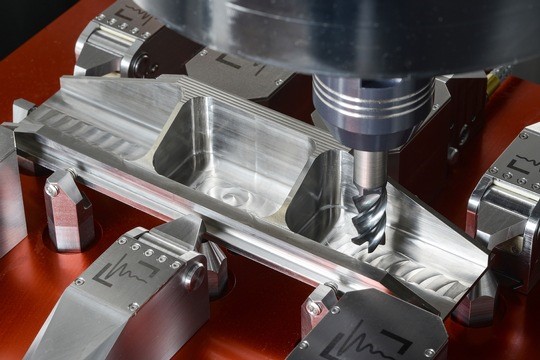
For the VoKoES research project, the team developed simulation software and a new type of clamping system that can be used to predict and reduce part distortion during milling. Image courtesy of Fraunhofer Institute for Production Technology
Review the print ads from this magazine to continue
This quick advertiser review unlocks the rest of the article and keeps the full-screen reader focused on the ads instead of the page chrome.
Advertisers included in this article experience
Print placements connected to this article
Tapmatic
NEW! DeBurr-Z
by CNC Deburring Tool with Compression and Extension Float • Deburr parts quickly and consistently on the CNC machine eliminating the need for tedious hand work. • The Deburr-Z floats in both compression and extension allowing the cutting tool to follow the top edges or underside edges of the work piece, even when these are not clearly defined like in the.
by NEW! DeBurr-Z CNC Deburring Tool with Compression and Extension Float • Deburr parts quickly and consistently on the CNC machine eliminating the need for tedious hand work. • The Deburr-Z floats in both compression and extension allowing the cutting tool to follow the top edges or underside edges of the work piece,
Visit Tapmatic View this placement in the issue recordPrint ads from this magazine
by CNC Deburring Tool with Compression and Extension Float • Deburr parts quickly and consistently on the CNC machine eliminating the need for tedious hand work. • The Deburr-Z floats in both compression and extension allowing the cutting tool to follow the top edges or underside edges of the work piece, even when these are not clearly defined like in the.
by NEW! DeBurr-Z CNC Deburring Tool with Compression and Extension Float • Deburr parts quickly and consistently on the CNC machine eliminating the need for tedious hand work. • The Deburr-Z floats in both compression and extension allowing the cutting tool to follow the top edges or underside edges of the work piece,
Continue reading
March 2023
A team from Fraunhofer IPT, together with partners in the VoKoES research project, developed a concept consisting of simulation software and a new type of clamping system that can be used to predict and reduce part distortion during milling of rolled and heat-treated workpieces. Using the example of an aerospace structural component made of the titanium alloy Ti6AI4V, the team was able to demonstrate that the solutions reduced distortion by 94%.
To this end, the researchers and their partner Access e.V. first programmed a thermomechanical finite element method simulation to determine residual stress states in heat-treated blanks. In addition, a numerical distortion simulation was developed that predicts part distortion after each milling operation. Fraunhofer IPT researchers programmed the simulation with the Institute of Structural Mechanics and Lightweight Design at RWTH Aachen University based on the finite cell method.
With project partner ModuleWorks GmbH, Fraunhofer’s team integrated the simulation software into a CAM system for toolpath planning. Based on the part distortion prediction, the team tested various compensation methods, such as varying the machining sequence or the position of the target part in the blank. The results of the compensation methods are visualized directly in the CAM system. The integration into the CAM system has the benefit that no additional software is required. Another advantage of the process is that it basically can be applied to all workpiece geometries, as well as subtractive manufacturing processes. CTE
— Fraunhofer Institute for Production Technology
Glossary terms in this article
Related




Subscribers can use MFGAxis notes, saves and discussion tools with their innoNET account.


