


Sensory perception: Drilling Performance
The Look Ahead section in the May 2015 issue of Cutting Tool Engineering magazine also presents a sensory toolholder for wireless, in-process measurement of cutting forces.
Examining chips, machine tool horsepower consumption and broken cutting tools only enables part and tool manufacturers to make a guess—albeit an educated one—at how to solve process problems, optimize tool development and reduce cycle times. Therefore, pro-micron GmbH & Co. KG, Kaufbeuren, Germany, created the SPIKE sensory toolholder to “see” how cutting forces and tool deflection impact a machining process by directly measuring them at the tool where they originate, according to Jon Boring, applications specialist for pro-micron distributor AIT Inc., Englewood, Colo.
The sensory toolholder has a flexible circuit board with a lithium-polymer battery set in an epoxy resin, Boring noted. A wireless transmitter sends a signal to a receiver, which links to a PC. The maximum sampling rate per channel is 1,600 Hz. “So we harvest 1,600 data points per second,” he said.
The sensory toolholder consists of the SPIKE sensor system; a machine tool interface, such as HSK, BT or CAT; and a clamping system, such as a collet chuck, hydraulic chuck, grinding axle or Weldon flat. “We can do virtually anything on that side except heat shrink because it ruins the electronics,” Boring said, adding that the company is working on a Capto machine interface. “Each SPIKE is essentially custom manufactured.”
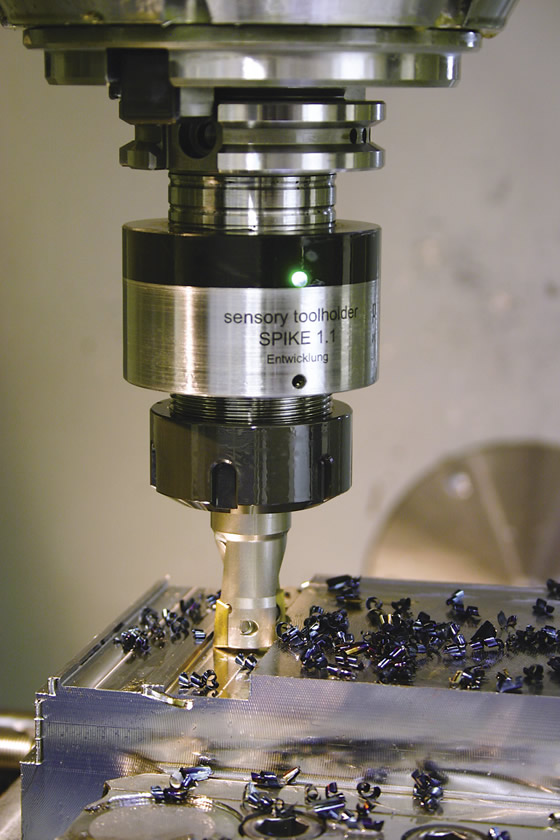
The SPIKE sensory toolholder from pro-micron measures cutting forces and tool deflection at the tool, where they originate, and wirelessly transmits the measured data to a receiving station. Image courtesy pro-micron.
Hubertus von Zastrow, CEO of pro-micron, emphasized the holder’s ease of use and transportability from machine to machine. “Component manufacturers can just take a few minutes, remove their normal holder, put the SPIKE in and learn a lot about their processes without going through a long, complicated, engineering-intensive process of acquiring data.”
The company is targeting four groups of customers, von Zastrow added. The largest is high-volume part manufacturers, where every second counts, and producers of high-value parts, where scrap is cost-prohibitive. The second is cutting tool manufacturers, which can use the system to complement their lab equipment and to demonstrate tools at customer sites. The third is universities and institutions that combine R&D with problem-solving services, and the fourth is lubrication and material manufacturers that want to improve product quality and consistency.
The applications for the toolholder are drilling, milling, tapping, grinding, reaming, roll forming and friction stir welding. An application for turning is being developed.
The SPIKE set includes the sensory toolholder, charging station, radio receiver with a USB interface, cables, 2.45-GHz antenna, display software and padded aluminum case. Measurement channels are available for positive and negative axial force, torque, temperature and bending moment in the X and Y axes. “What we call bending moment is tool deflection,” Boring said, noting bending moment provides a better gage for determining tool life and a better alternative for wear recognition than torque in many applications.
With its ability to graph the intersection of forces, which basically indicates the chip load and where the edge of the cutter is, Boring said SPIKE can generate polar plot diagrams to give a good indication of what is happening in the cut. Nonetheless, the diagrams cannot be immediately used for process improvement. “The data that is generated needs interpretation,” von Zastrow said. “However, it is something that our customers are telling us they want to learn.”
Boring, who previously ran a machine shop, added that the data is most helpful to someone with significant experience running machines. “When I’m using SPIKE and looking for trouble, I already have an idea of what it might be and I’m looking for verification through data.”
Regardless of a user’s machining background, the data becomes difficult to interpret at spindle speeds above 18,000 rpm, because too few data points are gathered per revolution. And if the spindle speed gets too high, data interpretation becomes impossible. “We specify our SPIKE for 18,000 rpm,” von Zastrow said, “and we stress-tested it up to 36,000 rpm, or until it broke.”
For more information about SPIKE, call Boring at (405) 496-1484 or visit www.pro-micron.de. CTE
About the Author: Alan Richter is editor of CTE. Contact him at (847) 714-0175 or alanr@jwr.com.
Glossary terms in this article
Related


Subscribers can use MFGAxis notes, saves and discussion tools with their innoNET account.