


Small shop’s high ideals yield big results
Talking Shop article as published in the July 2012 issue of Cutting Tool Engineering.
Founded in 1999 and located in Amherstburg, Ontario, across the Detroit River from Michigan, PTooling is a small, family-owned business specializing in oil-field component manufacturing. Thread milling and oblique, or offset, features (those off the part’s main centerline axis) are routine for the shop, which has five Mori Seiki turning centers. PTooling’s machines feature live tooling, full Y-axis control and a capacity of 3.6 ” in diameter through the spindle. That capacity means that longer parts can be turned and milled in fewer setups.
Freelance writer Jan Bottiglieri interviewed PTooling President Marv Fiebig, a manufacturing veteran with 35 years’ experience in industries such as oil and gas equipment, gas compression, aerospace and injection molding. Fiebig is an SME certified manufacturing engineer and an ASQ certified quality engineer.
All images courtesy of PTooling
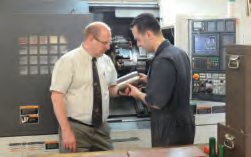
Marv Fiebig, president of PTooling, with his son Tai, head of manufacturing engineering.
CTE: How did PTooling get its start?
Fiebig: We started doing injection molds for the PET (polyethylene terephthalate) packaging industry. We designed and built preform molds used to make bottles. At that time, we also manufactured down-hole oil industry tooling components and work-over tools. Work-over refers to oil-well interventions involving invasive techniques; for our customers, applications included intervention for servicing a well, such as for repair, salvage or temporarily decommissioning a well for a safety, production or environmental concern. The economic recession that followed the 9/11 terrorist attacks [and the outsourcing of moldmaking to China] dealt a staggering blow to our business. By 2003, we had stopped making molds and were focused entirely on making oil industry components.
CTE: How did that change the shop?
Fiebig: We further developed our oil-field expertise, with a focus on threading. We started our machine shop with a single CNC lathe. Since our founding, we have purchased six CNC machine tools and our latest and greatest acquisition, which will arrive in July, will allow us to do more complex work on tubular oil-field components.
CTE: You mentioned you identified with Alan Rooks’ column in the July 2011 issue about Mittelstandcompanies in Germany, which are small to medium-sized, mostly privately owned firms said to be the core of Germany’s manufacturing prowess. Why is that?
Fiebig: The German business model strikes me with its practicality. German manufacturers tend to invest more in training and in quality management than their counterparts in North America. We try to structure PTooling along the German model. For example, we focus our energies on being the highest quality supplier for our customers. We want to be the best in their vendor base. When customers visit us, they are always amazed at what we accomplish from what appears to be a small business.
CTE: What’s your quality strategy?
Fiebig: It’s patient worker training. We also compensate our employees with higher wages than other machine shops, large or small. We use the best equipment we can afford. A significant portion of our operating budget goes to manufacturing engineering and we constantly optimize our processes. The result is that, even though we are a small shop, we are a major supplier to our customers.
CTE: What is PTooling’s approach to quality assurance?
Fiebig: It’s our key focus. We strongly believe that productivity—hence profitability—is a function of quality. We achieve quality through our culture. Simply put, we purchase the best and employ the best; therefore, our expectations are for the best. For example, our largest customer is a global completion/stimulation tool manufacturer. The oil-field tools we make parts for are almost exclusively used for fracking horizontal wells, and completion is the process of making a well ready for production. In 2011, our customer tracked its overall nonconformances at 6.2 percent of purchased parts across its vendor base. We produced almost C$4 million worth of parts for this customer and had zero nonconformances for the entire year.
CTE: What else sets PTooling apart?
Fiebig: Our people and their knowledge of the technology they use. Everyone at PTooling knows everyone else well, and we work as a team. We support each other, we teach each other. All our people are thoroughly familiar with all the machines and processes. We switch assignments and put people on the process best suited for them; teams of two people frequently work together and learn new things from this interaction.
CTE: The name “Fiebig” appears frequently on the company roster.
Fiebig: That’s no coincidence! My wife, Wendy, does our finances. Our sons Josh and Tai head QA and manufacturing engineering, respectively. We currently employ 15 people, whom we consider friends first and workers second.
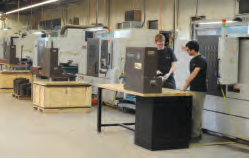
PTooling associates Gregg Kilner (left) and David DiPaolo discussing a job in the shop’s machine room.
CTE: What have been some of PTooling’s biggest challenges or turning points?
Fiebig: The major turning point was 9/11. As the market for injection-molding tools collapsed, we needed to consider what we would pursue for work. We had some dark times. We came through because we evaluated our strengths and weaknesses realistically and proceeded with a planned approach. We have never had an operating loan and have judiciously purchased machine tools when we could afford them. We spare no expense on necessities, yet we’ve built a reputation among our suppliers as their best-paying customer, so we can obtain the best from them in terms of quality and price.
A major challenge we face is being up to 2,500 miles away from our customers; we have had to be aggressive to make our presence known and felt. By this I mean that we are aggressive in promoting our technology. We purchase the equipment and employ the methods needed to fully satisfy our customers. We try to minimize the possibility of failure from our outside suppliers. We stock material in our yard rather than require our customers to provide free-issue stock. We communicate promptly and thoroughly, and typically visit customers three to four times per year. We reduce costs and share savings with our customers as we improve our processes. We need to structure our pricing to make it attractive. Our quality speaks for itself, but we don’t charge a premium for it. We make a good profit because our processes, people and technology produce high-quality parts faster and better than the competition.
CTE: What are your plans for the new turning center?
Fiebig: The new turning center is a Mori Seiki NL3000Y/3000. It is a 120 ” center-distance machine with a fully programmable, self-centering steady rest. We are pursuing jobs for longer oil-field components than we currently make and are tooling the new machine with the ability to through-bore to 60 ” in length.
CTE: What certifications does your company have?
Fiebig: Along with being ISO-9001 certified, we are also pursuing an American Petroleum Institute Q1 registration—the API’s highest quality-rated registration. It is specific to the petroleum industry and correlates to ISO-9001 with a few additional petroleum-specific requirements. We’re also working on API’s Monogram Mark quality management program. This will allow us to perform Monogram casing, tubing and rotary shoulder threads for the oil-field industry. The new machine will allow us to turn these types of threads on parts that are too long for our existing equipment.
CTE: What do you see ahead?
Fiebig: I have a wealth of personal experience in the aerospace industry, and we would like to diversify into that area. Right now, our order book is full with oil-field work. However, with the aerospace industry heating up, we might bring something to the mix in terms of round part manufacturing.

CTE: What is with your logo?
Fiebig: The pterodactyl started as a joke. When we were making injection molds, we formed a strategic alliance with our biggest customer, Plastic Technologies Inc., or PTI. Someone suggested using the same acronym but meaning Plastic Tooling Inc., and the name PTooling was born. I laughed and said we could just call it “Tooling”—as in the word pterodactyl, the p would be silent. The pterodactyl fits well with anything petroleum related. It would be especially fun if we start doing aerospace parts as well!
Glossary terms in this article
Related


Subscribers can use MFGAxis notes, saves and discussion tools with their innoNET account.