Spindle maintenance pays
Every machine tool owner can reap benefits from a good spindle maintenance program. These include reductions in costly unplanned machine downtime, longer spindle life and improved part quality. But effective spindle maintenance requires perseverance and the appropriate technology—plus a little common sense.
Every machine tool owner can reap benefits from a good spindle maintenance program. These include reductions in costly unplanned machine downtime, longer spindle life and improved part quality.
But effective spindle maintenance requires perseverance and the appropriate technology—plus a little common sense.
“We receive many calls about spindle operation and maintenance issues—the proper coolant to use, lubrication settings, etc.—and, in most cases, the answers are right in the manual,” said Gary Quirion, president of GMN USA, Bristol, Conn., which sells and repairs spindles. Quirion advises customers to read the operating manuals supplied with spindles from front to back. “They were made for a reason, and there’s a lot of good information in there.”

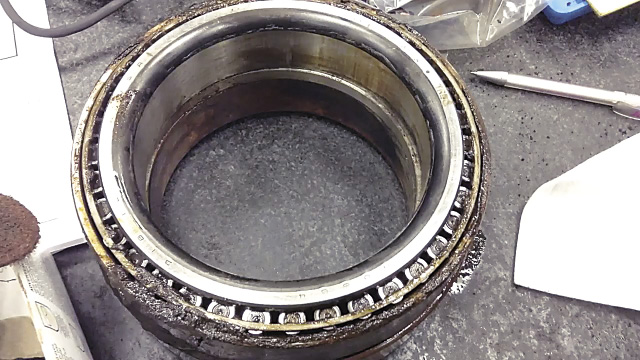
The main cause of spindle failure is bearing contamination. Image courtesy GTI Spindle Technology.
Quirion also recommends training operators to spot telltale signs of spindle problems. “Even without sophisticated vibration-analysis equipment, machine operators can be the first line of defense against failure,” he said. Warnings that something might be wrong include a change in spindle sound, an increase in operating temperature and the inability to hold part sizes within required tolerances.
Inspections are also crucial to properly maintain a spindle, noted Tom Hoenig, president of GTI Spindle Technology Inc., Manchester, N.H., which provides spindle repair, rebuilding and predictive maintenance services. For example, Hoenig said spindle lubrication and the coolant chiller for the spindle should be checked at least weekly. He also recommends regular inspection of the drawbar, which clamps a toolholder to the spindle, because the drawbar is a high-wear item that can destroy a spindle if not maintained.
Of course, the main objective of a spindle maintenance program should be to prevent spindle failure. “Wearing out a spindle is one thing, but when a spindle fails catastrophically, especially a high-speed spindle, a lot of other components can get damaged,” Quirion said.
GTI touts vibration analysis as the best method for detecting potential failure modes. According to the company, vibration-analysis tools detect imbalance, looseness and bearing problems so a spindle can be removed before an incident necessitates costly component replacement or rework.
Review the print ads from this magazine to continue
This quick advertiser review unlocks the rest of the article and keeps the full-screen reader focused on the ads instead of the page chrome.
Advertisers included in this article experience
Print placements connected to this article
Hornusa
Feed Rates Taken to the Extreme
Remove greater volumes of material, faster. The DAH high feed milling system excels at roughing steel, cast iron, stainless steel and aluminum with excellent stability and long tool life. The specialized cutting geometry of our indexable inserts allow rapid plunging, smooth cutting and high feed rates to HO R N – E X CE L L E N C E I N T E C H N O L O G Y.
Feed Rates Taken to the Extreme Remove greater volumes of material, faster. The DAH high feed milling system excels at roughing steel, cast iron, stainless steel and aluminum with excellent stability and long tool life. The specialized cutting geometry of our indexable inserts allow rapid plunging, smooth cutting and high feed rates to reduce processing time in various applications including tool and mold making. Coated milling cutters www.hornusa.com with internal cooling are available as end mills, screw-on heads and arbor mounting. www.hornusa.com HO R N – E X CE L L E N C E I N T E C H N O L O G Y GROOVING PARTING OFF GROOVE MILLING BROACHING PROFILE MILLING REAMING
Visit Hornusa View this placement in the issue recordPrint ads from this magazine
Remove greater volumes of material, faster. The DAH high feed milling system excels at roughing steel, cast iron, stainless steel and aluminum with excellent stability and long tool life. The specialized cutting geometry of our indexable inserts allow rapid plunging, smooth cutting and high feed rates to HO R N – E X CE L L E N C E I N T E C H N O L O G Y.
Feed Rates Taken to the Extreme Remove greater volumes of material, faster. The DAH high feed milling system excels at roughing steel, cast iron, stainless steel and aluminum with excellent stability and long tool life. The specialized cutting geometry of our indexable inserts allow rapid plunging, smooth cutting and high feed rates to reduce processing time in various applications including tool and mold making. Coated milling cutters www.hornusa.com with internal cooling are available as end mills, screw-on heads and arbor mounting. www.hornusa.com HO R N – E X CE L L E N C E I N T E C H N O L O G Y GROOVING PARTING OFF GROOVE MILLING BROACHING PROFILE MILLING REAMING
Continue reading
March 2016
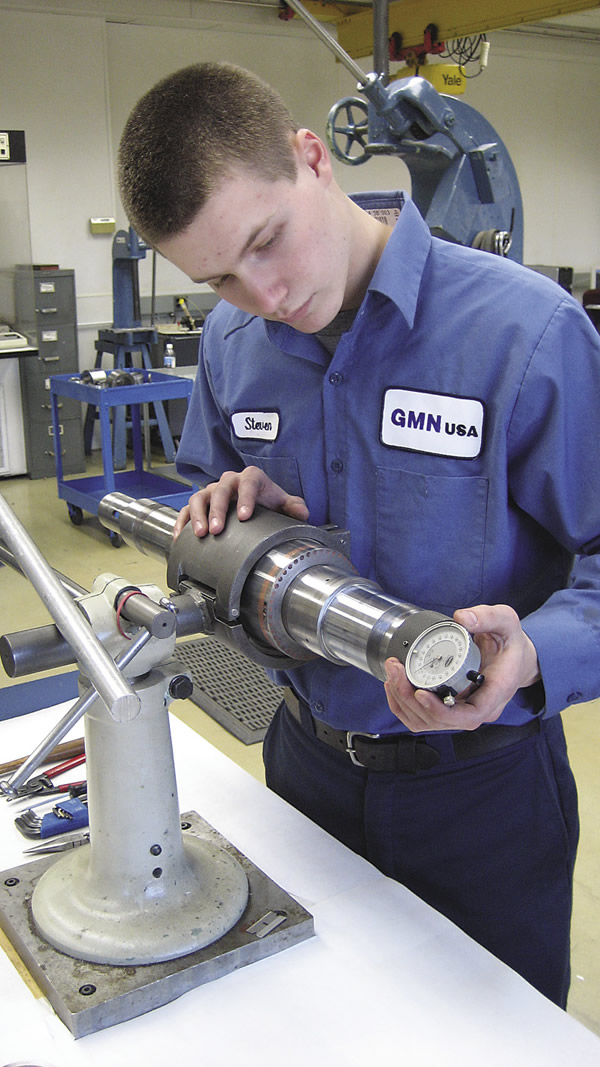
A technician checks the taper of a spindle shaft for size. Image courtesy GMN USA.
To obtain the most useful vibration data, GTI recommends starting with a baseline vibration measurement and then trending over time, being sure to always measure at the same speed and load. Monthly data collection during a maintenance shutdown or shift change will yield accurate trend information.
GTI also pointed out that adding temperature data to the data for vibration trends can improve failure prediction. Temperature increases indicate more bearing friction, as well as over- and under-lubrication.
To monitor vibration, an end user can attach an accelerometer to the spindle. Another option is purchasing a GMN spindle configured with an internal accelerometer that measures vibration in real time during machining. Quirion said an internal accelerometer eliminates the potentially difficult task of finding a place for an externally attached accelerometer on a spindle.
For those seeking a complete vibration-measurement solution, GTI says it offers a product consisting of small, wireless sensors with magnets on them that attach to a spindle, along with an iPad and VibePro vibration-analysis software. Once a vibration reading is taken, the user hits the “results” button to see if the reading is within ISO vibration specifications.
GTI also offers optional apps for balancing, alignment and other maintenance activities. The vibration-measurement system starts at less than $5,000, Hoenig noted.
It might be a small price to pay to prevent a catastrophic and costly spindle failure.