



A strong, but light-load-bearing metal nano-composite
Talk about composites in most machine shops usually refers to carbon-fiber material, though "composites" may refer to a variety of mixed materials going back to the mud-and-straw structures made in ancient times. The latest example: A new metal nanocomposite composed of magnesium infused with a dense and even dispersal of ceramic-silicon-carbide nanoparticles.
Talk about composites in most machine shops usually refers to carbon-fiber material, though “composites” may refer to a variety of mixed materials going back to the mud-and-straw structures made in ancient times. The latest example: A new metal nanocomposite composed of magnesium infused with a dense and even dispersal of ceramic-silicon-carbide nanoparticles. It’s a superstrong-yet-lightweight structural metal with record levels of specific strength and specific modulus, or stiffness-to-weight ratio, and was created by a team led by researchers from UCLA. The material also showed superior stability at high temperatures. It could be used to build lighter aerospace and automotive vehicles, helping to improve fuel efficiency, and for mobile electronics and biomedical devices, according to the researchers.

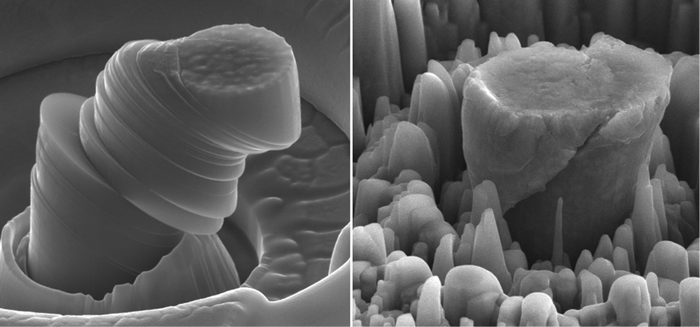
Scanning electron microscope images of a deformed sample of pure metal (left) and the new metal made of magnesium with silicon-carbide nanoparticles (right). Each central micropillar is about 4µm across. Images courtesy UCLA Scifacturing Laboratory.
To produce the material, team members developed a new way to disperse and stabilize nanoparticles in molten metals. They also developed a scalable manufacturing method that could pave the way for more high-performance lightweight metals.
“It’s been proposed that nanoparticles could really enhance the strength of metals without damaging their plasticity, especially light metals like magnesium, but no groups have been able to disperse ceramic nanoparticles in molten metals until now,” said Xiaochun Li, the principal investigator on the research team and Raytheon Chair in Manufacturing at UCLA. “Our method paves a new way to enhance the performance of many different kinds of metals by evenly infusing dense nanoparticles.”
Magnesium, at two-thirds the density of aluminum, is the lightest structural, or load-bearing, metal. Silicon carbide is an ultrahard ceramic commonly used in industrial cutting blades. The researchers’ technique of infusing a large number of silicon-carbide particles smaller than 100nm into magnesium added significant strength, stiffness, plasticity and durability under high temperatures.
Adding ceramic particles to metals has long been considered a potential way of making them stronger. However, with microscale ceramic particles, the infusion process results in a loss of plasticity.
Nanoscale particles, by contrast, can enhance strength while maintaining or even improving a metal’s plasticity. But nanoscale ceramic particles tend to clump together rather than disperse evenly.
To counteract this problem, the researchers dispersed the particles into a molten magnesium-zinc alloy. This new dispersion technique relies on the kinetic energy in the particles’ movement. This stabilizes the particles’ dispersion and prevents clumping.
To further enhance the new material’s strength, the researchers used a technique called high-pressure torsion to compress it.
The new metal nanocomposite is about 14 percent silicon-carbide nanoparticles and 86 percent magnesium. The researchers said magnesium is an abundant resource and scaling up its use would not cause environmental damage.
For more information about engineering research at UCLA, call (310) 206-0540 or visit newsroom.ucla.edu.
Related



Subscribers can use MFGAxis notes, saves and discussion tools with their innoNET account.


