

A tale of two shops
Separate yet combined is an apt description of Stock Drive Products/Sterling Instrument. Located on New York's Long Island, in New Hyde Park, both sides of the company were founded, and are still managed, by engineers.
Stock Drive Products/Sterling Instrument integrates two shops’ design, engineering and manufacturing functions.
Separate yet combined is an apt description of Stock Drive Products/Sterling Instrument. Located on New York’s Long Island, in New Hyde Park, both sides of the company were founded, and are still managed, by engineers. They machine and manufacture an array of mechanical components—offering more than 130,000 line items.
Although typically referred to as one entity, ISO 9001-registered SDP focuses on producing standard synchronous-drive products, while AS9100-registered SI primarily provides custom components to solve complex challenges for its customers, with standard tolerances as tight as ±0.0001 “. For SDP, which has machining and plastic molding capabilities, products include gears, couplings, bearings, timing pulleys and timing belts. Custom products, however, are not out of the question at SDP. For example, SDP can cut timing belt widths to exact specifications from its vast inventory of sleeves.
Courtesy of All images: A. Richter
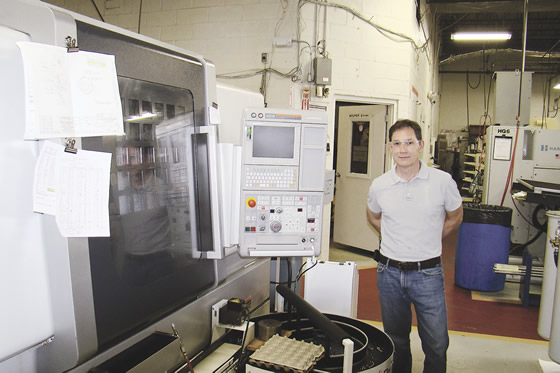
John Lowe, foreman for Sterling Instrument, is one of the company’s many long-time employees.
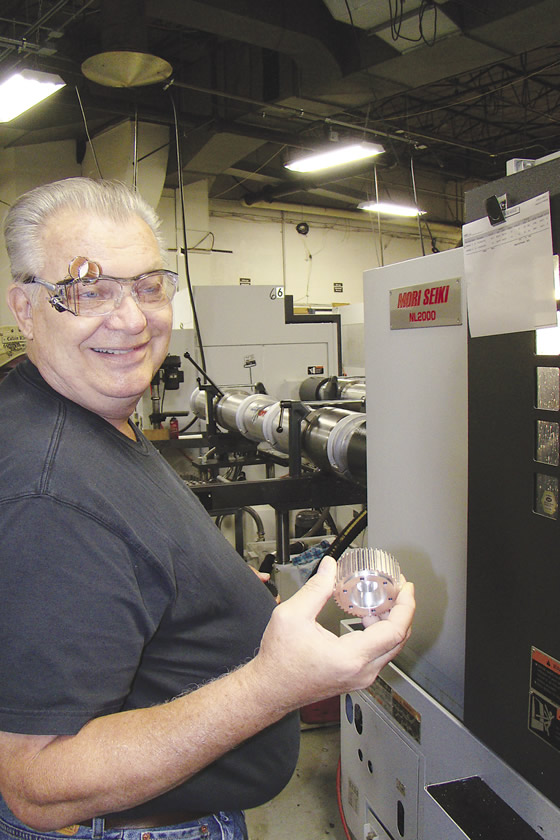
Bob Gaulrapp, shop foreman for Stock Drive Products, displays a part produced on a Mori Seiki NL2000 horizontal lathe.
SI specializes in precision gears, gearboxes, differentials, sprockets and aerospace parts made from a host of materials, including titanium, stainless steel, aluminum and nylon. Major customers include Boeing Satellite Systems, Hamilton Sundstrand, Raytheon Systems, Flir and Israel Aerospace.
“We do it all,” said John Lowe, SI foreman, “including anything that is driven or has to be connected to an encoder, motor or transmission.”
Linda Shuett, marketing manager for New Hyde Park-based Designatronics Inc., which owns both divisions, noted SI began operations about 50 years ago and SDP came into existence a few years later. Especially for the SDP side, she added that the plan was to be the go-to source for synchronous-drive products, from prototype to production quantities, and began including items in the catalog just as a benefit for customers. “[The idea was to] add other components, so if somebody is buying a gear, why not sell them something else they also might need?”
Early on, Lowe explained, the company noticed that customers needed certain gears SI wasn’t producing as well as belt-driven products. To produce the additional products required to meet this demand, the company developed the SDP side, which eventually became the larger of the two. “The Sterling side still maintains what it does best and that’s design,” he said. “We’re not just a manufacturer of standard components. Our biggest strength is our engineering staff. We’ll take your widget or gadget and develop that product until you’re happy, and that’s how a lot of relationships start.”
Other times, a customization project begins when an end user sees a product, such as a gear or transmission device, in one of SDP/SI’s catalogs but determines it isn’t exactly what’s needed. From there, Lowe said, the company will modify the product and develop prototypes to test before going into production. “Anybody can call and say, ‘We have a problem. How can you help us?’ “
Cutting Metal
Regardless of which side of the building you are in—you have to pass through a doorway to go from one shop to the other—you will see a lot of machining equipment on a visit to SDP/SI. The list includes 48 CNC and 22 manual lathes, 15 CNC milling machines and machining centers, 20 grinders, 34 pieces of drilling equipment, four deburring machines and more than 120 gear hobbing, shaping and generating machines. To verify parts are in tolerance and otherwise meet specification requirements, the company has more than 140 pieces of inspection and test equipment, as well as miscellaneous inspection tools, micrometers, calipers and gages. It also has an ISO 7/class 10,000 clean room.
Many of those machine tools are from one builder. “We’re one of the largest purchasers of Mori Seiki equipment in the Northeast,” Lowe said.
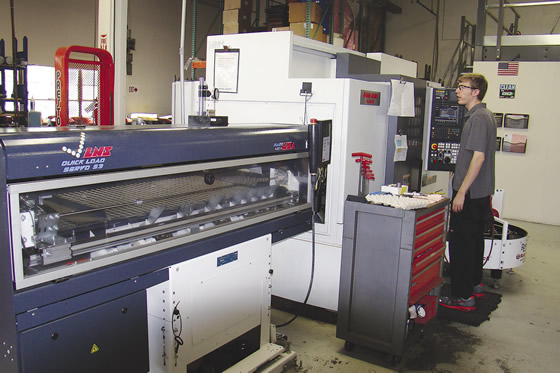
CNC machinist Jonathan Corda monitors a Mori Seiki machine tool that is integrated with an LNS bar feeder to provide long-run production.
About 5 years ago, SI purchased its first mill/turn machine, one from Mori Seiki’s original NL series. Since then, multitask machining has proven to be a beneficial addition, according to Lowe. “We were like ‘wow,’ ” he said about the company’s first mill/turn machine, “and bought a second one and said ‘wow’ again. This looks like the way our future is going.”
Lowe explained that prior to acquiring multitask technology, lathes were in one area and milling machines were across the aisle. Parts were transferred from machine to machine as needed. Now those machining tasks can be done in one setup unless the material requires heat treatment. He said: “Going forward, every possible opportunity goes through the mill/turn machine, even if it goes out for heat treating to bring up the Rockwell. We have successfully machined materials up to 64 HRC. The Mori Seiki machines are so consistent that we can hold 0.0001 ” or 0.0002 ” tolerances all day long when hard turning.”
Review the print ads from this magazine to continue
This quick advertiser review unlocks the rest of the article and keeps the full-screen reader focused on the ads instead of the page chrome.
Advertisers included in this article experience
Print placements connected to this article
Grinding
If space-saving is your priority, then the S11 is the
right machine for you. In a space of less than 5.9 ft2 (1.8 m2), the S11 produces extremely efficiently and reliably with a grinding wheel dia. 19.7 in (500 mm). The S11 can be set up quickly and easily thanks to the lean StuderWINfocus software, geared to the most important features. It can also be easily automated with an integrated loading/unloading device
If space-saving is your priority, then the S11 is the right machine for you. In a space of less than 5.9 ft2 (1.8 m2), the S11 produces extremely efficiently and reliably with a grinding wheel dia. 19.7 in (500 mm). The S11 can be set up quickly and easily thanks to the lean StuderWINfocus software, geared to the most important features. It can also be easily automated with an integrated loading/unloading device. www.grinding.com – Phone 937-859-1975
Visit Grinding View this placement in the issue recordPrint ads from this magazine
right machine for you. In a space of less than 5.9 ft2 (1.8 m2), the S11 produces extremely efficiently and reliably with a grinding wheel dia. 19.7 in (500 mm). The S11 can be set up quickly and easily thanks to the lean StuderWINfocus software, geared to the most important features. It can also be easily automated with an integrated loading/unloading device
If space-saving is your priority, then the S11 is the right machine for you. In a space of less than 5.9 ft2 (1.8 m2), the S11 produces extremely efficiently and reliably with a grinding wheel dia. 19.7 in (500 mm). The S11 can be set up quickly and easily thanks to the lean StuderWINfocus software, geared to the most important features. It can also be easily automated with an integrated loading/unloading device. www.grinding.com – Phone 937-859-1975
Continue reading
December 2013
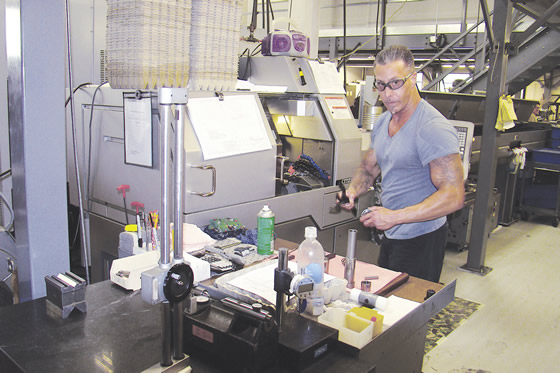
CNC machinist Damon Bahr sets up a Citizen Swiss-style machine.
In another effort to increase productivity, SDP/SI eliminated secondary operations while improving the quality of Swiss-style machined parts by acquiring updated equipment. This includes an 11-axis Star ECAS-32T Swiss-style machine, which runs three simultaneous programs and special editing software to write programs because the three programmed channels must work together.
When operating 25-year-old Swiss turning machines, SI would have to do a lot of secondary operations to finish-turn the journals, grind them, set the centers and inspect and check everything, Lowe said. “Now, we’re doing the same part with four, five, maybe six operations in one setup.”
Automation also plays a role in increasing productivity, enabling SDP/SI, which runs two shifts, to perform lights-out machining the remainder of the time. “The system will hold 0.0002 ” tolerances all night,” said Susan Anderson, vice president and general manager for SI. “We come in and there is a bucket of parts.”
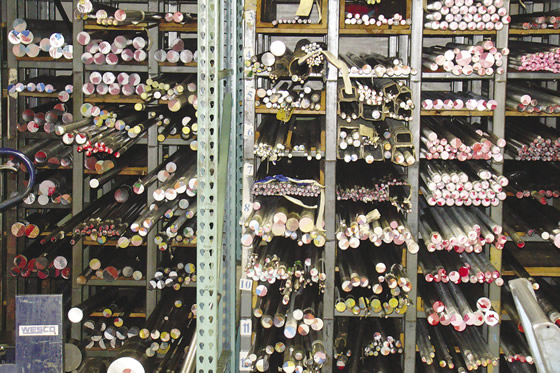
Bar stock is color-coded for easy identification, and every bar is assigned to a specific job.
In addition, the company regularly receives assistance from cutting tool manufacturers, such as Sandvik Coromant, Iscar Metals and Greenleaf, to help overcome machining challenges, which has paid dividends. “We don’t really have any machining problems anymore with heat-treated materials, titanium alloys or superalloys,” Lowe said.
Nonetheless, cutting tool testing continues with the goal of making further process improvements. “We throw them all into a pot and whoever can make it happen—best tool life, best surface finish, best tolerance—is the one who’ll work on that project,” Lowe added.
Attracting Skilled Workers
Similar to other part manufacturers, SDP/SI finds it “extremely difficult” to find skilled labor, according to Lowe. “We’ve been advertising for 6 months and have only had a couple of hits.”
To find people with the needed skills, the company has approached the three colleges within a 20-mile radius: Suffolk County Community College, Queensborough Community College and Farmingdale State College. They offer manufacturing engineering technology degrees, and SDP/SI was able to attract some promising candidates, but “the commute was killing them,” Lowe said about many. “Twenty-five miles in Long Island traffic is a nightmare.” The lack of skilled workers negatively impacts future company growth, he added.
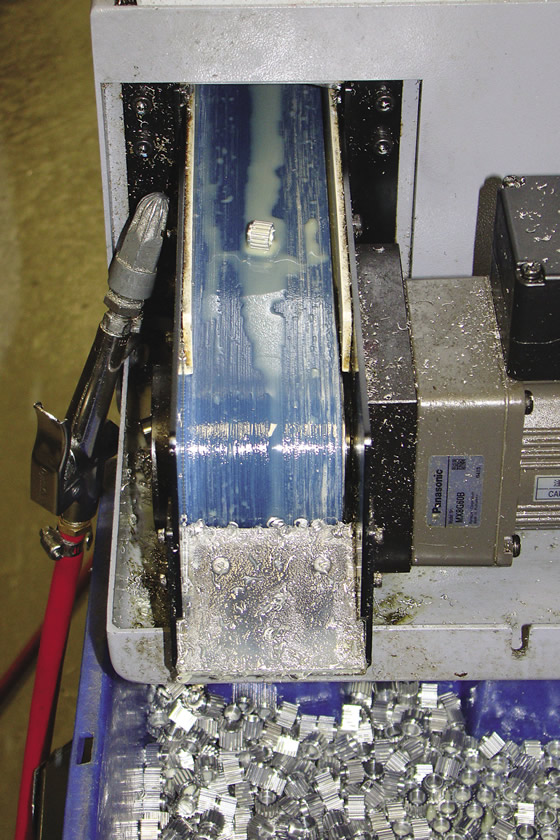
A finished part exits a Swiss-style machine at Sterling Instrument.
One hire who did work out is CNC machinist Damon Bahr. After losing his two food businesses in the Great Recession, he took a 1-year manufacturing technology course at Suffolk County Community College, continuing the education he gained early in his career setting up machines. “Damon came on board as a trainee and now he’s setting up one of the most sophisticated machines we have, a Citizen [Swiss-style machine],” Lowe said.
Lowe recalled how a 3-year engineering applications program in Toronto helped prepare him for a manufacturing career. In addition to working for a manufacturer 37 hours a week, the program required attending night school for 6 hours a day, 4 days a week. “It was tough,” he said. “If you screwed up on either end, you were done. But I liked working with my hands more than I liked sitting in the classroom with a slide rule.”
As the 300-employee company continues to grow, with the goal of moving from $60 million in annual sales to $100 million in 5 years, SDP/SI is looking for a new building to consolidate its four New Hyde Park facilities. The plan is to remain in the area to avoid any commuting or relocation issues for employees. This is especially critical for long-term workers, Shuett noted, adding that a couple have been with the company for more than 40 years. “[They’re] never late and never absent,” Lowe added. CTE
For more information about Stock Drive Products/Sterling Instrument, visit www.sdp-si.com or call (800) 819-8900.
Glossary terms in this article
Related




Subscribers can use MFGAxis notes, saves and discussion tools with their innoNET account.


