

The Bedrock of Precision Success
The workholding basics for CNC machining. By Erez Speiser The best CNC machines and cutting tools are only as effective as the workholding system used to secure a workpiece to the table during the machining process. The foundation of successful precision machining begins with the selection of the proper workholding system for the workpiece and machining operation at hand.
The workholding basics for CNC machining.
The best CNC machines and cutting tools are only as effective as the workholding system used to secure a workpiece to the table during the machining process. The foundation of successful precision machining begins with the selection of the proper workholding system for the workpiece and machining operation at hand. Without a robust foundation, precision is impossible. If a workpiece moves, vibrates, or is positioned inaccurately, the entire operation is compromised.
For professional machine shops, workholding is more than just “holding a part.” It is a strategic engineering decision that directly impacts part quality and setup time. Whether you are running a three-axis vertical machining center, or a high-end five-axis cell, understanding the spectrum of workholding solutions is essential for maintaining a competitive edge.
The Basics
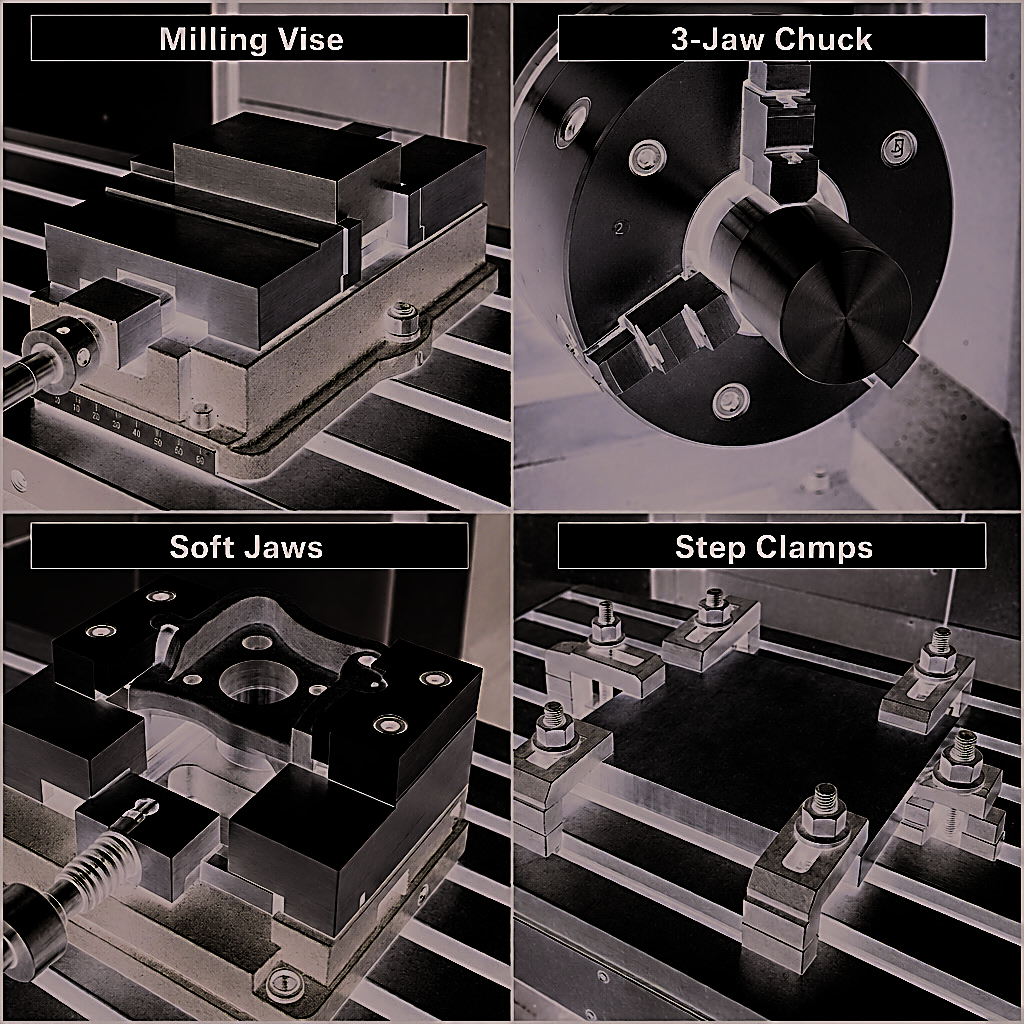
For most prismatic (block-shaped) parts, the milling vise remains the industry workhorse. Its popularity comes from its simplicity and strength. However, it requires a part to have at least two parallel sides. To achieve precision and gripping force with a vise, the workpiece should have adequate flatness and parallelism. The vise should also be precisely aligned with the machine axis.
When parts have an are irregular contour, soft jaws typically made from aluminum or plastic can be machined to match the exact profile of a workpiece. The soft material ensures that the grip on finished surfaces does not damage the part.
For cylindrical workpieces, a three-jaw chuck or a collet chuck will provide a simple and effective solution.
When a workpiece exceeds the physical capacity of a standard vise or features a complex geometry, step clamps (and their cousins, toe clamps) become essential because they secure the material directly to the machine’s table via T-slots. Though very flexible, this method has some drawbacks. Setup takes longer and repeatability is lower when changing workpieces compared to modular or zero-point workholding systems. Clamps also demand greater skill and experience from a machinist.
Advanced Workholding
As shops move from one-off jobs to medium-volume production, setup time becomes a profit killer. This is where fixture sub-plates (tooling plates) and modular fixturing come into play. These plates feature a precise grid of holes for dowel pins and fasteners, enabling high repeatability and lots of flexibility.
The easiest and fastest way to clamp parts with high repeatability is by using a zero-point clamping system. These systems use a special plate with a precision “quick-change” mechanism attached to the machine’s table, paired with a matching vise or other fixture. A workpiece can be taken out for measurement and returned instantly to the exact same location. Alternatively, you can use a second zero-point clamp to change workpieces quickly and accurately.
A zero-point clamping system offers the easiest and fastest way to clamp parts with high repeatability because fixtures can be swapped in seconds, positional accuracy is typically guaranteed to within 0.2" and spindle downtime is virtually eliminated. Machinists can prepare the next job on a separate pallet while the machine is running.
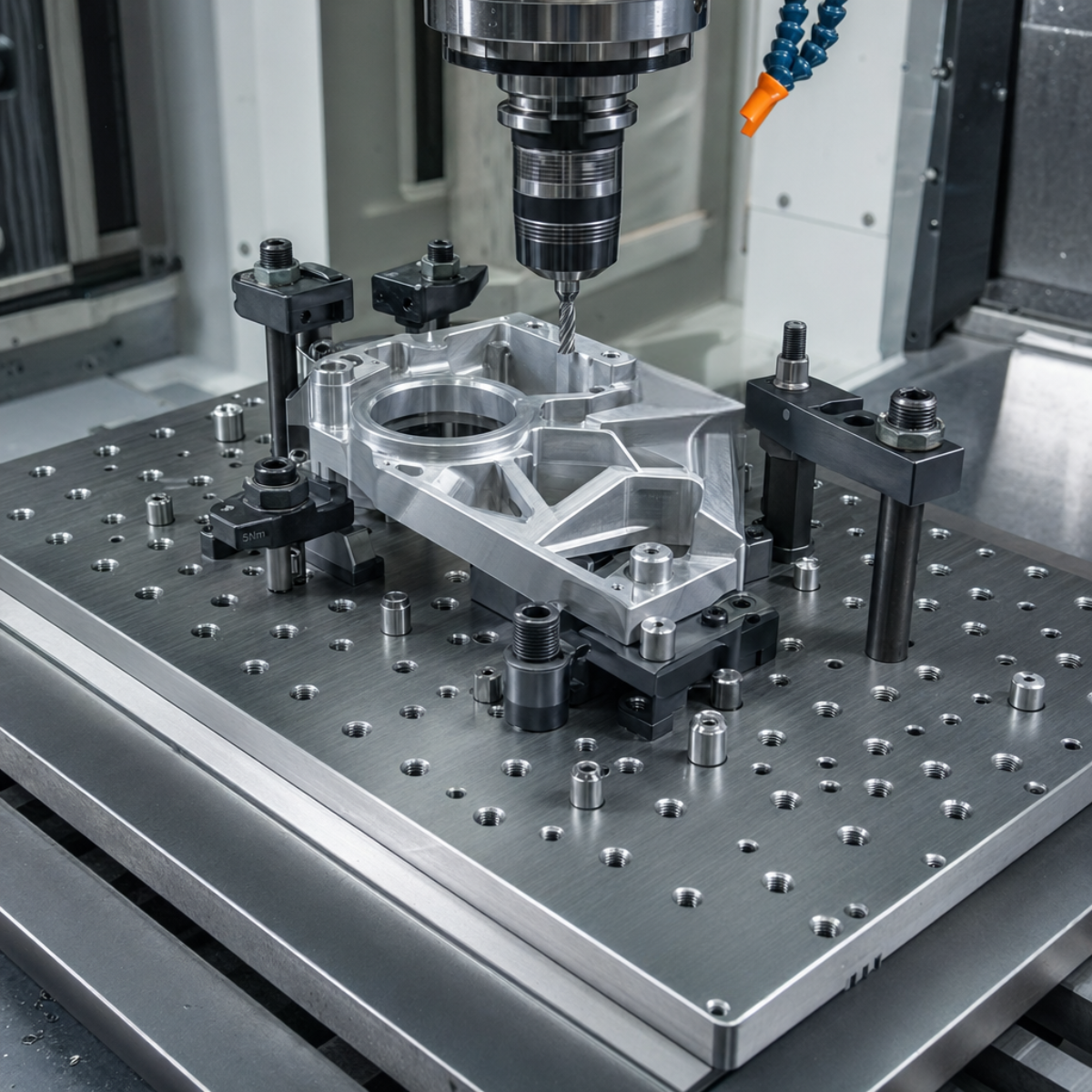
These systems use a special plate with a precision “quick-change” mechanism attached to the machine’s table, paired with a matching vise or other fixture. A workpiece can be taken out for measurement and returned instantly to the exact same location. Alternatively, you can use a second zero-point clamp to change workpieces quickly and accurately.
The 5-Axis Challenge
Five-axis machining introduces additional workholding challenges. Because the machine head or table tilts and rotates, a workholding system must be compact enough to avoid tool collisions while providing maximum access to all five sides of the part.
Review the print ads from this magazine to continue
This quick advertiser review unlocks the rest of the article and keeps the full-screen reader focused on the ads instead of the page chrome.
Advertisers included in this article experience
Print placements connected to this article
Lyndex-Nikken Inc.
Lyndex-Nikken Inc. print ad
Print ad listed on page 27 of the June/July 2026 issue.
Visit Lyndex-Nikken Inc. View this placement in the issue recordMate Precision Technologies
Mate Precision Technologies print ad
Print ad listed on page 28 of the June/July 2026 issue.
Visit Mate Precision Technologies View this placement in the issue recordMersen
Mersen print ad
Print ad listed on page 29 of the June/July 2026 issue.
Visit Mersen View this placement in the issue recordBeckett Packaging
Beckett Packaging print ad
Print ad listed on page 31 of the June/July 2026 issue.
Visit Beckett Packaging View this placement in the issue recordJ.W. Done Co.
J.W. Done Co. print ad
Print ad listed on page 31 of the June/July 2026 issue.
Visit J.W. Done Co. View this placement in the issue recordEltool Corp.
Eltool Corp. print ad
Print ad listed on page 32 of the June/July 2026 issue.
Visit Eltool Corp. View this placement in the issue recordRush Machinery
Rush Machinery print ad
Print ad listed on page 32 of the June/July 2026 issue.
Visit Rush Machinery View this placement in the issue recordPrint ads from this magazine
Print ad listed on page 27 of the June/July 2026 issue.
Continue reading
June/July 2026
Dovetail clamping is a preferred strategy for five-axis work. By machining a small dovetail profile into the raw stock, a low-profile clamp can grip the material with a minor footprint. This allows the cutting tool to reach virtually every surface without interference.
Specialty Solutions
Thin-walled parts present an additional challenge: deformation. Traditional mechanical clamping can easily dent or bend delicate components.
For such delicate parts, consider using one of the following workholding solutions:
Vacuum chucks: Vacuum workholding systems provide a uniform holding force across the entire surface of a part. This is ideal for thin sheets or electronic components where magnetic clamps would cause distortion.
Magnetic workholding: For magnetic materials (like steel and iron), a magnetic plate offers an equivalent and simpler solution.
Adhesive and cryogenic methods: For ultra-thin parts that cannot withstand even minimal pressure, specialized adhesives (like wax or double-sided tape) can be used. In more extreme cases, cryogenic workholding can be used to temporarily harden or freeze a part, making it rigid enough for machining before it returns to its normal state post-process.
Shop Floor Best Practices
Some basic rules are critical no matter how advanced the workholding system you decide to use.
Clean the table. Before placing any fixture on a machine table, ensure the surface is clean and free of chips. Even a tiny piece of swarf caught between a fixture and the workpiece can cause a scraped part. A light coat of rust-preventative oil is recommended if a fixture will remain on the table for an extended period.
Torque to spec. Always verify that clamps and fasteners are torqued to a specified value. Over-tightening can distort a workpiece or damage fixture components, while under-tightening risks movement during a cut. A calibrated torque wrench should be part of a professional setup.
Check for wear. Check datum surfaces and locating pins for wear on a regular basis. You don’t want a worn locating pin introducing a positional error that can be difficult to trace or mistaken for a machine problem. Replace any component showing visible wear before it affects part quality.
Record fixture orientation. When removing a fixture from the machine, mark its orientation before. Reinstalling a fixture in the wrong orientation is a common and avoidable mistake, particularly on fixtures that look the same from multiple angles.
Keep fixture documentation at the machine. Operators should have immediate access to setup sheets, torque specs and part drawings without having to search for them. Missing or outdated documentation is a leading cause of setup errors on the shop floor.
Related


Subscribers can use MFGAxis notes, saves and discussion tools with their innoNET account.


