Tiptop tapping: Turning Performance
Rigid tapping with the right equipment can yield better results than floating tapping.
When it comes to tapping — the process of cutting a thread inside a hole — there’s much to be said for choosing a synchronous approach, as well as tapping hardware tailored to the special characteristics and challenges of that technique.
Synchronous tapping features a rigid tapholder rather than one that’s flexible, or floating. The floating type also is known as a tension-compression tapholder because it allows axial extension and compression to compensate for some mismatch between the machine’s spindle speed and the infeed of the tap. The idea is to prevent damage to the tap and workpiece caused by pushing or pulling during the tapping process.
In rigid tapping, however, spindle rotation and feed rate are synchronized, and the tap can be held rigidly in a chuck. Today, most CNC machines come with synchronized or rigid tap cycles that are easy to program and capable of very accurate tapping depth control, said Mark Johnson, president of Tapmatic Corp. in Post Falls, Idaho.
Other rigid tapping advantages are the result of reduced runout compared with floating tapping.

Synchro Taps reportedly run much faster than conventional taps. Image courtesy of YG-1 Tool (USA)
When rigid tapping, “you are not allowing the tool to follow whatever path it wants to follow,” said Mark Ford, director of global product management for threading tools at YG-1 Tool (USA) Co. in Vernon Hills, Illinois. “You are controlling it very tightly by holding it rigidly, which helps you on runout.”
He said runout is the main cause of tapping problems with thread finish, breakage and sizing consistency. In addition, he said not permitting the tap to cut a much bigger path than necessary increases tool life. What’s more, rigid tapping typically lets users run tools faster.
“With threading, you cannot adjust the feed rate because it has to match the pitch of the tap,” Ford said. “So the only option to increase productivity is to increase spindle speed, something rigid tapping allows.”
Considering all this, it’s not surprising he recommends tension-compression holders only to people using older nonsynchronous machines.
“If someone is using a tension-compression holder with a modern CNC machine,” Ford said, “they are automatically giving up tool life, finish and consistency in gauging for no reason other than that’s the way they have always done it.”
Free-Cutting Taps
YG-1 Tool (USA) recently came out with a line of taps for high-volume, repetitive manufacturing operations looking for productivity gains. Called Synchro Taps, they can run roughly two to three times faster than conventional taps, Ford said. This is possible, he said, because the new taps are extremely free cutting — that is, designed for minimal contact with the part, which reduces cutting forces and heat. Additionally, the company controls runout features very tightly during the tap manufacturing process.
“We hold pitch diameter, OD and chamfer runout to within a few microns, whereas (applicable) standards allow tolerances of as much as 0.0015″ (0.0381 mm) when grinding these features,” he said. “By doing that, we can run the tap at extreme speeds.”
YG-1 Tool (USA) also holds a tolerance for the tap’s shank diameter that’s much tighter than normal — the same shank tolerance that commonly would be used for a carbide drill or endmill.
“That allows us to increase the pitch diameter of the tap ever so slightly,” Ford said, “but enough to add more tool life.”
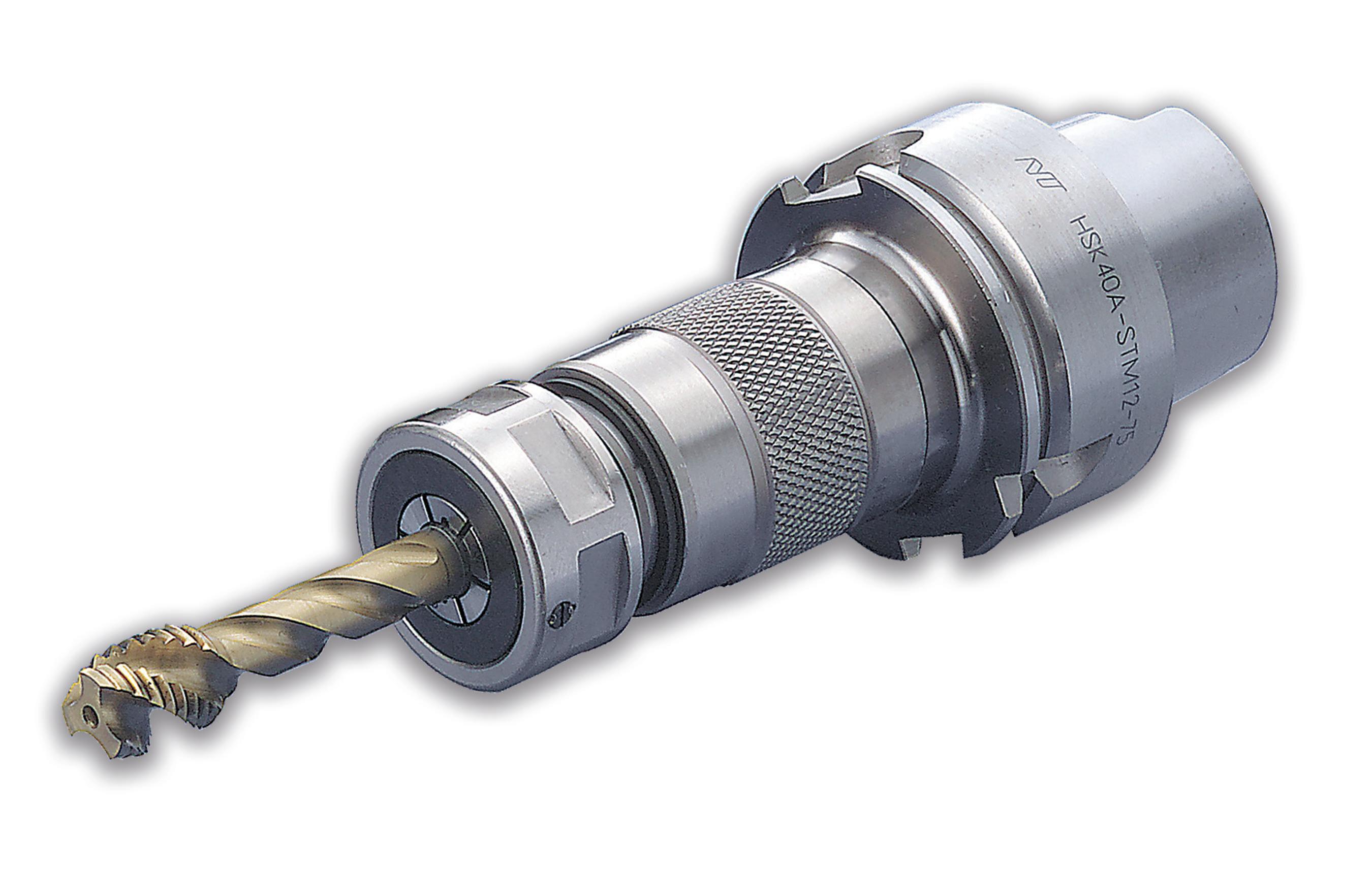
The STM holder allows users to quickly adjust the projection length of the tap by turning the guide ring on the holder. Image courtesy of NT USA
Some tap cutting tools include a drill that permits the pilot hole and threads to be cut in one operation. Those who choose this option eliminate a step from the process and don’t have to worry about a separate drill and tap lining up 100% correctly, said Kiwamu Stewart, general manager of NT USA Corp. in Franklin, Tennessee.
On the other hand, using one tool to drill a hole and cut threads puts a considerable amount of stress on the tap.
“A company like Toyota that makes thousands of parts a day wants less stress on each cutting tool,” Stewart said.
Review the print ads from this magazine to continue
This quick advertiser review unlocks the rest of the article and keeps the full-screen reader focused on the ads instead of the page chrome.
Advertisers included in this article experience
Print placements connected to this article
Tel: 508-987-0121
High Precision Universal and Centerless Grinders Centerless Grinding Machines Universal OD / ID Grinders Internal Grinding Machines Comprehensive Technical Sales, Service and Support Full series of high precision surface grinders and rotary grinders Rotary table machines in both vertical and horizontal spindle configurations.
Tel: 508-987-0121 eMail: [email protected] High precision, long term reliability, worldwide support and affordable maintenance www. gmsigroup.com High Precision Universal and Centerless Grinders Centerless Grinding Machines Universal OD / ID Grinders Internal Grinding Machines Comprehensive Technical Sales, Service and Support Full series of high precision surface grinders and rotary grinders Rotary table machines in both vertical and horizontal spindle configurations
Visit Facebook View this placement in the issue recordOmgamerica
The STM holder allows users to quickly adjust the projection
A US NT length of the tap by turning the guide ring on the holder. FH BAH RELY ON O.M.G. HEADS We prove our skills by continually innovating our range and by engineering cutting-edge products. With a highly professional approach we look for the right balance between operative efficiency and quality service for maximum customer satisfaction
A US NT The STM holder allows users to quickly adjust the projection length of the tap by turning the guide ring on the holder. FH BAH RELY ON O.M.G. HEADS We prove our skills by continually innovating our range and by engineering cutting-edge products. With a highly professional approach we look for the right balance between operative efficiency
Visit Omgamerica View this placement in the issue recordPrint ads from this magazine
High Precision Universal and Centerless Grinders Centerless Grinding Machines Universal OD / ID Grinders Internal Grinding Machines Comprehensive Technical Sales, Service and Support Full series of high precision surface grinders and rotary grinders Rotary table machines in both vertical and horizontal spindle configurations.
Tel: 508-987-0121 eMail: [email protected] High precision, long term reliability, worldwide support and affordable maintenance www. gmsigroup.com High Precision Universal and Centerless Grinders Centerless Grinding Machines Universal OD / ID Grinders Internal Grinding Machines Comprehensive Technical Sales, Service and Support Full series of high precision surface grinders and rotary grinders Rotary table machines in both vertical and horizontal spindle configurations
Continue reading
January 2021
Therefore, he said firms like this might opt to use different tools to cut holes and threads. This reduces stress on tools, which last longer as a result.
Special Tap Collets
In addition to the tapping tools themselves, people engaged in rigid tapping should consider carefully what they choose to hold the tools. In some cases, regular ER collets are used to hold taps. These collets have a cylindrical hole down the middle, so they don’t provide sufficient gripping force when holding the square-shaped tap end to prevent the tap from slipping as the machine spindle rotates. The result can be tap breakage, chipping and gauging problems, Ford said.
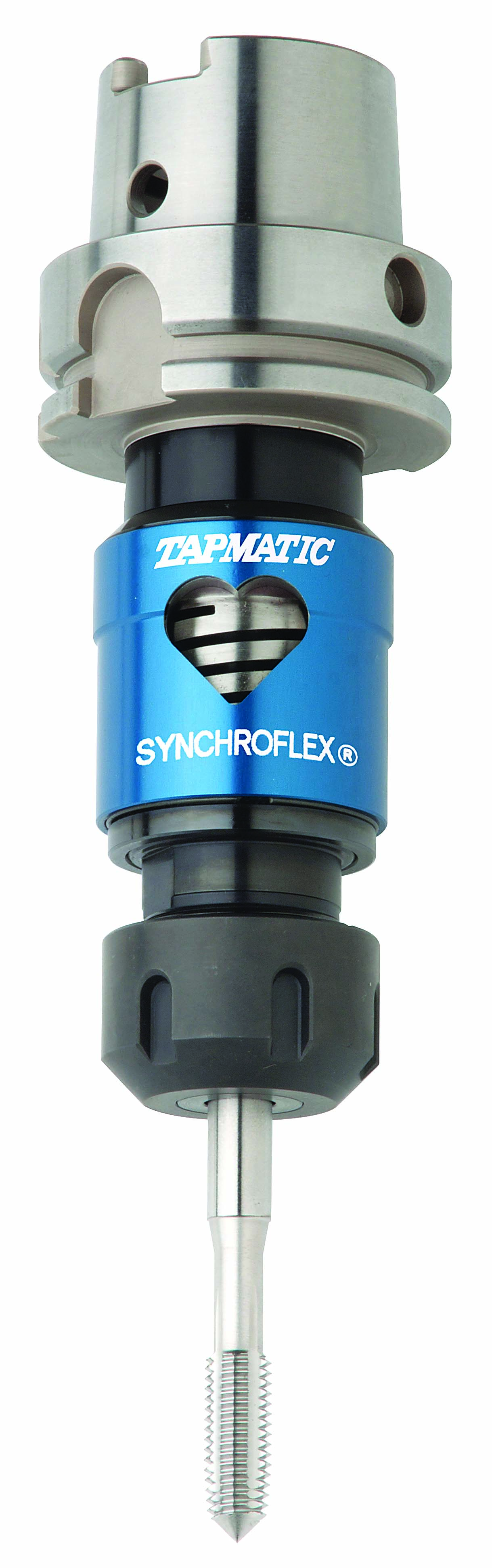
The SynchroFlex tapholder permits a small amount of axial compensation to reduce thrust forces on the tap. Image courtesy of Tapmatic
The correct choice for rigid tapping, he said, is an ER tap collet. Instead of a cylindrical opening, this type of collet has a square opening sized to match the square tap end so it can hold the tap firmly enough to prevent slipping during the tapping process.
“If you are diagnosing a tap problem,” Ford said, “particularly breakage, one of the first things you ask is whether they’re using a tap collet.”
Even if they know about ER tap collets, Stewart said some shops decide not to use them. One reason is that they’re somewhat more expensive than standard ER collets. Additionally, job shops may not have tight tolerance requirements like in the automotive and aerospace industries, so a little slippage could be acceptable. And if a shop isn’t tapping large numbers of holes, it may be able to check every one with a thread gauge.
However, “a company that makes thousands of holes a day cannot check every one,” Stewart said. “So they want the assurance that the tap is not going to slip.”
While a tap can’t slip in an ER tap collet, he said the collet itself can slip during rigid tapping. And if the collet slips, the tap slips despite being held firmly by the collet.
To prevent this, NT USA offers a rigid tapholder called the STM. Instead of being held by the collet, the square tap end is held firmly by a square opening in the STM itself. On the downside, a tap held by the STM probably will break instantly if the threaded end becomes jammed in a workpiece. But as Stewart explains it, the alternative could be undetected slippage of an ER tap collet that results in many bad parts being machined.
“If the tap breaks, the machine would detect that, so there may be one bad part,” he said. “But if the tap keeps slipping, (a shop) may need to scrap hundreds of
workpieces.”
STM holders also allow users to easily adjust the projection length of the tap by turning an outer guide ring. This is helpful in situations where manufacturers regrind taps to save money instead of replacing them after each job. Firms that do this, however, always need to have the same tap projection length from the gauge line of the holder.
“If they grind it down 2 mm (0.08″), they need to make it stick out 2 mm longer to make it the exact same gauge length,” Stewart said. “If you use a collet with the square built in, you drop the tap into it, and you can’t adjust anything. But our square moves up and down inside the holder, so you can adjust the tap projection length to compensate if you’re grinding it down.”
Not Completely Rigid
Although a totally rigid holder has a number of advantages over a floating holder, there’s also a downside: Unlike a floating holder, a rigid one doesn’t compensate for force applied to a tap during a rigid tapping cycle. This force stems from the fact that there is always a small discrepancy between the tap lead programmed into the machine controller and the lead actually ground into the tap. But there’s no give in a totally rigid holder to mitigate the effects of this discrepancy. As a result, Johnson said, a heavy thrust load is applied to the tap, which makes it wear more quickly and can adversely affect thread quality.
So for those using a synchronous machine for tapping, Ford recommends the use of a synchronous-style holder, such as his company’s Synchro Chuck. Inside these holders are objects like springs, washers and rubber gaskets, which allow a very small amount of movement — far less than that permitted by a floating holder but enough to absorb forces generated by rapid stopping and reversing while rigid tapping. He said this can yield as much as 25% more tool life and improved thread finish compared with tapping done by completely rigid holders. Some also believe that synchronous holders allow slightly faster spindle speeds during the tapping process, he said.
Inside the SynchroFlex synchronous holder from Tapmatic, the force-absorbing mechanism is a precision flexure like a machine spring. Johnson said the small amount of give provided by the flexure makes a big difference in tool life.
“You typically get double the tap life compared to a solid holder,” he said.