

Turning and hobbing combined
END USER: Mercury Marine, (920) 929-5000, www.mercurymarine.com. CHALLENGE: To increase productivity when machining driveshafts and propeller shafts. SOLUTION: A lathe with a hob assembly.
————-
END USER: Mercury Marine, (920) 929-5000, www.mercurymarine.com. CHALLENGE: To increase productivity when machining driveshafts and propeller shafts. SOLUTION: A lathe with a hob assembly. SOLUTION PROVIDERS: Okuma America Corp., (704) 588-7000, www.okuma.com
————–
With more than 70 years in the industry, Mercury Marine has maintained its leading market position with constant innovation, foresight and the latest technology. These characteristics are shown throughout 220,000-sq.-ft. Plant 4 in Fond du Lac, Wis., where Mercury Machine produces high volumes of driveshafts and propeller shafts for outboard and stern-drive marine propulsion systems. The plant has about 220 employees and contains 15 to 20 Okuma lathes of various types and vintages.
Mercury turns the driveshaft blanks on a twin-spindle LT10 Okuma lathe, without live tooling. The machined shafts are then manually transferred to a Gleason P60 hobbing machine to cut the splines.
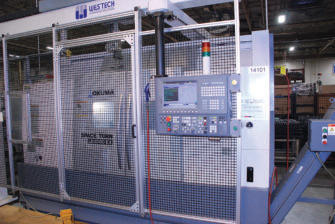
Mercury Marine’s Okuma LB3000 EX BB MYW800 is equipped with a Wes-Tech overhead gantry for loading and unloading shafts. Image courtesy Okuma America.
Recently, Mercury added a LB3000 EX BB MYW800 from Okuma America Corp., Charlotte, N.C., which has live tools, a Y-axis with 5″ of travel, a W-axis subspindle and a hob assembly from WTO Inc., Charlotte. The new machine produces a complete driveshaft in 3 to 4 minutes. It is equipped with a Wes-Tech overhead gantry for loading and unloading shafts.
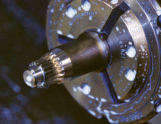
A close-up view of the hobbed pinion spline. It is a ¾” spline that rises to a taper, at which point the pinion gear is mounted. Image courtesy Okuma America.
“In the main spindle, we start with a blank that has been carburized,” said Kurt Lefeber, a Mercury process engineer. “We turn some of that carburizing off, giving greater definition to the part shape. We rough and finish one end and then transfer the shaft to the subspindle, where it’s roughed, finished, center-drilled and hobbed.”
Review the print ads from this magazine to continue
This quick advertiser review unlocks the rest of the article and keeps the full-screen reader focused on the ads instead of the page chrome.
Advertisers included in this article experience
Print placements connected to this article
Mscmetalworking
Hertel Ad MAY_CTE_Layout 1 4/6/11 12:51 PM Page 1
MILLING • HOLEMAKING THREADING • INDEXABLE For over 60 years, Hertel has been providing the metalworking industry with unsurpassed value. Hertel cutting tools are ideal for general machining applications and come in a wide variety of styles and sizes. Available exclusively at MSC Industrial Supply Co.®.
Hertel Ad MAY_CTE_Layout 1 4/6/11 12:51 PM Page 1 MILLING • HOLEMAKING THREADING • INDEXABLE For over 60 years, Hertel has been providing the metalworking industry with unsurpassed value. Hertel cutting tools are ideal for general machining applications and come in a wide variety of styles and sizes. Available exclusively at MSC Industrial Supply Co.®
Visit Mscmetalworking View this placement in the issue recordPrint ads from this magazine
MILLING • HOLEMAKING THREADING • INDEXABLE For over 60 years, Hertel has been providing the metalworking industry with unsurpassed value. Hertel cutting tools are ideal for general machining applications and come in a wide variety of styles and sizes. Available exclusively at MSC Industrial Supply Co.®.
Hertel Ad MAY_CTE_Layout 1 4/6/11 12:51 PM Page 1 MILLING • HOLEMAKING THREADING • INDEXABLE For over 60 years, Hertel has been providing the metalworking industry with unsurpassed value. Hertel cutting tools are ideal for general machining applications and come in a wide variety of styles and sizes. Available exclusively at MSC Industrial Supply Co.®
Continue reading
June 2012
Okuma has a unique method of transferring a shaft from the main spindle to the subspindle. There’s a pneumatic pusher system inside the main spindle, so when the gantry places a raw piece into the spindle, the piece goes to a backstop. The backstop has an air cylinder with a piston. When the first operation is finished, an M code in the control fires the air cylinder, which pushes the shaft out of the main spindle and transfers it to the subspindle.
“The spline I’m hobbing is only about ¾” long,” Lefeber continued. “But we’re hobbing into a taper. The spline follows a diameter for 0.400″ and then goes into a taper, which is another 0.350″.”
Mercury purchased the LB3000 EX BB MYW800 for added flexibility and as backup for the cell. Now one operator runs the LT10/P60 machine and the new lathe. “I’m getting an additional 75 percent output in the cell without an increase in manpower,” Lefeber said.
Machining the propeller shafts used to take multiple steps. The parts were turned on a Cincinnati lathe, taken to a labor-intensive WWII-vintage Barber Coleman hobbing machine to cut the spline and then ground. The turning operation alone took 3 minutes.
Now Mercury Machine is turning and hobbing the shafts on one machine in 3 minutes, 40 seconds using the Okuma LB3000 EX BB MYW1000 equipped with a hob assembly. Instead of using the two older machines, Mercury achieves similar throughput with one machine performing the operations. The new machine improves part quality, requires less part handling and frees up the operator.
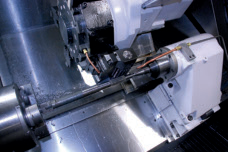
A propeller shaft is hobbed by the WTO hobbing unit. Image courtesy Okuma America.
“We’re turning the shaft and then cutting the splines that drive the propeller,” said Bill Cusick, a Mercury process engineer. “The propeller shafts are machined from 4820 or 8620 steel, and 630 stainless for corrosion resistance. Basically, the shaft has an alloy steel section friction-welded to a stainless steel section. The stainless is in bar stock condition, and we turn the shaft down, starting with the stainless, crossing over the weld and onto the alloy steel section. Then we hob a spline that’s about 2⅛” long into the stainless section.”
Okuma has made significant progress in developing hobbing in a turning center. One unique function is Autoretract. If there’s a problem with the hob, the operator pushes the stop button and Autoretract retracts the hob out of the cut without damaging the hob or the splines it is cutting.
Okuma also developed a programming tool, called spindle-speed variation, to eliminate chatter. The tool is useful when machining propeller shafts. “These are smaller shafts, 1″ to 1¼” in diameter, and fairly long,” Cusick said. “If you’re turning the center of this shaft across the friction weld between the chuck and the tailstock, you can get some chatter. But, for example, if you’re turning at 1,000 rpm, you can use the spindle-speed variation to increase or decrease the speed by 20 rpm for a tenth of a second. The result is a winding sine wave-type action. This takes the chatter completely out.”
As for the lathe itself, “it has the rigidity to do the hobbing work,” Lefeber said. “And that goes for the WTO unit as well—it has to be able to hold the hob cutter. Previous styles of holders we used held the hob on one end and the cutting end was not supported. WTO allows support on both ends of the hob. Now cutter life and spline quality are better.”
Glossary terms in this article
Related




Subscribers can use MFGAxis notes, saves and discussion tools with their innoNET account.


