

Up in the valley: Drilling Performance
Valley Tool invests in high-performance machine tools to effectively compete and grow.
Manufacturing has long been at the heart of the U.S. economy, as well as the communities and livelihoods it sustains. Despite times of turbulence, the industry has brought opportunity and prosperity to many, and Cayce Washington is no stranger to its promise. As owner of Valley Tool Inc., Water Valley, Miss., Washington offers others like him a chance they may not find elsewhere by hiring them.
Washington knew at an early age that he wanted to own a business, but his path was rough. As a teenager, he lived on his own, working to support himself while still attending high school. His mechanical aptitude led him through odd jobs in bicycle and car repair until he found steady employment with a local grocer. At 21, Washington noticed a new manufacturing facility that had opened in town. Eager for new experiences and opportunities, he applied for and took an entry-level job at the shop.
All images courtesy of Makino
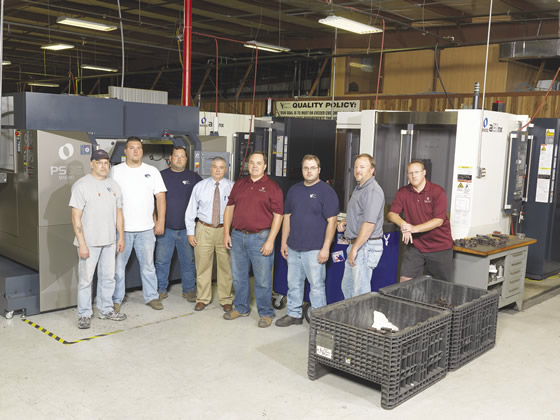
Cayce Washington (fifth from the left) took ownership of Valley Tool in 1997 when it employed five people. Valley Tool now employs 150 full-time workers, including these machine operators and manufacturing engineers.
“From the moment that I walked in the door, I knew that manufacturing was my calling,” he said. “I was filled with excitement at each opportunity to learn and grow, quickly mastering every type of machine on the shop floor and eventually becoming a floor manager.”
In 1997, the shop’s owner decided to start a business elsewhere. After the two worked out a loan, Washington, then 25, became president of the shop, renamed Valley Tool, which employed five people.
Today, Valley Tool is one of the area’s largest employers, with 150 full-time workers. The shop’s capabilities have captured the attention and business of numerous OEMs, including BorgWarner, Caterpillar, General Electric, Illinois Tool Works, Medtronic, Parker Hannifin and Winchester. In addition to its U.S. business, Valley Tool serves companies in Canada, France, Mexico and South Korea.
“While this company has grown substantially, I’ve never lost sight of my humble beginnings. Those experiences have built the foundation of Valley Tool,” Washington said. “While everyone here has different roles and responsibilities, we are members of the same team and share a common value of what matters most—providing a decent life for ourselves and the ones we love. To ensure a prosperous future for all, we always put our customers first by producing quality products, on time, at a competitive cost.”
Customer Needs Drive Volume
Historically, Valley Tool functioned as a low-volume job shop. However, in 2011, the company received a request to produce batch sizes from 200 to 500 parts. Unable to manage that level of production or obtain the necessary degree of quality, Valley Tool decided to invest in an a51nx horizontal machining center from Makino Inc., Mason, Ohio.
“With customer requests growing, we needed a solution that could get us producing higher-quality parts faster,” Washington said. “By purchasing the a51nx, we not only met the needs of the initial request, but also earned several additional large-batch orders. These orders continued to grow so much that we were able to rationalize a second a51nx investment in 2012. On those two machines, we’re producing more parts than all the other equipment on the shop floor combined. This has led us to a 20 percent increase in gross profits in just 2 years.”
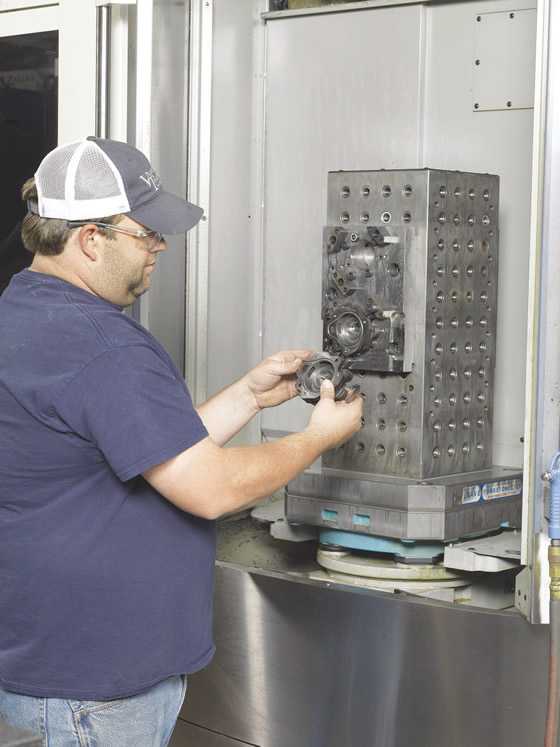
The 4th axis capabilities of its a51nx HMCs enable Valley Tool to complete parts in a single setup.
Prior to buying the a51nx machines, Valley Tool used mostly commodity-style vertical machining centers. This setup left little opportunity for substantial increases in part volume because of spindle utilization rates as low as 30 percent and the need for intensive operator intervention. For instance, operators would have to stop the spindle for extended periods of time whenever a tool change or part changeover was required. In addition, obtaining desired accuracies would often necessitate downtime to readjust machine offsets.
One appeal that Valley Tool saw in switching to a horizontal platform was the ability to disconnect tool management and part setup activities from the actual machining process, immediately improving productivity.
“One common-sense principle for any manufacturing environment is that a spindle has to be turning to make money, and this is especially true when dealing with larger volumes,” Washington said. “When we looked at our existing technologies, we realized that something had to change to be a cost-competitive resource for our customers.”
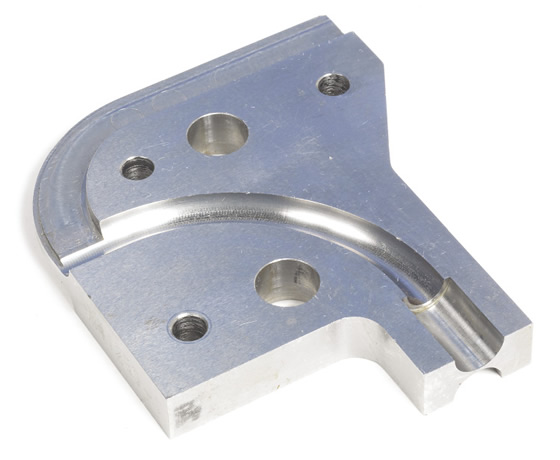
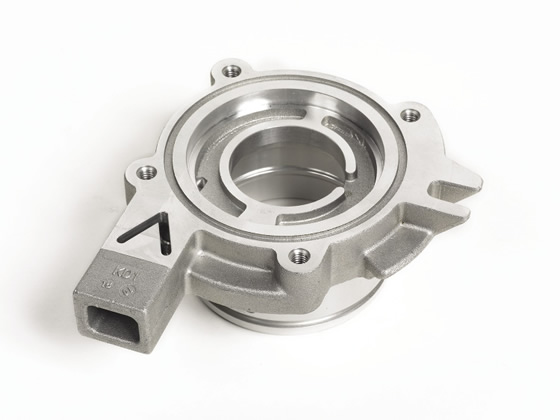
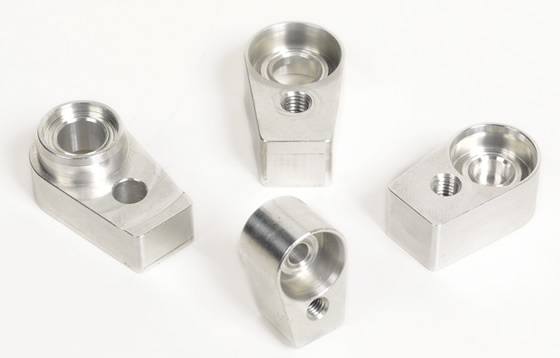
Valley Tool regularly achieves ±0.0001″ tolerances, with repeatability as tight as 0.0002″, when producing parts such as these on its a51nx HMCs.
The addition of the HMCs also provided Valley Tool with a rotational 4th axis, tombstone fixturing capabilities and the ability to program various part-specific fixture offsets. The company employs these features for single-setup operations of multiple part types on a single fixture.
Review the print ads from this magazine to continue
This quick advertiser review unlocks the rest of the article and keeps the full-screen reader focused on the ads instead of the page chrome.
Advertisers included in this article experience
Print placements connected to this article
Iscar
Intelligently large diameter drilling with unique insert clamping
Iscar promotes self-centering large-diameter drilling with a clamping mechanism designed for accuracy and longer tool life.
Intelligently large diameter drilling with unique insert clamping Iscar promotes self-centering large-diameter drilling with a clamping mechanism designed for accuracy and longer tool life. Visit iscarmetals.com to learn more.
Visit Iscar View this placement in the issue recordPrint ads from this magazine
Iscar promotes self-centering large-diameter drilling with a clamping mechanism designed for accuracy and longer tool life.
Intelligently large diameter drilling with unique insert clamping Iscar promotes self-centering large-diameter drilling with a clamping mechanism designed for accuracy and longer tool life. Visit iscarmetals.com to learn more.
Continue reading
March 2014
In one job transferred to the HMCs, Valley Tool had previously machined a single part across three different VMCs, with each one programmed to perform specific operations. This approach required five setups and three operators; total cycle time was 1 hour. Since transferring it, Valley Tool produces the part in just 15 minutes on one machine in a single setup with one operator.
“I could sit here and describe the productive benefits of the HMCs in a variety of ways, but the numbers speak for themselves: 50 percent average increases in throughput and cycle times of just 20 to 30 percent that of previous processes,” Washington said. “With these types of results, we could have these machines paid off entirely in 18 months, if we felt the need to.”
Positioned for Growth
While boosting productivity is key to meeting customer requests for long part runs, Valley Tool has also focused on improving part quality when cut- ting difficult-to-machine materials. According to Les Gilley, production machining manager at Valley Tool, the elimination of multiple setups has helped improve part quality by eliminating stack-up errors.
In addition, the shop previously EDMed holes in titanium, which consumed up to 48 hours. “On the a51nx, we are drilling through-holes in titanium to a depth of 2.5 ” on both sides, while holding location tolerances within ±0.0003 “,” Gilley said. “These parts are completed in less than 40 minutes. Accuracy and quality performances are even greater in standard-grade materials, where we’re seeing regular tolerances of ±0.0001 “, with repeatability as tight as 0.0002 “. The improvements are clearly seen in mating parts—they fit together perfectly each and every time.”
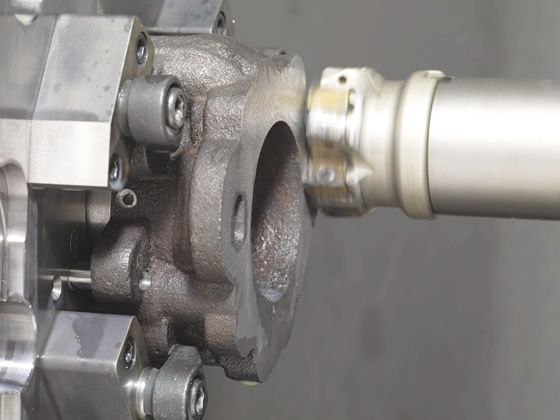
The a51nx HMCs help Valley Tool reduce cycle times by 20 to 30 percent and increase throughput 50 percent on average.
Valley Tool’s newfound accuracy was best demonstrated in dealing with a customer that was experiencing a 20 percent scrap rate in one of its product lines. The job was outsourced to Valley Tool, which added it to the a51nx production queue. Since then, there have been no issues with part quality.
Having the HMCs has also allowed the shop to perform machining operations it previously couldn’t, such as gundrilling. By not outsourcing tasks the shop can perform in-house, Valley Tool reduces lead times and boosts profitability.
Paving the Road Ahead
In spring of 2013, Valley Tool needed to replace a commodity vertical machining center. Based on the type of small runs produced on that machine, the company decided to stick with a VMC, but invest in a rigid, high-performance one that would improve part accuracy and cutting speed. As a result of its experience with the a51nx, the company chose a Makino PS95 VMC.
“When we heard that the PS95 used a similar spindle to that of the a51nx, we felt confident that this machine would help improve our performance in steel and cast-iron applications,” Gilley said.
In addition, Valley Tool also recently purchased a Makino EDAF2 sinker EDM. Based on testing estimates, the company expects to halve cycle times when EDMing carbide compared to its previous sinker EDM.
“These recent equipment additions weren’t made on a whim. We’ve worked closely with our local Makino dealership, Single Source Technologies, to determine the viability of each piece of equipment,” Washington said.
Exceeding customer expectations is important to Valley Tool, and the company knows that high-performance technologies are critical to providing its customers with the required results. According to Washington, the company’s management team believes Valley Tool’s experience with high-performance machining helps secure its employees’ futures.
“I didn’t have an easy road in my young life. I suppose it could have been worse, but I still wouldn’t wish it upon others,” Washington said. “As such, it’s a true blessing to me to have an opportunity to positively impact the community and help pave an easier road for other team members at Valley Tool. And by focusing our attention on customer service and technology, we can all go home to our families with a sense of confidence and security for tomorrow.”
For more information about Valley Tool Inc., call (662) 473-3066 or visit www.valleytoolinc.com. CTE
Glossary terms in this article
Related



Subscribers can use MFGAxis notes, saves and discussion tools with their innoNET account.


