

Vaporizing saw: General Industry Coverage
Sawing exotic materials, such as high-temperature superalloys, as well as hardened materials, can prove problematic. "You can eat teeth for lunch on that bandsaw blade trying to cut them," said Curtis Reichhold. He's president of Electrical Discharge Saws Inc., a supplier of electrical discharge saws that is working on commercializing an attachment for a manual lathe that turns the machine into an EDS.
Sawing exotic materials, such as high-temperature superalloys, as well as hardened materials, can prove problematic. “You can eat teeth for lunch on that bandsaw blade trying to cut them,” said Curtis Reichhold. He’s president of Electrical Discharge Saws Inc., a supplier of electrical discharge saws that is working on commercializing an attachment for a manual lathe that turns the machine into an EDS.
Instead of buying a dedicated EDS, which costs about $225,000, the EDS attachment will sell for considerably less, according to Reichhold. “The majority of job shops have a manual lathe they can take and make it a superhardened- or exotic-material slicer,” he said, noting, however, that the company has to analyze each application with a customer before proceeding.
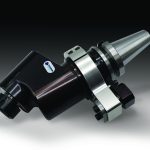
The attachment bolts onto a lathe’s ways and erodes electrically conductive material with a rotating ¾ “-high × 0.032 “-thick blade while the workpiece rotates as well. “Because of the expense of exotic materials, we try to keep blade thickness to a minimum,” he said, noting this minimizes waste.
Reichhold emphasized that the EDS blade cuts cleanly, produces a heat-affected zone of only about 0.002 ” deep and doesn’t workharden the material.
Review the print ads from this magazine to continue
This quick advertiser review unlocks the rest of the article and keeps the full-screen reader focused on the ads instead of the page chrome.
Advertisers included in this article experience
Print placements connected to this article
Iscar
Intelligently large diameter drilling with unique insert clamping
Iscar promotes self-centering large-diameter drilling with a clamping mechanism designed for accuracy and longer tool life.
Intelligently large diameter drilling with unique insert clamping Iscar promotes self-centering large-diameter drilling with a clamping mechanism designed for accuracy and longer tool life. Visit iscarmetals.com to learn more.
Visit Iscar View this placement in the issue recordPrint ads from this magazine
Iscar promotes self-centering large-diameter drilling with a clamping mechanism designed for accuracy and longer tool life.
Intelligently large diameter drilling with unique insert clamping Iscar promotes self-centering large-diameter drilling with a clamping mechanism designed for accuracy and longer tool life. Visit iscarmetals.com to learn more.
Continue reading
March 2014
When a shop doesn’t need to use the EDS, the attachment remains on the lathe, which can still function as a conventional machine tool. Between uses, however, an end user must wash the dielectric fluid, which is caustic, from the lathe to avoid causing damage, primarily to the ways.
Unlike an EDS that can cut a workpiece material with virtually any shape, the attachment is only for cutting round bars. In addition, the attachment is suitable only for manual lathes to avoid a variety of issues, such as coordinating the lathe speed and blade speed and the need for a feed mechanism. “With the manual machine, we just bring the blade up against the work and it’ll set there,” Reichhold said, adding that the possibility exists for developing an attachment for CNC lathes in the future.
He noted the company is seeking a lathe builder to demonstrate the EDS attachment at the IMTS 2014 trade show, which takes place Sept. 8-13 in Chicago.
For more information about Electrical Discharge Saws Inc., Jackson, Tenn., call (877) MCH-TOOL. CTE
Glossary terms in this article
Related


Subscribers can use MFGAxis notes, saves and discussion tools with their innoNET account.


