

Words with friends: People & Companies
Jim Carr and Jason Zenger breakdown the manufacturing industry with their "MakingChips" podcasts.
It’s Manufacturing Day, Oct. 2, 2015, and students across the country are attending more than 2,400 events, learning about modern machining techniques, solving the endless mysteries of 3D printing and deciding if a career in engineering and manufacturing is as good or stable as advertised.
I’m touring CARR Machine & Tool Inc., an Elk Grove Village, Ill., CNC machine shop, where the topic of conversation is the printing industry. The information is particularly noteworthy for someone who relies heavily on the success of the publishing trade. In short, business in the printing industry is good—actually great—according to CEO/owner Jim Carr, who is considering purchasing machine tools to keep up with the demand for components used in printing presses.

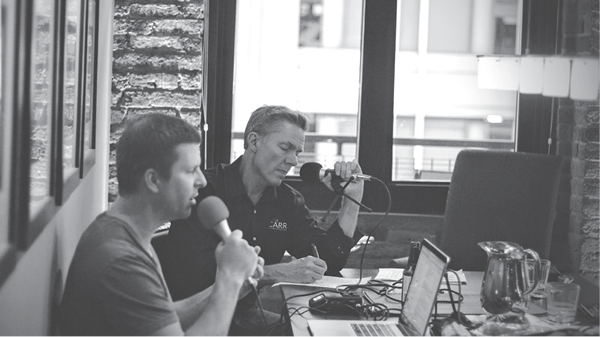
Jason Zenger (left) and Jim Carr delivered the first “MakingChips” podcast to the metalworking community in January 2015, after a year of research and planning. All images courtesy MakingChips.
Carr is excited for the future of manufacturing. He speaks passionately about how he took over his father’s business in 2004 and learned the ins and outs of the metalworking industry “from the back door to the front door.” But with each machining anecdote, you can’t help but notice an ulterior motive. There’s a pause with each new topic of conversation as though he’s internally snowballing ideas for a future project. For the past couple of years, many of these ideas have become the subjects of podcasts that Carr produces with Jason Zenger, president of industrial distributor Zenger’s Inc., Melrose Park, Ill.
Talk Radio
Zenger’s smartphone has more than 90 hours of podcast recordings. Each is anywhere from 3 minutes to an hour in length. Topics vary from marketing a business to theology to leadership and everything in between. Zenger, who’s a bit of a podcast aficionado, gains valuable insight on these various topics during his morning and afternoon commutes. He’s happy to listen as long as the value is clear and present. “If they’re just babbling on and on about a particular subject, I don’t listen,” Zenger said. “I like a limited amount of babbling.”
In 2013, Zenger was asked to participate in an AM radio talk show in Chicago to discuss manufacturing and, as luck would have it, Carr was on the same program. “We had a great rapport during the broadcast,” Zenger said. “After the show aired, I contacted Jim about creating our own podcast. I felt there was a void for a podcast dedicated specifically to the metalworking community.”
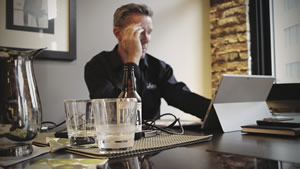
Jim Carr developed a strong social media presence at CARR Machine & Tool before agreeing to co-host “MakingChips.”
Carr frequently utilizes social media to attract new customers and foster relationships within the manufacturing community. He agreed to the project with the stipulation that they would be cognizant of program quality from the beginning. “If we were going to introduce a podcast to the metalworking industry, we were going to do it right.”
The Learning Curve
Carr and Zenger took a year to plan the podcasting project. This included joining a podcast community to learn as much as they could about the digital media platform. They researched commute times, which average 25 to 30 minutes in Chicago, to determine a suitable length for each program. They decided early on that manufacturing executives and leaders would be their target audience. They hired a sound editor, a composer to create intro and outro music, and an intern to help promote the program online.
Brainstorming sessions helped generate potential show topics. “These came relatively easy, based on our network of contacts within the industry,” Zenger said. “It seemed like the second we started talking about the podcast, all of our friends and colleagues had ideas for the show.”
The “MakingChips” podcast went live in January 2015 with an episode dedicated to social media in manufacturing. The first recording session offered a variety of production hiccups. Carr has a tendency to speak with his hands, for example, and while his animated presence is probably an asset in face-to-face sales meetings, it proved challenging in the studio. “My hands were going all over the place during our first episode,” Carr said. “I kept hitting the microphone during the show. It was probably driving our sound editor absolutely crazy.”
Zenger recalled sounding like a robot no matter what he tried to do. “It was very strange. Everything was fine until the moment we started recording and my voice suddenly changed.”
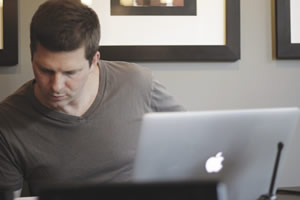
Jason Zenger took his interest for podcasts and transformed it into a unique and exciting opportunity to share manufacturing experiences with the metalworking community.
There were additional challenges that Carr and Zenger mentioned and wear like badges of honor. Learning how to limit background noise from furnaces and airplanes, for example, and overcoming the general fear of talking into a mic.
“For our nerves, we went through a bottle of wine just to get through the first recording,” Carr added.
Despite their fear, the podcast caught on rather quickly. As the duo taped new episodes, they continued to receive more and more positive feedback. “We had very low expectations going into the project, but the industry has really embraced the show,” Zenger said. “We were going to high-five each other if we could get 50 people to listen to a couple of episodes. Now, 1,000 downloads per episode is realistic.”
With 40-plus episodes available at www.makingchips.com, the show has more than 22,000 downloads and continues to grow. German conglomerate ThyssenKrupp has agreed to sponsor several episodes, and other manufacturers have conveyed a similar interest.
Carr and Zenger are in discussions with AMT—The Association For Manufacturing Technology and the Digital Manufacturing and Design Innovation Institute in Chicago to collaborate on future episodes. They’ve already worked with Crain’s Chicago Business for its Manufacturing Summit and Mazak for its Discover 2015 event.
Carr and Zenger believe a venture like this would have never worked 15 years ago. “Everything was so guarded in manufacturing and nobody wanted to give anyone else that competitive edge,” Carr said. “The industry is much more transparent today. We get to share our day-to-day experiences with the entire manufacturing community. This really resonates with the metalworking community.”
Review the print ads from this magazine to continue
This quick advertiser review unlocks the rest of the article and keeps the full-screen reader focused on the ads instead of the page chrome.
Advertisers included in this article experience
Print placements connected to this article
tolerances. Only Riten can supply you live
BIG TOOLS for big jobs
To accurately center rolls, drill pipe and other workpieces weighing hundreds of tons, you need roll class rigidity with gage class centers for loads up to 200,000 lbs. with guaranteed accuracy of ± .0002. Plus bell head, live and dead chuck mandrels, bore drivers, and other custom designed workholding products. Solutions, not excuses.
BIG TOOLS for big jobs To accurately center rolls, drill pipe and other workpieces weighing hundreds of tons, you need roll class rigidity with gage class tolerances. Only Riten can supply you live centers for loads up to 200,000 lbs. with guaranteed accuracy of ± .0002. Plus bell head, live and dead chuck mandrels, bore drivers, and other custom designed workholding products. Solutions, not excuses
Visit tolerances. Only Riten can supply you live View this placement in the issue recordPrint ads from this magazine
To accurately center rolls, drill pipe and other workpieces weighing hundreds of tons, you need roll class rigidity with gage class centers for loads up to 200,000 lbs. with guaranteed accuracy of ± .0002. Plus bell head, live and dead chuck mandrels, bore drivers, and other custom designed workholding products. Solutions, not excuses.
BIG TOOLS for big jobs To accurately center rolls, drill pipe and other workpieces weighing hundreds of tons, you need roll class rigidity with gage class tolerances. Only Riten can supply you live centers for loads up to 200,000 lbs. with guaranteed accuracy of ± .0002. Plus bell head, live and dead chuck mandrels, bore drivers, and other custom designed workholding products. Solutions, not excuses
Continue reading
December 2015
Character Building
While the podcast has featured topics like utilizing business management tools (episode 33), the power of networking (episode 10) and surface feet per minute (episode 23), the show aims to inspire more than inform. One of Zenger’s favorite episodes are Nos. 34 and 35, the two-part series on Workshops for Warriors—an effort to rebuild the manufacturing workforce one veteran at a time.

Jason Zenger (left) and Jim Carr tour the Digital Manufacturing and Design Innovation Institute, a 94,000-sq.-ft. manufacturing and educational facility situated on Goose Island in Chicago.
Carr looks back at episode 5, about two sisters, Stacey Bales and Sara (Bales) Mortensen, who took over their father’s company after his untimely death, as a story that resonated with listeners. “Here are two girls who worked in the front office and now they’re suddenly running the company,” he said. “When the bankers asked them when they were planning on selling off the assets, it lit a fire in them and they wanted to prove they could adapt to their new roles and remain a successful manufacturing company.”
Then there’s the story of Patricia Miller, who had a background in pharmaceuticals and no previous knowledge of her grandfather’s struggling plastic-injection-mold shop, yet dug in and turned it around thanks to her determination, will and business acumen (episode 28). “There are so many great stories to tell and so many great characters working in machine shops across the country,” Carr added. “These are the stories people want to hear.”
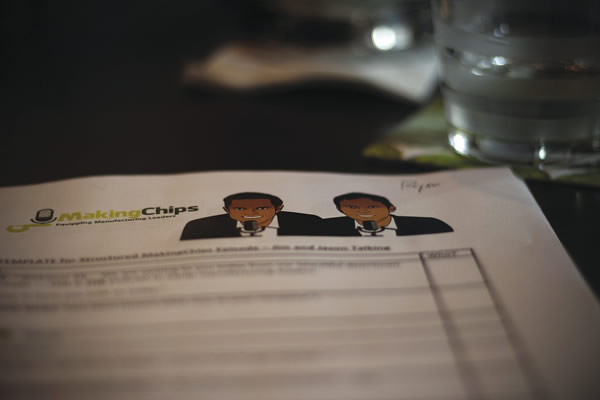
Jim Carr and Jason Zenger hired an illustrator to create the logo seen here for the podcast. Additionally, they hired a sound editor, composer and full-time intern to help further develop the program.
Stories that Carr and Zenger hope to tell utilizing both audio and video by the end of the year. The plan is to maximize exposure of “MakingChips” by videotaping the podcasts and posting them on YouTube, Facebook and Twitter. “People watch a lot of video content on their computers,” Zenger said. “This gives us an opportunity to bump up our views and gain more exposure online.”
The pair is debating the location for a permanent studio. At the moment, it is recorded in a couple locations in and around Chicago, based on their work schedules.
Zenger thinks Chicago is the right place to produce the show. “The manufacturing network is huge in Chicago, and there are so many different resources,” he said. “We feel like we’ve really only scratched the surface 40-plus episodes in.”
Brand Awareness
Zenger and Carr found a way to incorporate podcasting into their businesses. This may be the most interesting aspect of the project from a marketing and advertising point of view. By utilizing their knowledge to teach colleagues about search engine optimization (SEO), social media and business marketing tools, they receive more exposure in the manufacturing industry.
Carr admitted that the podcasts have led to new business opportunities for his shop. “I just talked to someone yesterday who needed some work done and found out about us because his boss regularly listens to the show. It’s a soft sell. Someone is interested in the podcast, goes to the website and is directed back to CARR Machine.”
They’ve even taken requests to help others start their own podcasts. “We’re learning as we go, obviously, but I’m sure we could discuss the amount of work it takes to produce a weekly show like this and offer suggestions,” Zenger said.
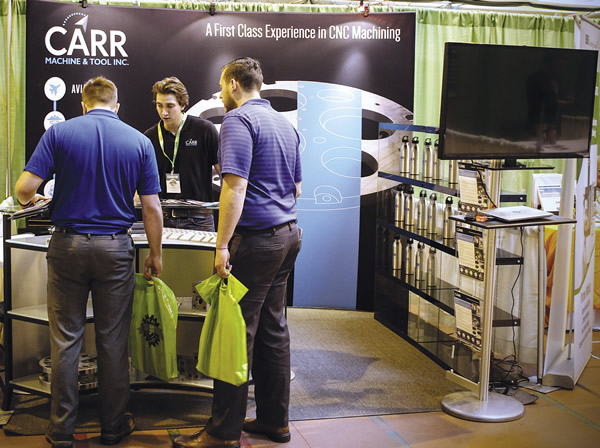
Ryan Carr (center), operations manager at CARR Machine & Tool, works the recent Made in Elk Grove Manufacturing and Technology Expo near Chicago. The “MakingChips” podcast has generated new customers for the machine shop, thanks to executives that listen regularly to the program.
Zenger and Carr want people to start thinking differently when it comes to branding, social media and manufacturing marketing. “This isn’t your father’s machine shop anymore,” Carr said. “The rules are different today and you need to ask yourself if you’re using the right tools and technology to tell your story.”
Zenger noted some of the interesting things happening in social media, for example. “Instagram is huge for machinists right now,” he said. “They post and share photos of cool projects they’re working on, things they’ve done differently from a machining standpoint. There’s an interesting subculture right there. Companies are finding unique ways to capture their target audiences.”
The end game is to get more manufacturing professionals together under one roof to encourage collaboration. “One idea is bring business owners and manufacturing leaders together to talk about the things that matter to them,” Carr said. “This may involve a live broadcast of the show with an audience. Perhaps we could schedule something a day or two before IMTS. There are so many different possibilities.”
Spending just a couple of hours with Carr and Zenger one quickly recognizes that the co-hosts aren’t short on big ideas and finding ways to make them happen. That very first recording back in January—when Carr was inadvertently taking swings at the microphone and Zenger sounded like C-3PO—seems like ancient history.
“We’re having so much fun right now,” Carr said. “We live and breathe this stuff on a daily basis. The next logical step was to share our experiences with the rest of manufacturing community. We’re excited to see where it goes from here.”
For more information about CARR Machine & Tool Inc., call (847) 593-8003 or visit www.carrmachine.com. For more information about Zenger’s Inc., call (800) 660-8665 or visit www.zengers.com. For more information about “MakingChips” please visit www.makingchips.com .
Related




Subscribers can use MFGAxis notes, saves and discussion tools with their innoNET account.


