

Workbench and working comfort basics
Shop Operations column from February 2011 issue of Cutting Tool Engineering magazine discusses the importance of comfortable workbenches and worktables.
Shops need several types of specific workbenches and worktables. All should be of sturdy construction, because a rickety workbench is annoying.
The main types of workbenches are basic work and assembly, welding and mobile. All three have special requirements. When the budget is tight, many shops build their own during slack time.
A basic assembly and work version should be rectangular with a maximum width of 36 “. Much wider and it’s hard to reach across. We surface our general benches with a whiteboard material called melamine that is similar to what is used for dry erase boards. We also add a short rim on three sides on some of the benches near machinery to keep tools and parts from rolling off.
A table height of 36 ” to 40 ” is appropriate for most workers. A lower height causes back pain after a long day. Generally, higher is for fine work and lower is for heavy work.
Light-colored replaceable tops reflect light and make small parts easier to see. When they get beat up, changing the tops makes the tables look brand new. Beware of the lower shelf; it’s an area that tends to collect junk.
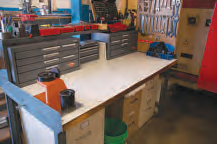
Courtesy of T. Lipton
A short rim on three sides keeps tools and parts from rolling off a workbench.
I used to believe that the only things in a shop that should be on wheels were a hand truck and forklift. I have since changed my mind. For maximum versatility, most—if not all—workbenches should be on wheels, with the exception of heavy welding tables and benches that have heavy machinery attached to them. These need to be stable to do decent work.
To clarify this a bit, the wheels need to be swivel ones with a brake and swivel lock. Otherwise, skip putting wheels on a workbench.
Review the print ads from this magazine to continue
This quick advertiser review unlocks the rest of the article and keeps the full-screen reader focused on the ads instead of the page chrome.
Advertisers included in this article experience
Print placements connected to this article
Mikron
rings produced by Tungsten Pride have a and images on the OD, and ID engraving customer wants if he sends us a file.”
the percentage of binder in the alloy. The ments. A laser engraver produces patterns Greek, Chinese, figurines—anything a 10 percent nickel binder. A higher per- is accomplished with a small, program- For example, Tungsten Pride produces centage of binder reduces hardness but mable 4-axis dividing head developed by a large number of rings for military per-.
the percentage of binder in the alloy. The ments. A laser engraver produces patterns Greek, Chinese, figurines—anything a rings produced by Tungsten Pride have a and images on the OD, and ID engraving customer wants if he sends us a file.” 10 percent nickel binder. A higher per- is accomplished with a small, program- For example, Tungsten Pride produces centage of binder reduces hardness but mable 4-axis dividing head developed by a large number of rings for military per- adds toughness. “We found that 10 per- the company to apply a diamond tool. sonnel. “An Army Ranger will e-mail us cent nickel provides enough hardness so “We can scribe anything that’s on Micro- his logo and we will laser it on the ring,” that the rings are basically impossible to soft Word,” Brosius said. “It’s simple for Brosius said. The shop can work with scratch; you can call it a permanently pol- us just to pull
Visit Mikron View this placement in the issue recordPrint ads from this magazine
the percentage of binder in the alloy. The ments. A laser engraver produces patterns Greek, Chinese, figurines—anything a 10 percent nickel binder. A higher per- is accomplished with a small, program- For example, Tungsten Pride produces centage of binder reduces hardness but mable 4-axis dividing head developed by a large number of rings for military per-.
the percentage of binder in the alloy. The ments. A laser engraver produces patterns Greek, Chinese, figurines—anything a rings produced by Tungsten Pride have a and images on the OD, and ID engraving customer wants if he sends us a file.” 10 percent nickel binder. A higher per- is accomplished with a small, program- For example, Tungsten Pride produces centage of binder reduces hardness but mable 4-axis dividing head developed by a large number of rings for military per- adds toughness. “We found that 10 per- the company to apply a diamond tool. sonnel. “An Army Ranger will e-mail us cent nickel provides enough hardness so “We can scribe anything that’s on Micro- his logo and we will laser it on the ring,” that the rings are basically impossible to soft Word,” Brosius said. “It’s simple for Brosius said. The shop can work with scratch; you can call it a permanently pol- us just to pull
Continue reading
February 2011
Having most workbenches on wheels allows reconfiguring a workspace quickly for any job. Such workbenches are easier to move for cleaning or if more floor space is needed for a large project. For job shops that never quite know what will crawl through the door, bringing the table to the job is beneficial.
Mobile workbenches and carts are much smaller than regular workbenches. These are used to move raw material and parts between machines and processes. High-quality wheels are a must for these often-overloaded carts.
Small is beautiful for mobile carts because of where they are used. They are easy to stow and push around because they have a load limit of 200 lbs.
Furniture dollies can also be used to move heavy plates and boxes to different work centers. They are cheap, store relatively flat and roll easily. Carpet on the surface keeps loads from sliding off.
In addition to having appropriate workbenches, a shop’s environment is critical for enhancing efficiency. Because many metalworking shops start out as warehouse spaces, they are typically cold in the winter and hot in the summer. If you can, insulate the space and then add dedicated heating and cooling equipment. Typically, these areas need to be kept at different temperatures than office spaces, so be sure they have their own climate controls. I don’t think anyone would complain if the temperature remained at 68° F all year. This also keeps precision measuring equipment closer to calibration standards.
The food preparation and eating area should also not be overlooked. Every engine needs fuel, and every shop needs a refrigerator and at least one microwave oven.
If you have two or more microwaves, you can designate one for questionable food items and forensic leftovers. There is always one person who has to heat a fermented mackerel and sardine casserole to the temperature of the sun’s surface, permanently contaminating the oven.
The lunch room should be separate from the shop. It’s nice to sit down and not hear CNC machines running while you’re taking a break. A large table promotes camaraderie and boosts morale. And be sure to leave work-related magazines in the lunch room. CTE
 About the Author: Tom Lipton is a career metalworker. Lipton’s column is adapted from information in his book “Metalworking Sink or Swim: Tips and Tricks for Machinists, Welders, and Fabricators,” published by Industrial Press Inc., New York. The publisher can be reached by calling (888) 528-7852 or visiting www.industrialpress.com. By indicating the code CTE-2011 when ordering, CTE readers will receive a 20 percent discount off the book’s list price of $44.95.
Related



Subscribers can use MFGAxis notes, saves and discussion tools with their innoNET account.


