Poly – Poly – or what? Part 9: Lach Diamant Goes East
No, this story does not begin with "once upon a time," since it is far too serious, vivid and full of unique facts for a fairy tale. The German partition created different living conditions in both parts of Germany.
‘Poly – Poly – or what?’ Part 8: How the ‘issue with the comma’ became a success
Let's look back. Could it be that the world's first presentation of a dia-compact monoblock milling cutter for aluminium machining at FAMETA in 1980 already laid the foundation for large-scale use within the automobile industry in the 80s? Actually yes, if the aforementioned "stumbling blocks" were not there.
Poly – Poly – or what? Part 7: Stumbling blocks on the way into the automotive world …
When you read this, 40 years will have already passed since the discovery of spark erosion for machining polycrystalline cutting materials. Lach Diamant named this process "spark grinding," which accompanied the development of proprietary machines. Polycrystalline diamond tools conquered a multiple-application market traditionally reserved for carbides. Diamonds, baked under pressure and heat during synthesis, made this possible.
Poly – Poly – or what? Part 6: Quo vadis – Where are you going …?
The fact that polycrystalline diamonds (PCD) could "show profile" in October 1978 could be attributed to random chance, but could it have something to do with "luck"? But how did golf professional Tiger Woods answer when a journalist pointed out that he often had a lot of luck during his games?
‘Poly-poly-or what?’ Part five: Diamonds show profile
It is October 1978. On Oct. 13, my discovery at the former Matra company in Frankfurt that PCD can be eroded by means of electric sparks was registered at the patents office. In October 2018, we looked back at 40 years of experience in the application of spark erosion for manufacturing and versatile application with polycrystalline blades of PCD- and PCBN-tipped tools.
‘Poly–poly–or what?’ fourth part – a trade show initiates a brilliant idea
Between 1974 and 1976, polycrystalline cutting materials, such as PCD and PCBN, could show their potential for the first time. As a result of the hardness of diamond, combined with the sharpness for machining tasks, the superiority of PCD was displayed early on when turning, milling and drilling.
‘Poly–poly–or what?’ third part – hard turning
We are in part three of our article series "Poly–poly–or what?" The series looks back at the time between autumn 1974 and the Hanover Trade Show in the spring of 1975.
LACH DIAMANT looks back on 95 years, part 2
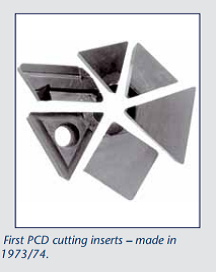
Where do we come from – what is our destination? This was the question after the first introduction of this new cutting material "polycrystalline diamonds" (PCD) at the Hanover Trade Show in 1973.
How new superhard cutting materials revolutionized machining, part 1
The introduction of our Borazon CBN grinding wheel was still in full swing when I received information from General Electric in 1972 that a new cutting material would be coming soon. What could it be? Naturally all of us were curious!