Skip to content
Operation / Process

Machining

Optional: narrow results to one content type.
Select one or more.
Select one or more.
Select one or more.
Reset

Latest in Machining

Raising the CNC Technology Bar
Article August 1, 2000 Dennis Esford
Raising the CNC Technology Bar
Overview of the new machine tool technologies introduced at IMTS 2000. Among them are linear motors for axes travels, ballscrew chillers, a new way to lubricate linear guideways and controlling machining processes via the Internet.

Bond Smart: Trade Shows & Events
Article August 1, 2000 Ed Galen
Bond Smart: Trade Shows & Events
Discussion of different types of bonds used to make superabrasive grinding wheels. Author provides tables with price comparisons, physical properties and operating parameters for various bonds.
A Break in the Action
Article August 1, 2000 Kip Hanson
A Break in the Action
The author offers tips about making interrupted cuts while turning. He also discusses the differences between interrupted cuts in turning and milling and various types of materials.
Hands Free: Turning Performance
Article July 1, 2000 Les Loncharich
Hands Free: Turning Performance
Shop owners who operate multitask machines talk about the time and cost benefits of producing parts in a single chucking. They also discuss some of the problems they had when adopting the technology. Accompanying Articles focus on a multitask users group and machine that hard-turns and grinds.
Silver Lining: Safety, Standards & Compliance
Article July 1, 2000 Markus Jakobuss
Silver Lining: Safety, Standards & Compliance
GE Superabrasives' silver-coated diamond crystal is designed for grinding tungsten carbide. Discussed are the benefits--reduced friction, greater crystal retention and a cooler grinding environment--and how to apply wheels made from the crystal.
Ceramics Take a Turn: Turning Performance
Article July 1, 2000 Dennis Esford
Ceramics Take a Turn: Turning Performance
Author describes applications for the two basic types of ceramic turning inserts–alumina and silicon nitride–as well as the types of parts and materials users have turned with them. Specifics about speeds, feeds and DOCs are given.
Double Header
Article June 1, 2000 Jack Burley
Double Header
The author discusses the advantages and proper application of twin-cutter boring tools. They're recommended for rough-boring applications on castings, forgings and other jobs requiring a tool that can bore a cored hole. Details are provided on the three basic types of methods for rough boring with a twin cutter: balanced, stepped and full profile.
Smoother Roughing
Article May 1, 2000 Kip Hanson
Smoother Roughing
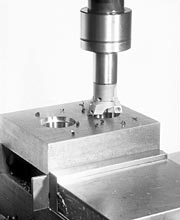
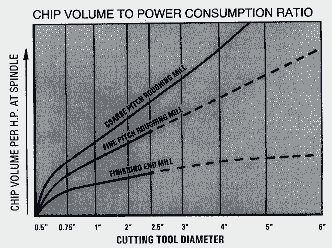
The author discusses the disadvantages of using a finishing endmill for roughing applications. He also presents a quick, systematic, step-by-step series of calculations that allows machinists to optimize metalcutting when applying coarse-pitch, cobalt-HSS roughing endmills.
Talking Points: Industry Trends & Analysis
Article May 1, 2000 Alan Richter
Talking Points: Industry Trends & Analysis
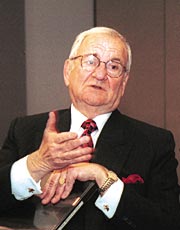
A conversation with Lee Iacocca, chief spokesman and a member of the board of directors of The Online Asset Exchange (onlineassetexchange.com), a service for buyers and sellers of machine tools. Iacocca also is involved with a company that produces electric bicycles.
Tool Men
Article May 1, 2000 Brent Chandler
Tool Men
Establishing a good relationship with your cutting tool salesperson can benefit your operation. A good salesperson can help solve problems you don't have time to tackle and offer recommendations for machining difficult parts. The author also addresses what to do when a relationship sours.

Keep exploring