Tool management software is designed to help users of cutting tools get more control of their toolcribs. The article describes the types of tool management software available, the savings possible by utilizing software and includes comments from shop owners who've installed these systems.
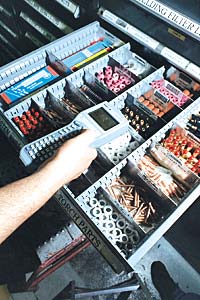
An organized toolcrib is necessary to ensure that tools will be available when needed. This article reviews the techniques and equipment different shops have used to keep track of their tools.
Machinists can now find machining simulators on the Web that can tell them what the results will be for a given set of conditions as well as what set of conditions will produce the results they are looking for. This article describes these simulators and the research consortium that developed them.
Computer simulations of the cutting process can help tool designers predict the effects of tool-geometry changes. This article describes how one manufacturer is using the most recent advances in computer modeling to reduce the need for producing and testing prototype inserts. An accompanying article describes a commercially available simulation program.
This article explains how state-of-the-art tool presetting-and-measuring machines can reduce a shop's tool setup time while increasing precision. The article also describes how the additional functions of these high-end units can turn them into sophisticated tool-management systems.
Modern control technology makes extremely fast milling speeds possible. But the top speed can only be as fast as the slowest link in the chain between controller and machine. This article looks at some of the bottlenecks that can prevent a mill from running at full speed.
In the lab, researchers are using artificial intelligence to turn CAD and CAM programs into systems that can think and make decisions. This article looks at several of these efforts and the capabilties of the systems that have been developed.