


L.S. Starrett Co. demos bandsaw blades
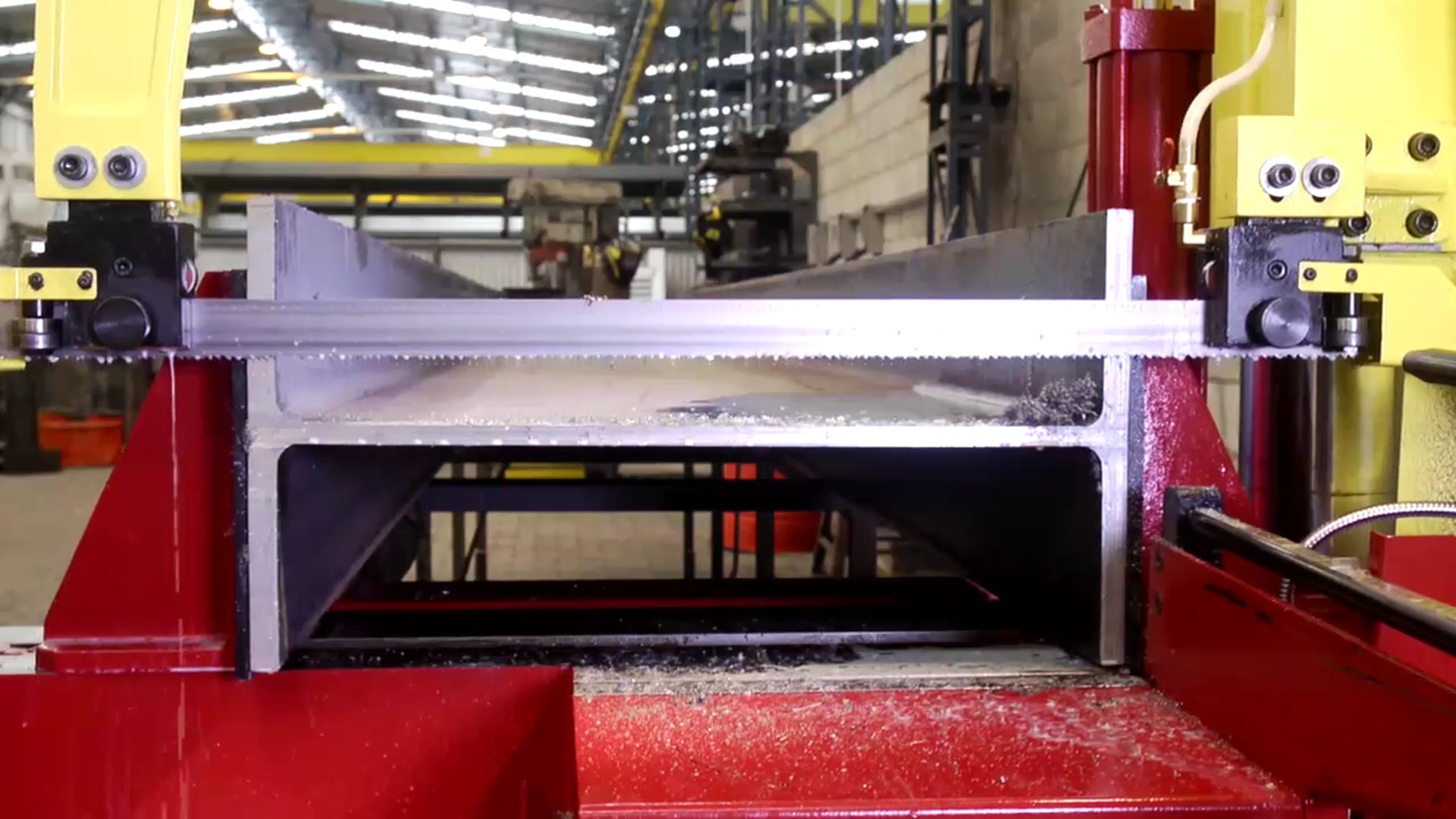
The L.S. Starrett Co. offers a demonstration of its bandsaw blades as part of a video supplement to "A Steady Approach," a feature article in the September 2018 issue of Cutting Tool Engineering magazine that focused on sawing difficult-to-machine materials.
More Product Demos

The most difficult-to-cut metals are nickel-base superalloys, according to Jay Gordon, North American sales manager for saws and hand tools at the saw division of The L.S. Starrett Co., Mount Airy, North Carolina. “People are running into them more often.”
The sawing parameters not only have to remain consistent but must be correct. “With a carbon steel product, you can get away with the feeds and speeds being somewhat out of whack,” Gordon said. “But when you get into these difficult alloys, they have to be correct if you want to get any blade life and production out of it.”
While the compositions of standard alloys, such as Inconel 718 or Hastelloy C-276, are known, part manufacturers also must saw proprietary metals, Gordon noted. “Of course, when it is proprietary, you don’t know what’s in it.”
To help, he recommended asking the material supplier what the proprietary metal cuts like. “It becomes a lot more dependent on the saw specialist to be able to read chips and determine what may be required.”
If the chips look black and blue because of excessive heat and are similar to chips produced on a turning machine, Gordon said something is wrong. Instead, chips should look like steel wool or the familiar curled shape, depending on the application.
“I would say there’s a lot of trial and error in some of these materials,” he said. “For proprietary materials, you just have to work your way through it and keep adjusting until you arrive at the best solution.”
Available from Starrett are the Advanz MC5 and MC7 carbide-tipped bandsaw blades, which utilize a multiple-chip grind with a high/low tooth sequence to distribute the load over five or seven teeth.
“It allows you to saw more aggressively because the load on each tooth is less than it would be without the progressive tooth grind,” Gordon said. “That will also increase your speed. In most cases, the smoothness of the cut increases as well.”
“It allows you to push a little harder because each tooth is taking as much load as possible to that chip,” Gordon said. “That will also increase your speed. In most cases, the smoothness of the cut increases as well.”
Gordon added that Advanz MC5 is more user-friendly whereas Advanz MC7 boosts production. “If an operation has 10 saws and all are heavy-duty machines with no vibration, has the right coolant, good operators and needs to go as hard and as fast as possible, we recommend the MC7,” Gordon said. “On the other hand, if a shop has a few saws that are older and operators that are not as well-trained, they would probably be better off with the MC5.”
Also, Starrett AMP technology is available on some Starrett bandsaw blades, including Advanz MC5 and MC7 ones, which increases cutting efficiency and blade life, according to the company. A custom back-edge enhancement on the blade generates a rocking motion while cutting, increasing tooth penetration without adding feed pressure. This cutting motion also serves to minimize the surface contact area, increasing blade life when sawing difficult-to-cut alloys.
n