

Machinist’s Corner: Turning Performance
Figure 1 Last issue I wrote about how and why 5-axis milling has become popular. This month I am looking at EMUGE-FRANKEN USA’s new clamping solution for this process. EvoGrip is a modular system based on self-centering vises with zero-point plates called EvoPoint that allow for swapping vises while maintaining a zero position index.
Review the print ads from this magazine to continue
This quick advertiser review unlocks the rest of the article and keeps the full-screen reader focused on the ads instead of the page chrome.
Advertisers included in this article experience
Print placements connected to this article
Sandvik
Time for change
Time for change Visit sandvik.coromant.com to learn more.
Visit Sandvik View this placement in the issue recordPrint ads from this magazine
Time for change Visit sandvik.coromant.com to learn more.
Continue reading
March 2026
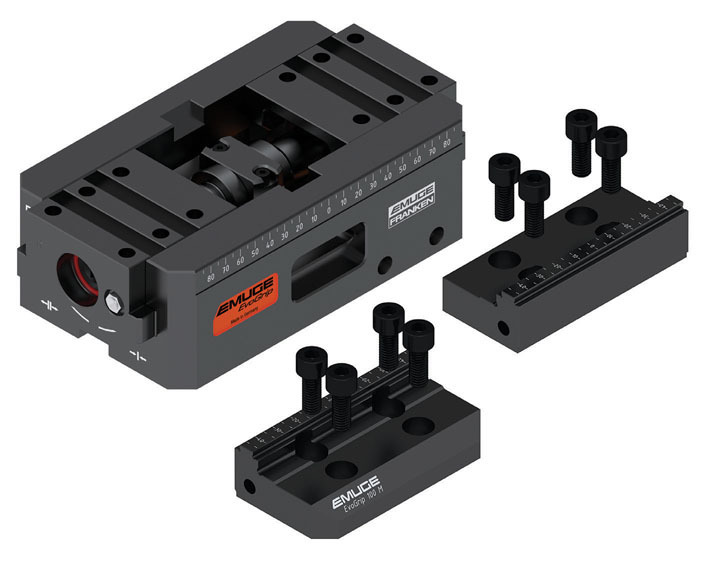
Last issue I wrote about how and why 5-axis milling has become popular. This month I am looking at EMUGE-FRANKEN USA’s new clamping solution for this process. EvoGrip is a modular system based on self-centering vises with zero-point plates called EvoPoint that allow for swapping vises while maintaining a zero position index. There are also riser blocks (EvoBlock) that are machinable from the bottom for a custom workpiece height. Three widths of vises, each with three lengths, many shapes and sizes of base plates and riser blocks all make for significant versatility.
The vises are similar to lathe scroll chucks in that they have base jaws, which slide on ways in the vise body, and reversible jaws that bolt to the base jaws. The reversible jaws clamp the workpiece. The base jaws don’t protrude above the vise body and have sealed lubrication channels (see Figure 1). The jaws are moved by a lead screw that mounts into a bearing block at the center of the vise. The screw has a left-hand thread on one end and a right-hand thread on the other, so turning the screw moves the jaws simultaneously, toward or away from the center and each other. The bolts used for the reversible jaws are all ISO 898-1 Class 14.9, and exceptionally high clamping forces up to 75kN can be generated. These vises should be tightened with a torque wrench. EMUGE provides tables of torque versus clamping force and recommendations, so the correct force is used for a particular workpiece.
A large variety of reversible jaws are available. There are hard jaws with smooth surfaces or with teeth. The Vario reversible jaw sets can have round or square jaw inserts. The inserts come in sets of four and can be bolted to the reversible jaws to grip round or irregularly shaped parts. There are also soft jaws in steel or aluminum. The reversible jaws have provisions for work stops.
EMUGE’s vises can be bolted to a T-slot table with standard T-slot nuts and keys, or used with the EvoPoint indexing system. Then an EvoPoint base plate (see Figure 2) is bolted to the table with T-slot nuts and keys. There are also EvoPoint plates without table mounting bores for custom arrangements.
Pull studs, such as used on milling machine toolholders, screw into the underside of a vise. They locate and hold the vise to the EvoPoint zero-point plate. Figure 1 shows a vise that has four pull studs on its bottom and a pair of reversible jaws with their associated bolts. Four or eight pull studs are used, depending on the size of the vise. When the studs on the bottom of a vise are put into matching holes in a zero-point plate, a screw is turned on the side of the zero-point plate and all the studs are clamped, pulling the vise against the plate. This system has an industry standard square pull stud pattern of either 52 mm (2.05″) or 96 mm (3.78″).
EMUGE has hardware available to connect EvoPoint plates together in a daisy chain arrangement so all the pull studs in a setup are clamped or unclamped simultaneously. There is also hardware so an EvoGrip vise can be used with a competitor’s zero-point index plate. Then the competitor’s pull studs are used with adaptor sleeves on the threads. However, competitors’ pull studs have 2 mm smaller threads. It’s my opinion that EMUGE’s new workholding system is more robust than other systems currently available.

Brandt Taylor is the owner of Taylor Engineering, a Berlin, Massachusetts- based machine shop. He can be reached via email at gbrandttaylor@gmail.com.

EvoBlock riser blocks move the workpiece away from the face of the machine’s rotary table. There are a variety of standard heights that can be stacked and some are machinable from the bottom side for a custom workpiece height.
And one last thing. If a workpiece is too big to be clamped by a vise, two vises can be used together. Then the leadscrews of each vise are linked by a telescoping coupling, and one reversible jaw is used on each vise so that turning the leadscrew assembly moves the reversible jaws toward or away from each other.
This system is designed for versatility, maximizing 5-axis milling machining capabilities. I can attest that the components of this system have excellent fit and finish.
Our trade continues to evolve.
Related



Subscribers can use MFGAxis notes, saves and discussion tools with their innoNET account.


