


Economic uncertainty clouds Cutting Tool Industry Fall 2026 Outlook
Though economic uncertainty surrounding trade policy and raw material costs persist, the U.S. cutting tool industry enters the final months of 2026 with considerably stronger sales expectations than a year earlier, according to results from the United States Cutting Tool Institute’s latest biannual industry outlook survey.
Though economic uncertainty surrounding trade policy and raw material costs persist, the U.S. cutting tool industry enters the final months of 2026 with considerably stronger sales expectations than a year earlier, according to results from the United States Cutting Tool Institute’s latest biannual industry outlook survey.
The fall 2026 Cutting Tool Industry Business Outlook survey reports 81% of responding companies expect total annual U.S. cutting tool industry sales revenue to increase this fall. That’s nearly twice as many company representatives who forecast an increase in the fall 2025 report.
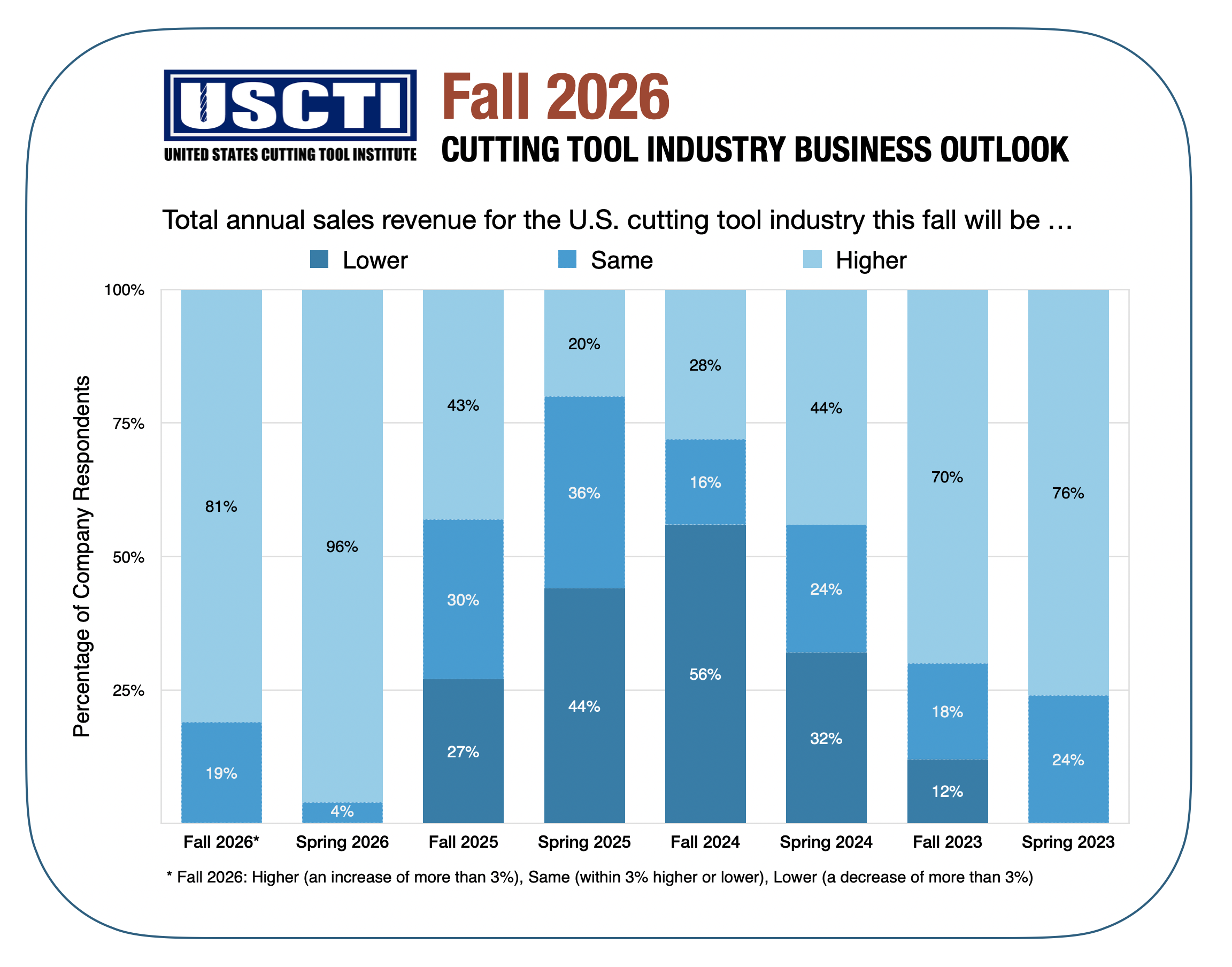
Importantly, the survey measures whether companies report or anticipate increases, rather than the magnitude of those changes. Higher nominal revenue also does not necessarily indicate equivalent growth in unit sales or production volumes.
One respondent specifically noted that sales volumes were holding steady while inflation affected revenue.
Based on responses from 26 USCTI-member companies, the fall 2026 survey asked company representatives to share their quarterly and annual cutting tool sales expectations as well as their outlook on hiring prospects, raw materials pricing, export performance and financial health. For context related to changes in business conditions and expectations, the report also presents historical data collected from biannual surveys extending back to spring 2023.
Sales Performance and Expectations
Company-level results support the improved outlook with 88% of respondents reporting higher sales revenue in their most recent quarter, compared with 60% in fall 2025 and 25% in fall 2024. Only 8% reported a revenue decline in the most recent quarter.
Looking ahead, 88% anticipate higher company sales revenue over the next 12 months, while 12% expect little change. None forecast a decline.
Material costs and supply chains
Raw material conditions remain a significant challenge, although some indicators have improved.
While 100% of the spring 2026 respondents and 97% of the fall 2025 respondents reported higher prices for raw materials, the fall 2026 survey revealed improvement with 62% of respondents citing higher prices for raw materials. Another 31% reported stable prices, and 8% reported decreases.
Supply chain conditions also improved compared with the spring survey. Half of the respondents reported longer raw material delivery lead times, down from 81% in spring 2026. The remaining 50% reported relatively unchanged lead times, with none reporting shorter deliveries.
Employment and operating conditions
Employment results offer another indication of improving business activity with 46% of companies reporting increased staffing during the preceding six months, compared with 23% in fall 2025. Another 38% maintained employment levels, while 15% reported reductions.
Inventory trends were less positive with 35% reporting lower inventories, compared with 30% in spring 2026 and 23% in fall 2025. Only 19% reported increases.
Meanwhile, 46% reported higher borrowing costs compared with a year earlier, and 19% said their borrowing costs had remained the same. Interestingly, no companies reported a decline in borrowing costs while the response from 35% of the companies was “not applicable (no borrowing).” That option doesn’t show up in the previous seven biannual business outlook reports.
Export performance presented a mixed picture. Among all respondents, 19% reported higher exports for the most recent quarter versus the previous quarter, while 12% reported decreases. However, 23% indicated exports this year represented a smaller share of total company revenue, and no company reported an increasing share.
Policy uncertainty dominates risks
Beginning with the fall 2026 survey, USCTI introduced a new question that asked company representatives to identify the “most significant risk” to their businesses over the next 12 months. The multiple-choice answer options included:
- policy/external shocks, (such as tariffs, geopolitics or trade war escalation),
- cost inflation (such as for labor or materials),
- weaker demand/recession fears,
- interest rates/financial concerns, and
- “other,” an open-ended choice allowing respondents to identify a risk not covered in any of the previously listed answer options.
Half identified policy and external shocks as their primary concern. Another 35% selected cost inflation, while 8% cited weaker demand/recession fears. One respondent selected the “other” option to combine policy/external shocks with weaker demand.
Together, the findings illustrate an industry experiencing stronger reported revenue and employment conditions without a corresponding disappearance of operating pressures.
Use Caution When Extrapolating the Results
Though half of all USCTI member companies participated in the survey, the relatively small group of 26 company respondents warrants caution when extending the findings of the fall 2026 business outlook to the entire industry. Also, changes between survey periods may reflect differences in participating companies as well as changes in industry conditions.
Nevertheless, the historical comparisons show a pronounced improvement from the weaker conditions reported during 2024 and early 2025. Whether stronger revenue expectations translate into sustained improvements in production volumes, profitability and investment will depend partly on how manufacturers navigate continuing cost and supply chain challenges.
Related




Subscribers can use MFGAxis notes, saves and discussion tools with their innoNET account.