


Realbots
Artificial intelligence provides a platform for real-world automation applications.
Artificial intelligence provides a platform for real-world automation applications.
Artificial intelligence continues to make inroads into automation applications at parts manufacturers, enabling faster deployment, easier job changeovers, greater autonomy, and real-time control and visibility.
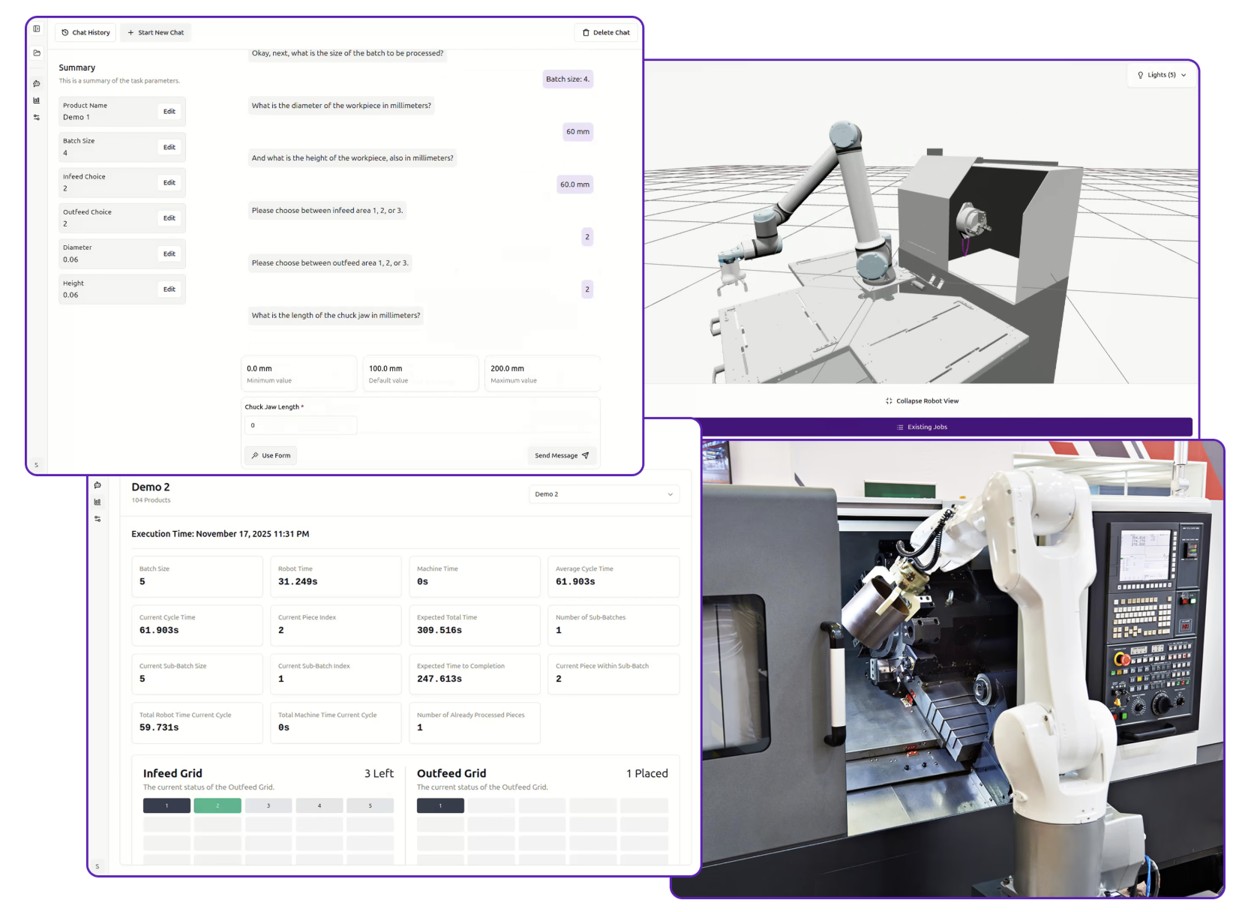
Trener Robotics in San Jose, California, is one company that has developed an AI-native software platform for robotic automation, said John Marioni, the company’s director of U.S. sales. Called Acteris, the intelligence layer for industrial and collaborative robots is used for machine tending.
“As a company, we decided starting out to just focus on CNC machine tending as a skill, and we developed our whole language model around CNC machine tending,” he added. “We did that so that we wouldn’t get spread too thin trying to take on other typical applications like welding and palletizing.”
In addition to loading and unloading parts, machine tending includes part blowoffs, rinsing and inspection, Marioni noted. “We have an installation where the customer didn’t want to spend the money to automate the workholding, so we put a clamp booster on the end of the robot arm so that every time the robot picked or placed a part in the vise, it first pushed up to and engaged the vise to make sure it opened and closed each time.”
Instead of programming a robot in the traditional way, which involves point-to-point teaching or a procedural method with if-then statements, Acteris uses model-based learning, Marioni explained. Human input, cameras, sensors and haptics provide data, while machine learning allows the platform to adapt to new situations over time. “What we’re doing with physical AI is we’re trying to transform traditional robot integration, transform traditional robots from rigid, preprogrammed machines and turn them into intelligent, self-learning, almost teammates that can operate reliably and autonomously.”
The software platform has two layers, Marioni said: a user interface, or runtime version, for the end user and an integration suite that a technical specialist uses for setup. At a computer, a chat agent prompts the user for the parameters needed to build a program, such as the size and weight of the part, its pickup location and where it should go after machining. “It automatically creates a 3D simulation digital twin so that you can see it running. Then you can hit go and execute the robot.”
The software also makes robots easier to deploy and scale over time, Marioni added. “Once you do your first job using our software, you can repurpose, recycle lots of what you did the first time for the next job, and the more jobs you do, the easier it gets to just kind of pick and choose and piece together what you need.”
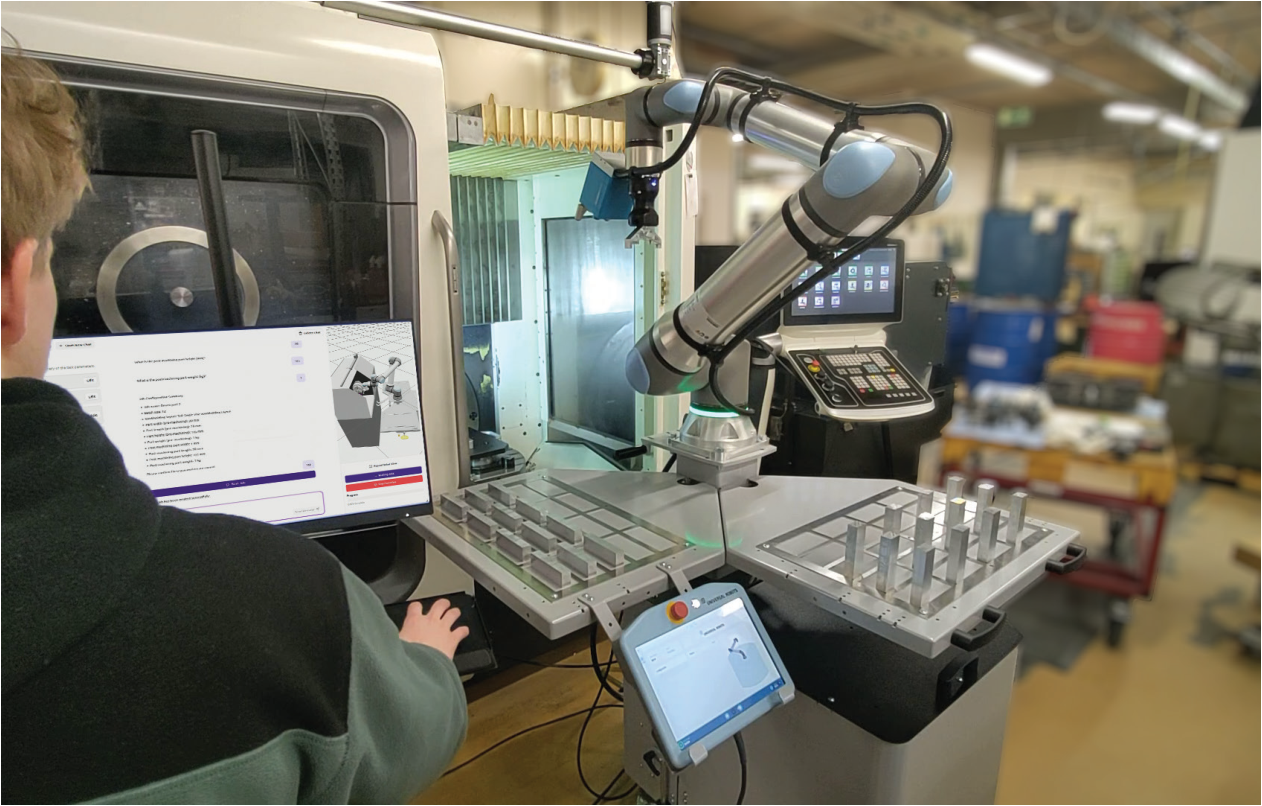
Acteris incorporates a partner ecosystem designed for scalable automation, according to Trener Robotics. The platform works with several robot brands, including Universal Robots, Fanuc and ABB, and accounts for each robot’s payload, work envelope and reach. “So that you as an operator, if you type in the wrong information, it knows, it catches it, and it tells you to try again, basically,” Marioni said.
With the ability to see, feel and detect anomalies, a robot can begin to act more like a human operator, he noted. When an error occurs, a traditional machining system provides a code that may be unfamiliar and require the end user to call the integrator. “When we throw out an error, we throw out context along with why and where and when the error occurred.”
Acteris also offers step-by-step instructions for troubleshooting and resolving an error, Marioni said. “Integrators love that because it means they will get fewer phone calls. It saves a lot of time and hassle in dealing with technical support.”
The cost of downtime can accumulate quickly. Marioni cited an integrator partner with major automotive customers for whom rapid error recovery is critical. In those applications, he said, the return on investment from error handling alone can justify the system.
Smaller manufacturers traditionally have been hesitant about automation because they may lack someone to program and manage robots, Marioni said. Acteris can appeal to those customers. “Because our software and our agent, which knows everything about the robot and everything about CNC machining, becomes the in-house expert, you don’t have to hire a robot specialist to use our system. In fact, our system becomes your in-house robot specialist.”
Sensor-Driven Control
AICA, a developer in Prilly, Switzerland, offers an AI platform for programming automation equipment, with an emphasis on robotic arms, said co-founder and CEO Baptiste Busch. “We have an AI software platform that allows us to control robotic arms. We’re focusing right now on robotic arms because that’s what’s mostly used in industrial environments.”
In some mass-production industries, such as automotive, a manipulator arm performs the same task thousands of times and rarely needs reprogramming, Busch explained. In industries that make smaller batches with variations or customization, however, reprogramming can be time-consuming and expensive. “You can’t just take two days of programming for the arm to do one day of work.”
That is where AI, including physical AI, enters the mix and can assist with code generation, he said. “You could have a robot that reprograms itself or adapts its behavior on the fly. Suddenly, instead of spending two days programming, the robot takes one hour to be programmed and then it starts making sense for high-mix, high-variability products.”
AICA System is an AI platform for adaptive robots that provides sensor-driven, real-time control and AI-based motion generation, according to the company.
“When it comes to the motion of robots, those robots are made to move exactly in a certain way and have been programmed to do so. When you enter AI in the mix, the way the robot moves does not matter as much as the ability to modify that motion on the fly,” Busch said. “The idea is to have this control strategy that allows you to react to the environment.”
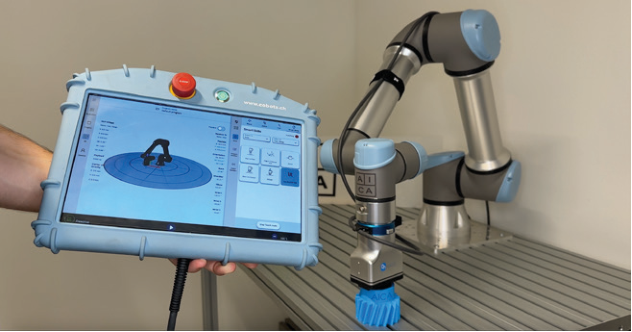
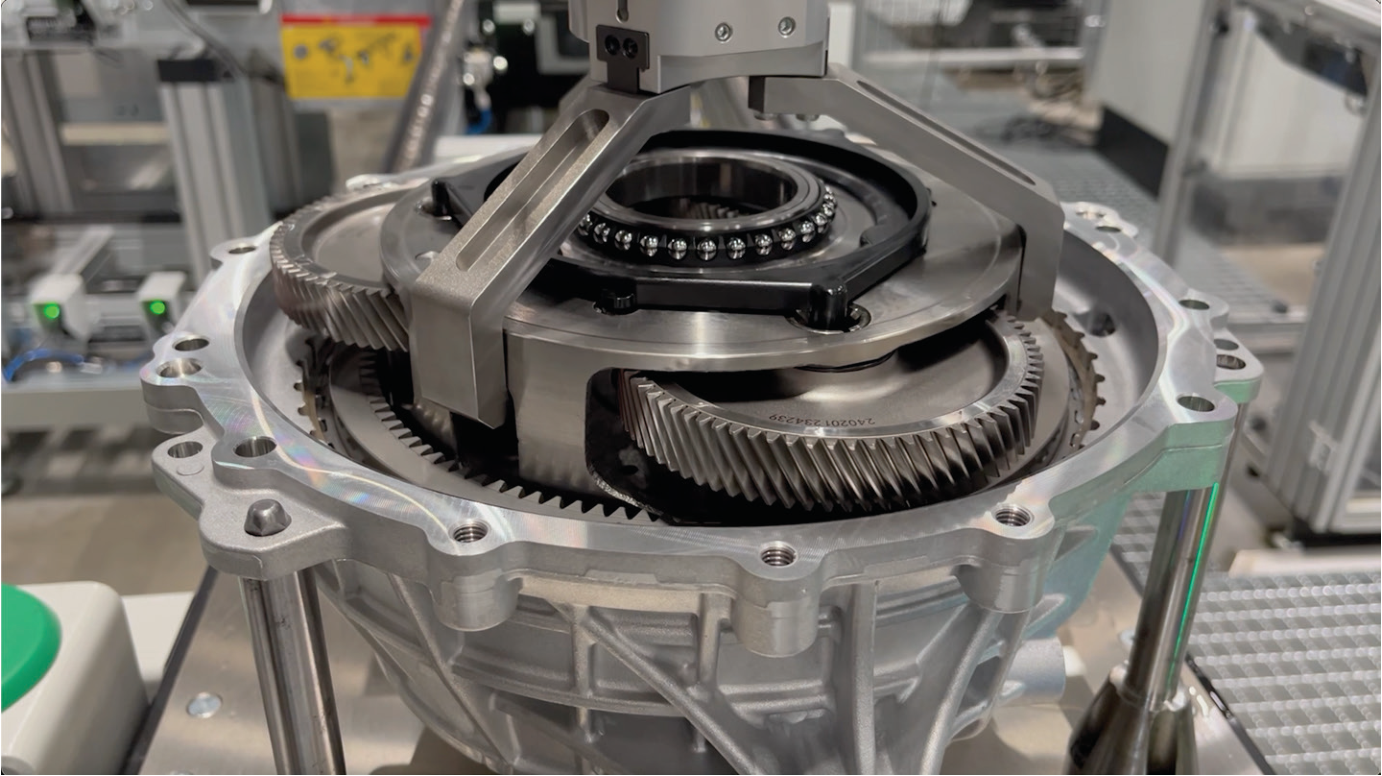
As an example, Busch cited Schaeffler AG in Herzogenaurach, Germany, which sought to improve the efficiency and accuracy of its gearbox assembly process. AICA developed the Smart Assembly module, enabling robots from different brands to adapt their movements between part batches in an hour. The gears must align precisely to mesh properly instead of grinding against one another.
To avoid applying excessive force and potentially damaging a gear, the AICA software employs force sensing, Busch said.
In test results from Schaeffler’s use case, AICA reports that the module achieved a 98% success rate, reduced downtime by 75% and lowered expenses by 40%.
Busch cautioned, however, that AI presents technical challenges, including the potential for a model to hallucinate and undermine user trust. “From a technical standpoint, you need to put protection in, like guardrails around the AI system in order to be sure that you can trust it statistically. If you put in your guardrail system correctly, then you can solve some, if not all, of the edge cases that you can identify.”
Another challenge is the human element, he added. For example, a manufacturing expert who fears that an AI-enabled robot will replace a job might not train the application faithfully. “The expert could say, ‘Hey, I don’t want the robot to replace me, so I’m just going to train the robot badly and blame it on the machine.’”
When trust issues are overcome, manufacturers can use AI systems to help robots perceive, learn and adapt in real time, Busch said. He advised against assuming that humanoid robots are needed to begin automating. “In my opinion, humanoid platforms are not necessarily reliable enough yet to be deployed in industrial settings. But you can absolutely do the same thing, almost, with one or two arms. If you need them to move, you can put them on a mobile platform.”
From Lab to Shop Floor
As physical AI matures, the robotics industry is shifting toward collaborative robots driven by sophisticated robotic foundation models rather than static, preprogrammed logic, said Andrew Pether, head of AI partnerships at North Reading, Massachusetts-based Teradyne Robotics, whose brands include collaborative-robot manufacturer Universal Robots and Mobile Industrial Robots.
To make that possible, AI models need to be trained properly. Much physical AI training is performed in laboratories, and models built there often cannot make the jump to a production line because they are not robust enough or were not trained on the same type of robot hardware used on the factory floor, Pether said. To help bridge that gap, Universal Robots developed the UR AI Trainer to collect high-fidelity data on production-grade robots so models can be trained under conditions similar to those in which they will run.
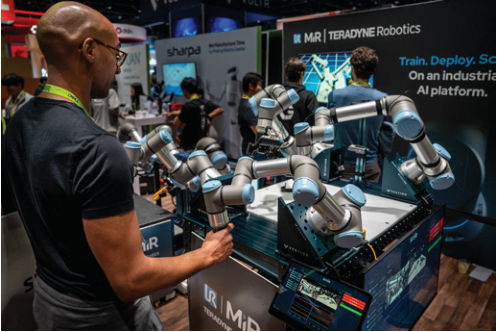
The modular UR AI Trainer uses leader and follower robots, Pether explained. A human operator guides the leader through real tasks while the follower mirrors the motion in real time. Integrated software captures synchronized motion, force and vision data for training AI models.
The follower robot uses production-ready grippers to grasp and manipulate objects while capturing the contact forces generated during a task. That force feedback distinguishes the AI Trainer from a system that records only motion: A model learns not only where the robot arm moved but how it interacted with the world, including grip pressure, contact resistance and the physical dynamics of a real task. Pether said that type of contact-rich data helps a model handle delicate or variable work when deployed.
CNC machine tending illustrates how force-torque data can change an application. Universal Robots cobots already handle many tasks without AI, but Pether said a conventional approach requires everything to be scripted in advance: exact pickup points, insertion angles and timing. A traditional program cannot sense what is happening at the point of contact. If a part is off by a few millimeters or a chuck does not seat where expected, the robot cannot adjust. Instead, the setup must be engineered to eliminate the variation, which takes time to program and can become brittle when conditions change.
A vision-language-action model trained on the UR AI Trainer’s contact-rich data changes that equation, he said. Because the model has learned what correct contact feels like — the grip force needed to seat a part and the resistance of a chuck closing correctly versus catching on something — the robot can respond to small variations in real time instead of requiring them to be programmed away. That enables the same task to run without the rigid, precisely structured setup traditionally required for machine tending.
The data behind that flexibility are substantial, Pether said. The UR AI Trainer synchronizes four image-data channels: a camera on each robot’s end effector and two scene-mounted cameras, one overhead and one aimed at the tabletop between the robots. It also records joint currents, velocities, accelerations and torque, capturing thousands of data points per second.
“The reason we gather all of this data is to model a better understanding of what the desired outcome is from the process,” Pether said. “As the integration of robotics and physical AI continues to rapidly evolve, the company’s industrial customer base will make robots even easier to use and more capable of performing a wider range of tasks. We strongly believe that this is going to be the way the majority of our robots will be deployed in the future.”
Related

Subscribers can use MFGAxis notes, saves and discussion tools with their innoNET account.