Hard-Job Specialist
Ceratizit's new six-flute endmill tackles titanium and super alloys with advanced geometries, delivering superior stability, cutting performance, and tool life.
An innovative new tool was engineered solely to meet the challenges of cutting titanium and heat-resistant super alloys.
Sold by Ceratizit USA LLC in Schaumburg, Illinois, the six-flute cutter is an addition to the company’s OptiLine series of solid-carbide endmills. It’s Ceratizit’s first six-flute endmill and its first cutter of any kind aimed right at titanium and super alloys, noted Scott Walrath, the company’s business development leader for solid round tools. Tasked with the job of developing a six-flute tool for these difficult-to-machine materials, Walrath suggested Ceratizit “build it from the ground up and optimize it.”
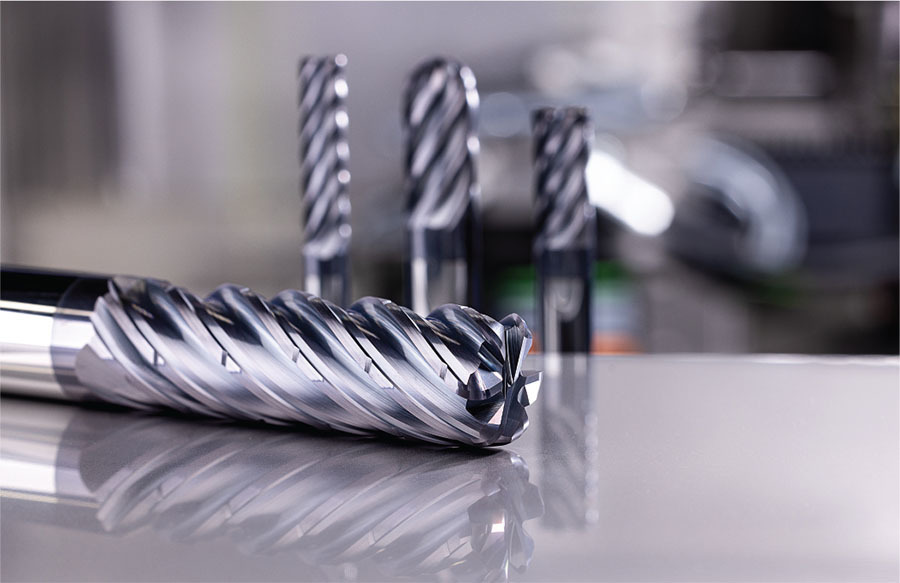
A new addition to Ceratizit’s OptiLine series of solid-carbide endmills, this six-flute tool was designed and developed to tackle the difficulties involved in machining titanium and heat-resistant super alloys. Ceratizit USA LLC
For the substrate, the developers chose CTS24Z, a proprietary Ceratizit carbide grade that provides high fracture toughness but isn’t quite as hard as other common options. For machining titanium and super alloys, “I was a big supporter of having a tougher grade with a little more ductility, as opposed to going to the other end of the spectrum for a harder material,” Walrath said. CTS24Z is more expensive than some other possible substrate choices, he added, “but there is a huge payback in terms of performance and lowering the price per cut.”
The substrate material’s high fracture toughness allowed Ceratizit “to get a little more aggressive” with the tool’s geometry, Walrath noted. So the developers came up with an asymmetrical flute design with a variable helix, variable index configuration. This means each tooth is oriented at a different helix angle and that the flutes are not evenly spaced, he explained. Designed to give the tool more cutting stability than endmills with a typical helix design, the asymmetrical configuration of the OptiLine endmill reduces vibration and extends tool life.
Review the print ads from this magazine to continue
This quick advertiser review unlocks the rest of the article and keeps the full-screen reader focused on the ads instead of the page chrome.
Advertisers included in this article experience
Print placements connected to this article
Cutting Tool Engineering
Access Cutting Tool Engineering anywhere
Read the digital edition on iOS, Android, or on the web through Cutting Tool Engineering’s digital magazine reader.
GET OUR APP! Stay informed and engaged! Access Cutting Tool Engineering magazine anytime, anywhere through our digital edition, available on iOS and Android devices in their respective app stores and at digital.ctemag.com. iOS and Android
Visit Cutting Tool Engineering View this placement in the issue recordPrint ads from this magazine
Read the digital edition on iOS, Android, or on the web through Cutting Tool Engineering’s digital magazine reader.
GET OUR APP! Stay informed and engaged! Access Cutting Tool Engineering magazine anytime, anywhere through our digital edition, available on iOS and Android devices in their respective app stores and at digital.ctemag.com. iOS and Android
Continue reading
October 2024
The new endmill also features a finer-than-normal grain structure that gives it a more homogenous cutting edge, Walrath noted. In addition, the endmill benefits from Ceratizit’s Dragonskin coating technology, which consists of multiple nanolayers that combine to protect tools and reduce adhesion during cutting.
Optimized for cutting titanium and super alloys, the endmill could find a home in shops serving a wide variety of industries, including aerospace, automotive, medical and energy. Walrath also pointed out that the tool could work “very well” cutting several kinds of steel, even though it wasn’t engineered to machine those materials.
As for cost, he said the tool is competitively priced, but shops should be prepared to pay “a little bit extra” for it. Despite the cost premium, however, he maintains that buyers are getting more than their money’s worth.
“Even though it’s running at an elevated speed and feed, it also can help you with extended tool life,” he said. “So if it can give you a 20% to 25% increase in performance and you also get 25% to 50% (longer) tool life, and if the tool costs 5% more than our competitors’ tools, to me it’s a no-brainer.”Glossary terms in this article