Groovy kind of process: People & Companies
When machining, specialty materials always have come with unique problems and solutions. With grooving specifically, working with materials like titanium alloys and heat-resistant superalloys is no exception. Experts have different suggestions for successful grooving but agree that it takes experience, the right tooling and patience.
When machining, specialty materials always have come with unique problems and solutions. With grooving specifically, working with materials like titanium alloys and heat-resistant superalloys is no exception. Experts have different suggestions for successful grooving but agree that it takes experience, the right tooling and patience.
Grooving falls into its own category in manufacturing. The process creates good clearances, offers flexibility and generates features that no other tooling can. Grooving even can run multiple operations with a single tool. The downside is that grooving doesn’t allow the same mechanical advantage as other methods. For example, a square tool is used to cut a round object that’s rotating quickly. This makes it more difficult to reliably hold the tool, perfectly line it up with the centerline of the rotating material and achieve a “perfect” groove. These challenges become even larger when specialty materials are introduced.
Physically Speaking
The physical differences among titanium alloys, HRSAs and “standard” materials, such as stainless steel and aluminum, go beyond what you might see if you look at them. Titanium alloys have high levels of nickel and chromium while HRSAs are exceptionally good at keeping heat away from material — a property that’s great in some situations but disastrous at a machine shop.
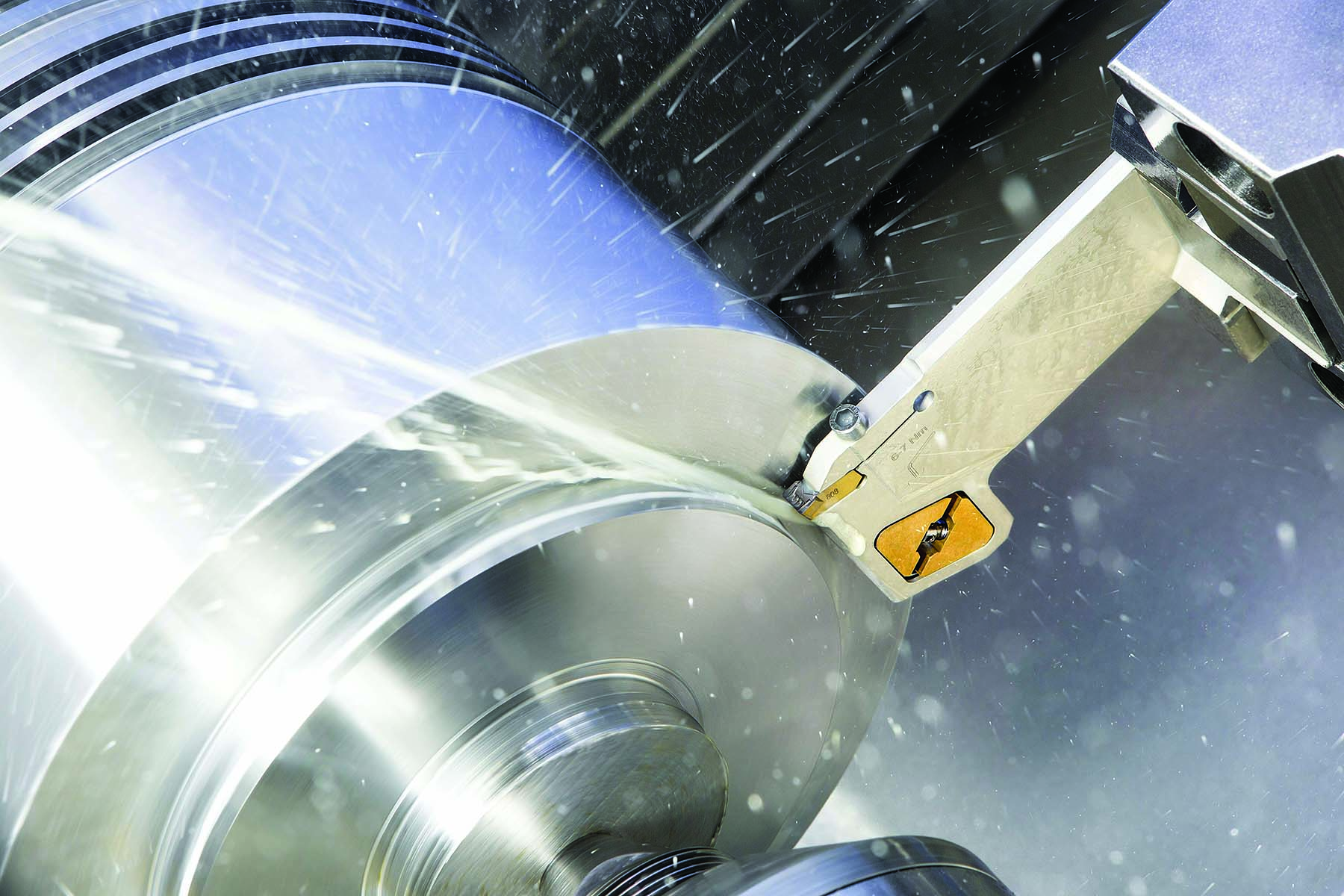
Coolant sprayed from channels within the tooling helps keep a tool from overheating. Image courtesy of Iscar USA
Due to these physical differences, titanium alloys and HRSAs cannot be cut reliably with the same tooling, speeds or even techniques as stock 6061 aluminum, for example. Sometimes people don’t understand these differences, so education can be hard. To address the first part of the equation, machinists need to combat the heat resilience of these materials.
Travis Coomer, national key account manager for Tavares, Florida-based GWS Tool Group, said it all comes down to how much heat is generated, where it goes and how it’s handled. Controlling heat is one of the main focuses of machining. That’s largely why feeds, speeds and tooling considerations matter in the first place.
“If you’re cutting HRSAs,” he said, “then the heat has only two places to go: the chip or the tool that is cutting.”
Machinists know that heat in a tool is rarely a good thing. It wears out tooling quicker and hurts machine performance. When tools wear out, they need to be replaced, which takes time and costs money.
While titanium alloys don’t feature the same heat resistance as HRSAs, they are equally as difficult to machine. Because the material is so much harder to cut due to the added nickel and chromium, extra heat and force are put into the grooving tool, shortening its life.
Tool chatter is another common issue while machining titanium alloys or HRSAs. With harder materials, more vibration is sent into the cutting head. This alters the precision of grooves and might lead to creating parts outside customer specifications.
Upgrading Tooling
For these problems, a best practice used across the industry is to opt for higher-tech tooling. Since it will be cutting into the material, shops prefer to use stronger, more durable, heat-resistant tooling.
Steve Vanderink, national product specialist for grip products at Arlington, Texas-based Iscar USA, pointed out tooling changes that improve the ability to groove specialty materials. He mentioned switching to submicron carbide tooling, thin physical vapor deposition coatings, high-sheer chipformers and coolant upgrades.
These upgraded tooling changes solve the problems associated with grooving titanium and HRSAs. Heat is diverted away from the tool, which allows cutters to last longer, produce more reliable results and reduce overall downtime. The trade-off is that these tooling changes cost a lot more than a traditional grooving tool that a shop might use to cut aluminum. It also means that shops without these tools can’t consistently groove specialty materials like titanium and HRSAs — creating a divide with shops that offer grooving.
All these technical advances help prolong tool life. Submicron carbide and PVD coatings improve the cutting ability and physical characteristics of tooling, permitting a tool to wear slower when it works on difficult materials like titanium. Better chipformers keep hot chips away from the material and tooling.
High-quality tooling used to cut HRSAs might have built-in holes and channels to support flowing coolant during machining. Keeping heat away from the tool and out of the part is a big focus in creating a good groove. With the introduction of coolant that was supplied directly through the cutting tool, heat became better controlled, letting tools last longer.
Review the print ads from this magazine to continue
This quick advertiser review unlocks the rest of the article and keeps the full-screen reader focused on the ads instead of the page chrome.
Advertisers included in this article experience
Print placements connected to this article
Platinumtooling
THE NAME TO KNOW FOR...
LIVE TOOLS / ANGLE HEADS / SPEED MULTIPLIERS SWISS COMPONENTS / MARKING TOOLS / KNURLING TOOLS Platinum Tooling is the exclusive North American importer of Heimatec Live Tools and Angle Heads, Tecnicrafts Swiss Collets and Guide Bushings, Henninger Spindle Speeders, AMF Cleaners and Quick Knurling and Marking Tools. Platinum Tooling offers a wide selection of machine tool accessories for most machine brands.
THE NAME TO KNOW FOR... LIVE TOOLS / ANGLE HEADS / SPEED MULTIPLIERS SWISS COMPONENTS / MARKING TOOLS / KNURLING TOOLS Platinum Tooling is the exclusive North American importer of Heimatec Live Tools and Angle Heads, Tecnicrafts Swiss Collets and Guide Bushings, Henninger Spindle Speeders, AMF Cleaners and Quick Knurling and Marking Tools. Platinum Tooling offers a wide selection of machine tool accessories for most machine brands, including standard and custom tools to help with the most challenging applications. If you need live tooling, we’re here to help. See Us At Booth #432245
Visit Platinumtooling View this placement in the issue recordKyocera Sgstool
V A L U E A T T H E S P I N D L E ®
Controlled Precision For High Production Holemaking Series 143M-S Coolant-Thru Drills Gain unparalleled performance in High Temp Alloy and Stainless Steel. Available in two lengths of cut, the single margin design is engineered to combat edge wear, hole deviation, and other issues commonly encountered during high production drilling operations
V A L U E A T T H E S P I N D L E ® Controlled Precision For High Production Holemaking Series 143M-S Coolant-Thru Drills Gain unparalleled performance in High Temp Alloy and Stainless Steel. Available in two lengths of cut, the single margin design is engineered to combat edge wear, hole deviation, and other issues commonly encountered during high production drilling operations.
Visit Kyocera Sgstool View this placement in the issue recordPrint ads from this magazine
LIVE TOOLS / ANGLE HEADS / SPEED MULTIPLIERS SWISS COMPONENTS / MARKING TOOLS / KNURLING TOOLS Platinum Tooling is the exclusive North American importer of Heimatec Live Tools and Angle Heads, Tecnicrafts Swiss Collets and Guide Bushings, Henninger Spindle Speeders, AMF Cleaners and Quick Knurling and Marking Tools. Platinum Tooling offers a wide selection of machine tool accessories for most machine brands.
THE NAME TO KNOW FOR... LIVE TOOLS / ANGLE HEADS / SPEED MULTIPLIERS SWISS COMPONENTS / MARKING TOOLS / KNURLING TOOLS Platinum Tooling is the exclusive North American importer of Heimatec Live Tools and Angle Heads, Tecnicrafts Swiss Collets and Guide Bushings, Henninger Spindle Speeders, AMF Cleaners and Quick Knurling and Marking Tools. Platinum Tooling offers a wide selection of machine tool accessories for most machine brands, including standard and custom tools to help with the most challenging applications. If you need live tooling, we’re here to help. See Us At Booth #432245
Continue reading
August 2022
Further Innovation
Vanderink mentioned the importance of specialty tooling grippers and named Iscar’s Heli-Grip, Whisper-IQ-Grip, Sumo-Grip and Dove-IQ-Grip — four tools used in four different scenarios.
The Sumo-Grip, for instance, has grooving blades with no top jaw. This allows better chip evacuation, keeping heat away from the part and tool. Also, for example, the Whisper-IQ-Grip changes how the cutting tool is held, permitting deeper grooves into titanium without additional chatter or tool breakage.
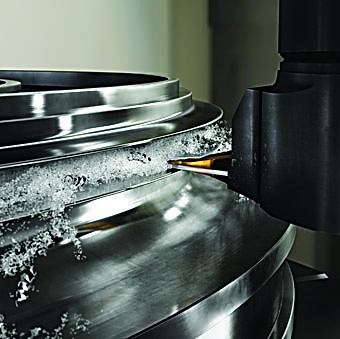
An industrial groover works on a large plate of titanium. Image courtesy of Sandvik Coromant
“High-quality, application-specific tooling with very specific characteristics is needed if a shop wants to machine successfully,” Vanderink said.
Working With Customers
Another part of the puzzle comes from customers. Whenever a shop works with specialty materials, the design of the part needs to be considered carefully. It’s also imperative that the customer understands the budgetary differences. Running titanium alloys requires a machine to cut slower, feed material slower and take more frequent breaks. These differences result in more time and attention on the machine, leading to higher quoted prices and longer turnaround times.
One option is to turn to a simpler solution: utilizing off-the-shelf goods. Often, determining if this is viable means having upfront conversations with the designer on the team at the customer, said Scott Lewis, aerospace industry specialist at Mebane, North Carolina-based Sandvik Coromant Co. In his experience, customers commonly need extra help when designing grooves for specialty materials. He said with more information at the start, suggestions can be made to save time and money and avoid customization.
A custom tooling solution might be required but often is unnecessary. Sometimes if a designer makes slight changes to a model, an off-the-shelf product can be used instead, which typically is preferred.
“Listen to the customer, and understand what they’re looking for,” Lewis said. “Show them what you offer (in terms of) tools and support services.”
He said doing so can cut down the quote and shed weeks from the total process.
Vanderink echoes that message.
“Provide a technical engineer to assist — or even better, partner up — with the customer’s application,” he said.
By receiving this level of guidance, a customer can understand better what options are available.
Lewis and Vanderink urge manufacturers to remember that customers might not have any knowledge of how titanium alloys and HRSAs react during grooving. Something simple to do with 304 stainless steel may require specialty inserts and tooling. If a designer has experience only with more generic metals, he or she will design a piece accordingly.
Through a combination of improved communication, specialized inserts, upgraded tooling and better coolant flow, shops can offer grooving options for titanium and HRSAs that were previously impossible. Better yet, shops can provide these solutions at more competitive prices and with faster turnaround times.