Improving the daily grind
Blaser Swisslube helps toolmaker reduce cycle times, grinding wheel dressing intervals, machine idle times and scrap while improving safety.
Based in the Bavarian town of Waakirchen, Germany, Werkzeugschleiferei Hugo Limmer produces a variety of carbide, ceramic and cermet standard and custom cutting tools and provides resharpening services for the mechanical engineering, aerospace and medical industries.
To improve the toolmaker’s production processes, company founder Hugo Limmer wanted a grinding oil that reduced cycle times, grinding wheel dressing intervals, machine idle times and scrap while improving process security and worker health and safety. He contacted a business partner of Stuttgart, Germany-based Blaser Swisslube GmbH for a solution. Together, they examined the grinding processes, looked for ways to optimize operations and decided to test Blaser Swisslube’s Blasogrind GTC 7 grinding oil in one of the toolmaker’s grinders.
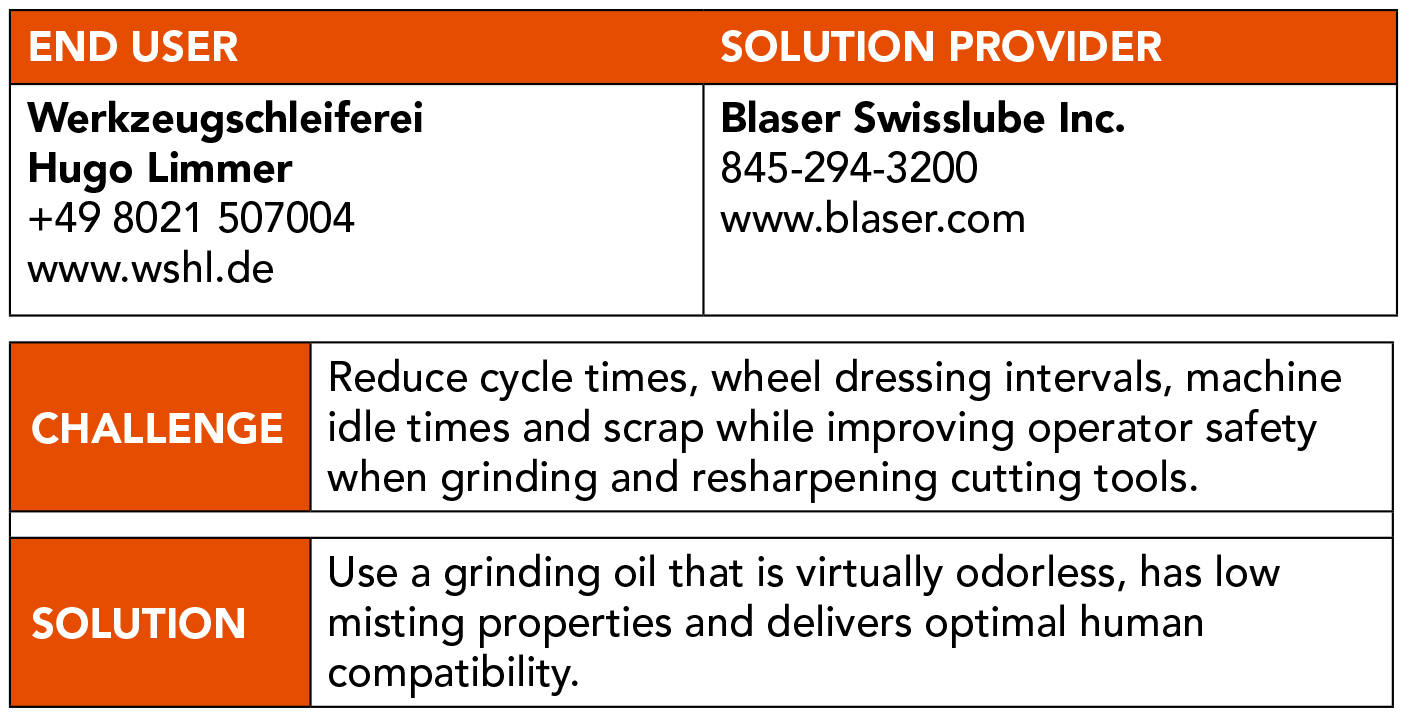
Tom Cappadona, product manager for gears, grinding and EDM at Blaser Swisslube Inc. in Goshen, New York, said the coolant manufacturer’s testing procedure involves performing a grinding operation with a Blaser Swisslube oil using the same parameters used for the competitor’s oil and then increasing the feed rate to reduce the cycle time when producing parts to the required level of quality, such as achieving the specified surface finish with no burns.He said Blaser Swisslube’s Liquid Tool analyzer allows existing conditions and costs to be documented and enables a projection to be made of what the company believes that it can achieve, which it calls a value proposal.”After the test is completed, we do what is called a value communication,” Cappadona said, “which verifies exactly what we were able to achieve, so the customer has one piece of paper showing the savings they can achieve.”Limmer said the new oil needed to be virtually odorless, have low misting properties and deliver optimal human compatibility.”At the same time,” he said, “we wanted to continuously improve productivity and quality to get the most out of the available resources and in this way add economic value.”By switching to Blasogrind GTC 7 grinding oil, machine efficiency improved by 15%.Cappadona said increasing throughput means that a manufacturer does not have to purchase additional machine tools and hire more workers to operate those machines as product demand increases.”It clearly saves them money at the end of the day,” he said. “Time is the No. 1 thing we are after, and it always, always, always overcomes the cost of the oil. The oil may be more expensive, but you get the money back based on performance.”Blasogrind GTC 7 reportedly contributes to a savings of nearly $80,000 per year at Werkzeugschleiferei Hugo Limmer.Werkzeugschleiferei Hugo Limmer Engineer Linus Erlacher (center right) examines a cutting tool with founder Hugo Limmer (center left) and Martin Reichhart, application engineer for Blaser Swisslube (far right), in front of a Rollomatic six-axis tool and cutter grinder.Image courtesy of Sonja Sindlhauser
A grinding oil that is well matched to all parameters, including the workpiece material, grinding wheels, machines and machining environment, can significantly impact the entire production process, said Martin Reichhart, application engineer for Blaser Swisslube.
“That’s why we examine all the details in order to find the ideal metalworking fluid,” he said. “When used correctly and complemented by customized services, the right metalworking fluid increases overall productivity.”
Review the print ads from this magazine to continue
This quick advertiser review unlocks the rest of the article and keeps the full-screen reader focused on the ads instead of the page chrome.
Advertisers included in this article experience
Print placements connected to this article
Archgp
Precision-ground,
high-performance solid carbide chamber reamers “ Fast is fine… engineered and produced but accuracy is everything.” specifically to your print. WYATT EARP Our new precision-ground chamber reamers are engineered to your specifications and enable your chambers to be produced quickly and with high- performance repeatability. Accuracy generating.
Precision-ground, high-performance solid carbide chamber reamers “ Fast is fine… engineered and produced but accuracy is everything.” specifically to your print. WYATT EARP Our new precision-ground chamber reamers are engineered to your specifications and enable your chambers to be produced quickly and with high- performance repeatability. Accuracy generating
Visit Archgp View this placement in the issue recordImts
SEPT. 12-17, 2022 • MCCORMICK PLACE, CHICAGO
FIND IT Technology demonstrated by Mazak MegaStir EXPERIENCE THE POWER OF HYBRID MACHINING Untitled-2 43 DIGITAL MANUFACTURING. IMPLEMENTED. MAZAK MEGASTIR Hybrid multitasking technologies can add immediate value through efficiency increases inherent in additive, hotwire, gear turning, and friction stir welding. Experience Mazak MegaStir.
FIND SEPT. 12-17, 2022 • MCCORMICK PLACE, CHICAGO IT Technology demonstrated by Mazak MegaStir EXPERIENCE THE POWER OF HYBRID MACHINING Untitled-2 43 DIGITAL MANUFACTURING. IMPLEMENTED. MAZAK MEGASTIR
Visit Imts View this placement in the issue recordPrint ads from this magazine
high-performance solid carbide chamber reamers “ Fast is fine… engineered and produced but accuracy is everything.” specifically to your print. WYATT EARP Our new precision-ground chamber reamers are engineered to your specifications and enable your chambers to be produced quickly and with high- performance repeatability. Accuracy generating.
Precision-ground, high-performance solid carbide chamber reamers “ Fast is fine… engineered and produced but accuracy is everything.” specifically to your print. WYATT EARP Our new precision-ground chamber reamers are engineered to your specifications and enable your chambers to be produced quickly and with high- performance repeatability. Accuracy generating
Continue reading
January 2022
According to Blaser Swisslube, Blasogrind GTC 7 is formulated to achieve high material removal rates, long dressing intervals and fine surface finishes. The oil also minimizes cobalt leaching, and fast air release promotes optimal cooling performance and prevents microcracks from forming in tools.
Cappadona said unlike some of the company’s predecessor products derived from crude oil, Blasogrind GTC 7 is a newer-generation gas-to-liquid product derived from natural gas.
“It starts out as natural gas,” he said, “eliminating all those impurities that come out of crude. We assemble those natural gas molecules to get the base oil that we want and then add the additives to get the formulation we are looking for. It is a much purer oil than some of the older-generation oils.”
Cappadona said if there is any mist with the gas-to-liquid oil, the droplets dissipate faster than those found in a fine mist, which can remain airborne and land on an operator if a grinding machine’s mist collection system isn’t adequate.
“It doesn’t feel oily,” he said. “It has a very gentle feel, and that is a benefit of the gas-to-liquid technology. It reduces skin irritation and dermatitis.”