

Cut like ant teeth: Research & Innovation
Learning from nature is one way of understanding what makes materials stronger and more damage-resistant.
Ever wonder how tiny creatures so easily can slice, puncture or sting? New research reveals that ants, worms, spiders and other minuscule beings have a built-in set of tools that would be the envy of any carpenter or surgeon.
A study published in the nature journal “Scientific Reports” shows for the first time how individual atoms of zinc are arranged to maximize cutting efficiency and maintain the sharpness of these exquisitely constructed animal tools. A collaboration between a research team at the University of Oregon and the U.S. Department of Energy’s Pacific Northwest National Laboratory revealed how tiny creatures cut and puncture with relative ease.
Consider the tooth of an ant. Yes, ants have teeth as anyone who has stepped on an ant mound can attest. These specialized structures — technically called mandibular teeth because they are attached outside the mouth — are made of a network of materials that tightly bind individual atoms of zinc. The effect is a mandible that packs more than 8% of the tooth weight with zinc.
These kinds of specialized critter tools have been a decadeslong fascination for associate professor Robert Schofield, who led the study. His team of biophysicists has developed techniques to measure hardness, elasticity, energy of fracture, abrasion resistance and impact resistance on a miniature scale.
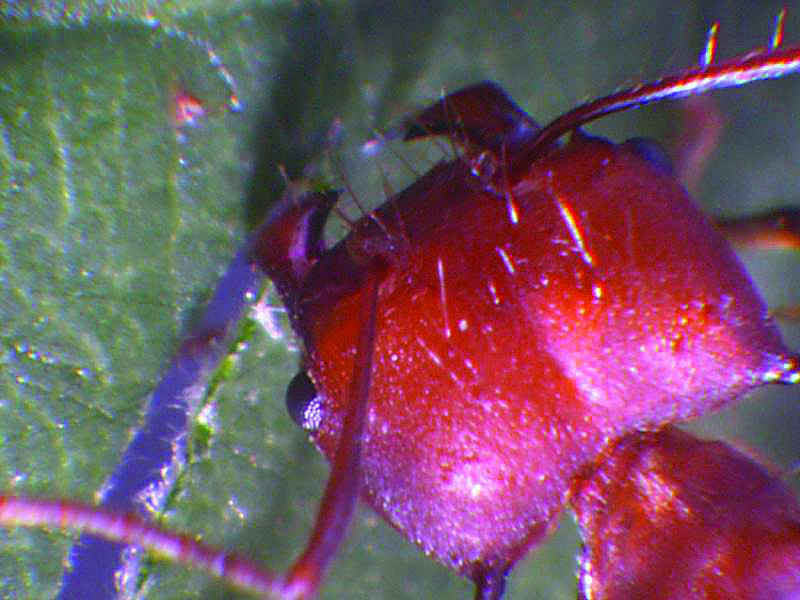
Arun Devaraj works in the lab. Ant mandibles (top photo) pack a powerful bite thanks to embedded atoms of zinc. Image courtesy of Pacific Northwest National Laboratory
But the team couldn’t actually see the structure of the materials that make up ant teeth and other microscopic animal tools, especially at the atomic scale. That’s where PNNL Materials Scientist Arun Devaraj and doctoral intern Xiaoyue Wang entered the picture. Devaraj is an expert in the use of a specialized microscope technique called atom probe tomography. He used a focused ion beam microscope to take a tiny needle sample from the tip of an ant tooth and then imaged that needle sample using atom probe tomography, allowing the team to identify how individual atoms are arranged near the tip of an ant tooth.
Using this technique, Devaraj and Wang recorded for the first time the nanoscale distribution of zinc atoms in the tooth of an ant.
Review the print ads from this magazine to continue
This quick advertiser review unlocks the rest of the article and keeps the full-screen reader focused on the ads instead of the page chrome.
Advertisers included in this article experience
Print placements connected to this article
Imts
SEPT. 12-17, 2022 • MCCORMICK PLACE, CHICAGO
FIND IT Technology demonstrated by Mazak MegaStir EXPERIENCE THE POWER OF HYBRID MACHINING Untitled-2 43 DIGITAL MANUFACTURING. IMPLEMENTED. MAZAK MEGASTIR Hybrid multitasking technologies can add immediate value through efficiency increases inherent in additive, hotwire, gear turning, and friction stir welding. Experience Mazak MegaStir.
FIND SEPT. 12-17, 2022 • MCCORMICK PLACE, CHICAGO IT Technology demonstrated by Mazak MegaStir EXPERIENCE THE POWER OF HYBRID MACHINING Untitled-2 43 DIGITAL MANUFACTURING. IMPLEMENTED. MAZAK MEGASTIR
Visit Imts View this placement in the issue recordPrint ads from this magazine
FIND IT Technology demonstrated by Mazak MegaStir EXPERIENCE THE POWER OF HYBRID MACHINING Untitled-2 43 DIGITAL MANUFACTURING. IMPLEMENTED. MAZAK MEGASTIR Hybrid multitasking technologies can add immediate value through efficiency increases inherent in additive, hotwire, gear turning, and friction stir welding. Experience Mazak MegaStir.
FIND SEPT. 12-17, 2022 • MCCORMICK PLACE, CHICAGO IT Technology demonstrated by Mazak MegaStir EXPERIENCE THE POWER OF HYBRID MACHINING Untitled-2 43 DIGITAL MANUFACTURING. IMPLEMENTED. MAZAK MEGASTIR
Continue reading
January 2022
“We could see that the zinc is uniformly distributed in the tooth, which was a surprise,” Devaraj said. “We were expecting the zinc to be clustered in nanonodules.”
The team estimated that because these biomaterials can be sharper, they make it possible for animals to use 60% or even less of the force that would be necessary if the tools were made of materials similar to what’s found in human teeth. Because less force is required, smaller muscles spend less energy. These advantages may explain why every spider, ant, worm and crustacean, as well as many other organisms, have these specialized tools.
“Human engineers might also learn from this biological trick,” Schofield said. “The hardness of ant teeth, for example, increases from about the hardness of plastic to the hardness of aluminum when the zinc is added. While there are much harder engineering materials, they are often more brittle.”
Devaraj said learning from nature is one way of understanding what makes materials stronger and more damage-resistant. He is using a DOE Early Career Award to study these principles at the atomic scale.
“By studying steel microstructure also at the atomic scale,” he said, “we can better understand how altering the composition of materials changes its damage resistance, specifically stress corrosion resistance and behavior over time.”
— Karyn Hede
Glossary terms in this article
Related

 MFGAxis Discussion
Be part of the shop-floor conversation
Like, save, or comment on this CTE story.
MFGAxis Discussion
Be part of the shop-floor conversation
Like, save, or comment on this CTE story.


MFGAxis Discussion