Detect spindle anomalies: Digitalization & Industry 4.0
To reduce scrap and improve productivity, the Artis GEMDS system from Marposs Corp., Auburn Hills, Michigan, detects spindle anomalies in real time. This helps shops prevent damage to machines and avoid out-of-tolerance components. The system uses data from a noncontact eddy current sensor to monitor spindle elongation on machine tools due to temperature changes or other causes of displacement.
To reduce scrap and improve productivity, the Artis GEMDS system from Marposs Corp., Auburn Hills, Michigan, detects spindle anomalies in real time. This helps shops prevent damage to machines and avoid out-of-tolerance components. The system uses data from a noncontact eddy current sensor to monitor spindle elongation on machine tools due to temperature changes or other causes of displacement.
“During machining processes in machine tools, temperature variations occur,” said Product Manager Jorge Pena. “And in most cases, these variations are the cause of spindle growth, which leads to poor workpiece quality and damages.”
The system gives early feedback if set limits are exceeded.
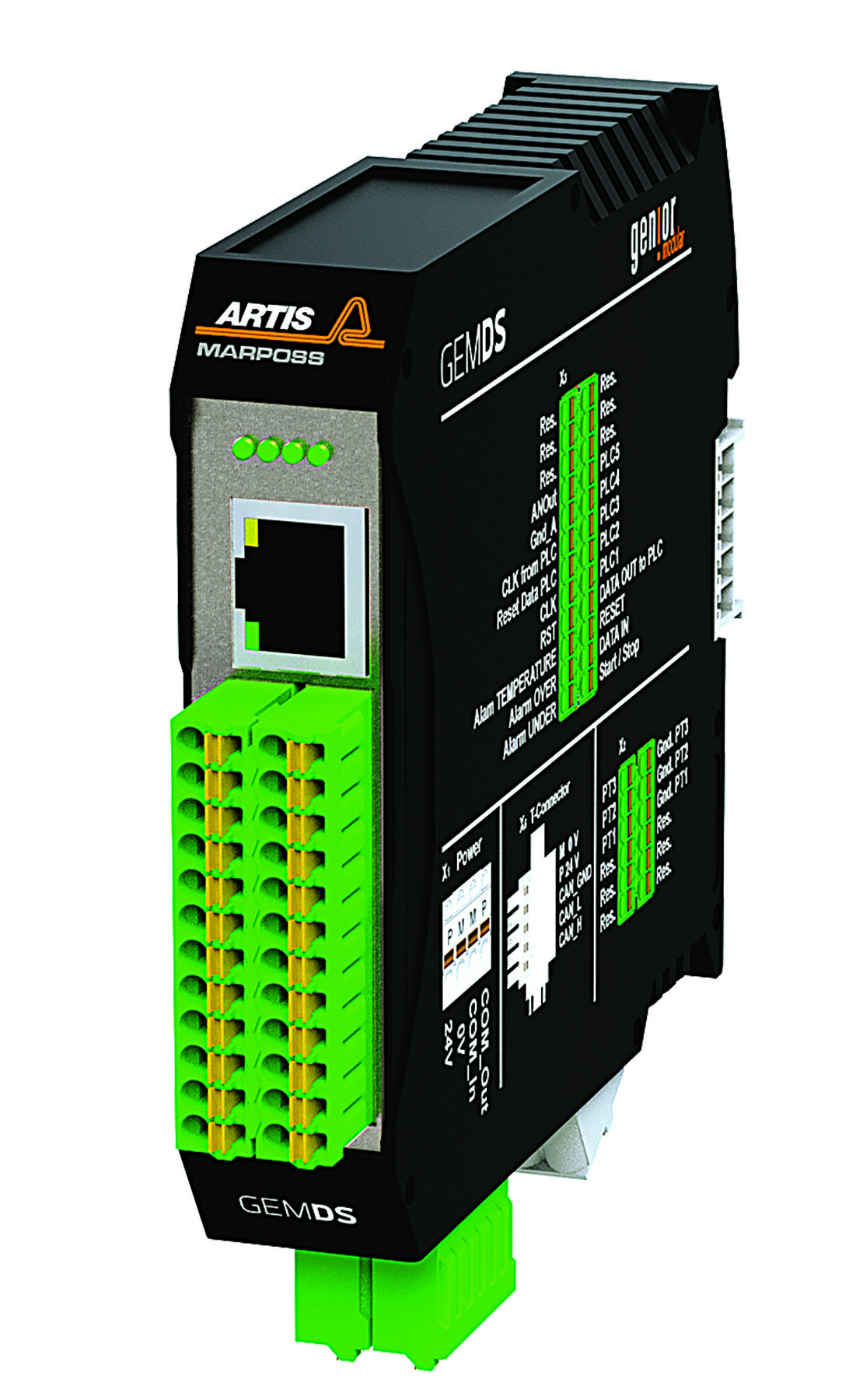
The GEMDS module. Image courtesy of Marposs
“The GEMDS system uses contactless sensors to measure the variation of the distance of a specific target and then either generates alarms to stop the machine or transmits the information to the numerical control to provide a compensation,” Pena said.
The system consists of the eddy current sensor, an amplifier, a connecting cable and a monitoring module. Four different sensor signals can be monitored — one for displacement and three for temperature — sharing real-time feedback on critical variations. GEMDS has a measuring range of 550 µm (0.022″) and precision down to ±0.2 µm (0.000008″).
Review the print ads from this magazine to continue
This quick advertiser review unlocks the rest of the article and keeps the full-screen reader focused on the ads instead of the page chrome.
Advertisers included in this article experience
Print placements connected to this article
Toolflo
The Threading & Grooving Specialist!
Solution for Chip Control in Grooving! FLOCUT MULTI-FUNCTIONAL GROOVING TOOLS Stable Locking System for your grooving application! Excellent stability allows for increased depth of cut! Superior breaker designs for better chip control! √ grooving √ face grooving √ deep grooving √ side turning √ cut off √ internal & external.
The Threading & Grooving Specialist! Solution for Chip Control in Grooving! FLOCUT MULTI-FUNCTIONAL GROOVING TOOLS Stable Locking System for your grooving application! Excellent stability allows for increased depth of cut! Superior breaker designs for better chip control! √ grooving √ face grooving
Visit Toolflo View this placement in the issue recordPrint ads from this magazine
Solution for Chip Control in Grooving! FLOCUT MULTI-FUNCTIONAL GROOVING TOOLS Stable Locking System for your grooving application! Excellent stability allows for increased depth of cut! Superior breaker designs for better chip control! √ grooving √ face grooving √ deep grooving √ side turning √ cut off √ internal & external.
The Threading & Grooving Specialist! Solution for Chip Control in Grooving! FLOCUT MULTI-FUNCTIONAL GROOVING TOOLS Stable Locking System for your grooving application! Excellent stability allows for increased depth of cut! Superior breaker designs for better chip control! √ grooving √ face grooving
Continue reading
July 2020
“The system monitors the displacement of spindle and machine parts before and during machining,” Pena said.
GEMDS functions as an intelligent stand-alone solution installed on a mounting rail in a switch cabinet. All necessary interfaces are available for easy integration into existing controls, network environments and Industry 4.0 solutions. As part of the Genior Modular product family, the system can be integrated into a Genior modular monitoring system for process monitoring purposes, creating a flexible solution to adapt to changing needs.
“The modular system design can be configured to a dedicated system or machines or added to systems as needed,” Pena said. “It is preferable for a high-precision machine process.”
He said GEMDS improves process reliability thanks to continuous monitoring of machining operations. The system helps increase productivity and workplace quality, better utilizes a machine and allows integration of tools with sensors.
Pena said although GEMDS is capable of measuring phenomena that vary slowly like thermal variation or leakage of fluid, the system also measures other phenomena, such as planarity error, misalignment and eccentricity of rotating parts.
For more information about Marposs, call 248-370-0404 or visit www.marposs.com.