Perks of fiber lasers
Machine shops don't have to be experts with fiber laser cutting technology to know that if they can cut a 6.35 mm (0.25") plate with a 4-kW laser, they can cut faster with an 8-kW laser power source, let alone a 12-kW or 15-kW fiber laser cutting machine.
Machine shops don’t have to be experts with fiber laser cutting technology to know that if they can cut a 6.35 mm (0.25″) plate with a 4-kW laser, they can cut faster with an 8-kW laser power source, let alone a 12-kW or 15-kW fiber laser cutting machine.
The main benefit of high-powered fiber laser technology is decreased process time for laser cutting. That’s often why a shop buys a high-powered laser cutting machine to replace two or even three old lasers. Parts can come off a laser bed more quickly and, accordingly, cheaply than before. But those are not the only perks.
“Pulsed fiber lasers offer numerous advantages compared with traditional fabrication methods, such as mechanical cutting, stamping and electrical discharge machining,” said Thomas Schreiner, product line manager for Coherent Munich GmbH & Co. KG, Gilching, Germany. (Coherent Inc. is in Santa Clara, California.) “The laser can be extremely spatially selective. It can be focused to a spot diameter much smaller than the width of a mechanical blade or saw, enabling the creation of finer details with greater precision.”
He said a fiber laser typically produces a high-quality edge that requires no post-processing, reducing overall costs. Also, unlike with a drill or an EDM tool, noncontact laser processing involves no tool wear, so consistent, uniform results are delivered.
Lasers in Use
Schreiner gave an example of an application that illustrates the advantages of laser cutters. Bone drill bits, such as craniotomes, now are made routinely by laser cutting. These stainless steel devices have small, sharp edges. The use of pulsed fiber laser cutting avoids heating the bulk of the material, virtually eliminating thermal transformation, which otherwise could render these edges prone to break off. Also, the correct function of the drill depends on the precise geometry of various features — like the cutting edge, rake face and flank face — so the superior spatial accuracy of laser cutting is ideal for creating these instruments.
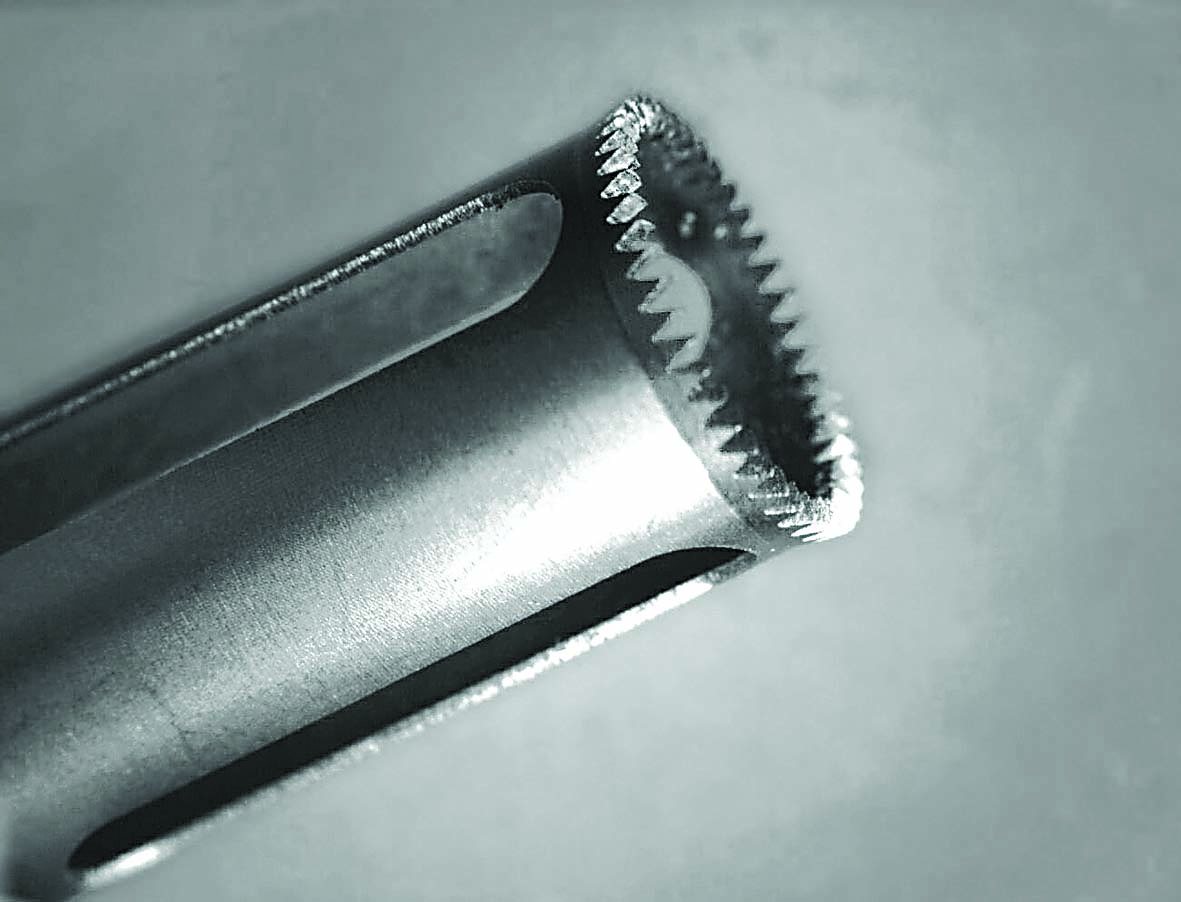
Laser cutting is ideal for creating tools like craniotomes and other drill bits. Image courtesy Coherent
In terms of the laser technology, Coherent offers a comprehensive range of lasers with pulse widths from milliseconds to femtoseconds, output power from tens of watts to multikilowatts and wavelengths from deep ultraviolet to midinfrared. For medical devices, many applications are well served by near infrared lasers in the tens-of-watts power range with adjustable pulse widths, such as the fiber laser technology in Coherent’s StarFiber 100-600 fiber laser machine.
Common Composites
Composites are structures in which two or more materials combine to produce a material whose properties would not be attainable by conventional means. An example is carbon fiber-reinforced polymer, which is constructed by two materials — carbon fiber and polymer matrix — that have significantly different properties.
Ronald Schaeffer, CEO of HH Photonics, New Ipswich, New Hampshire, said numerous laser job shops are familiar with the challenges of machining FR-4, which is glass-reinforced epoxy laminate material. An overwhelming proportion of the composite dielectric material used in the interconnect industry remains FR-4, though a lot of other materials, including CFRP, are used extensively in the aerospace industry. CFRP is finding its way into a host of new applications and is amenable to laser processing, cutting, drilling and structuring.
He is former CEO of a laser materials processing company, Pelham, New Hampshire-based PhotoMachining Inc., which has an array of laser tools ranging in wavelength from 248 nm in UV to 10 µ (0.0004″) CO2 in infrared and with pulse lengths ranging from milliseconds to femtoseconds. This includes fiber lasers that operate in infrared with pulse lengths in the hundreds of nanoseconds.
Schaeffer said how these laser tools are used depends on the application and the power of a laser. High-energy lasers can “punch” through many materials in one pulse, which effects faster processing but results in losing some control. Lower-energy beams can be rapidly multipassed, which usually results in better cut quality and smaller feature sizes — if a small kerf is used — but at the sacrifice of processing speed. To enhance cut cleanliness, laser contract manufacturers like PhotoMachining typically design laser machines with the smallest usable kerf.
“If we squeeze that energy per pulse down into a very small spot and keep the pulse length as short as possible,” he said, “it results in high peak power intensity, which is the key to clean processing.”
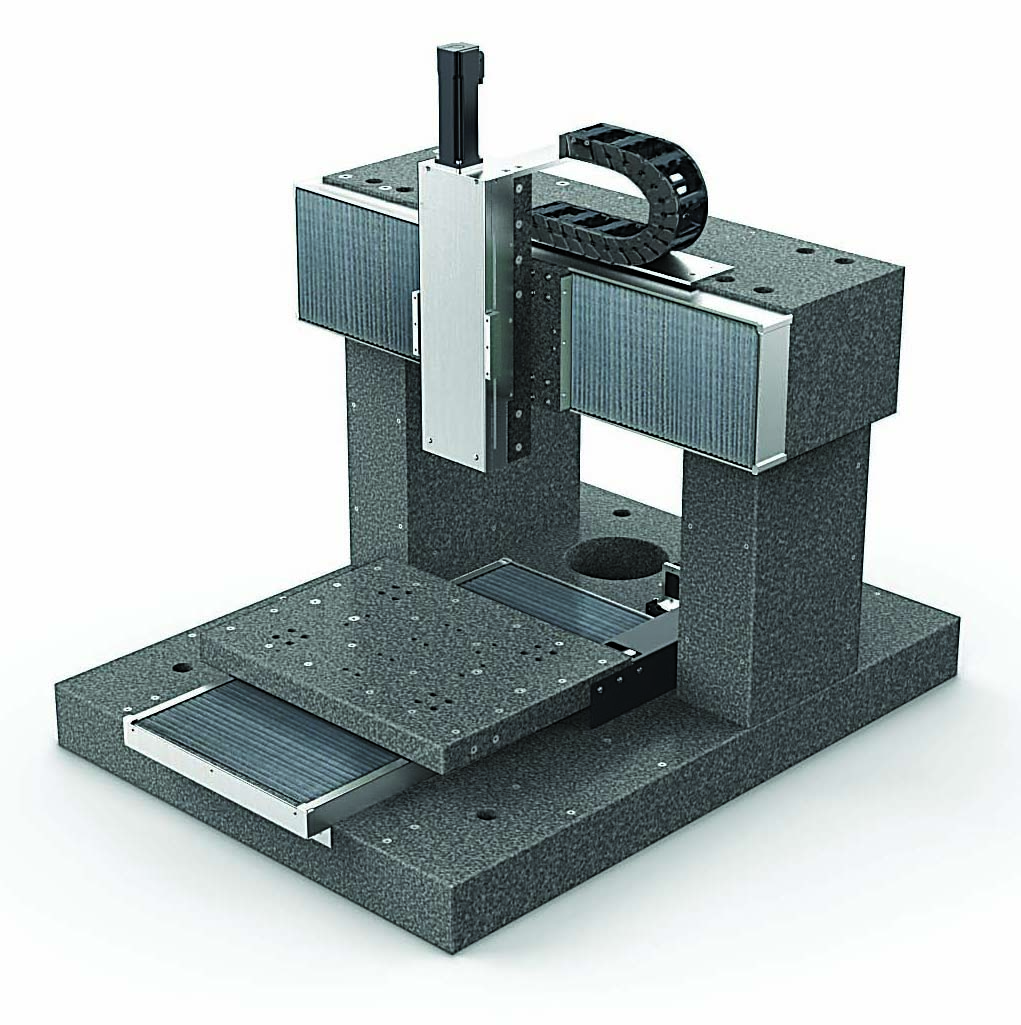
The use of a granite-based motion module ensures dimensional accuracy and repeatability with the ExactCut system. Image courtesy of Coherent
PhotoMachining uses a Lumera UV laser with a 12-picosecond pulse and 20-W to 100-W Q-switched fiber lasers with pulses of 100 nanoseconds and shorter for micromachining composites. Even so, PhotoMachining often laser-machines composites in multiple passes to allow heat to dissipate between them, Schaeffer said. He said cutting a feature, such as a hole, in a single pass is quicker, but the quality isn’t as high.
“The ability to tailor properties, combined with the inherent low density of the composite and its relative ease of fabrication, makes this material an extremely attractive alternative for many different industrial sectors but primarily the aerospace sector,” said Mohammed Naeem, director of business development and special projects at Prima Power Laserdyne LLC, Brooklyn Park, Minnesota.
Delamination, fiber pulling out, matrix chipping, heat damage and tool wear generally represent the main concerns when machining composites. These materials require processing like cutting, drilling and milling, typically using traditional machine tools.
Laser Versus Water
Aerospace companies recently have been investing in waterjet technology for cutting CFRP.
“Waterjet can give a high-quality cut,” Naeem said, “but this has associated problems of causing delamination and requires a pilot hole to be drilled mechanically if the cutting process starts anywhere other than at the edge of the sheet.”
“Waterjet cutting is a subtractive manufacturing technique, but it uses pressurized water focused in a very small point to cut the material,” said Alexei Markevitch, market development manager at IPG Photonics Corp., Oxford, Massachusetts.
The pressure can be as high as 27,216 kg per square inch (60,000 psi). Water may be mixed with an abrasive, such as garnet, which increases cutting possibilities by allowing more materials or closer tolerances.
Waterjet cutting is ideal for stone, ceramics and thicker metals, which are more difficult to process by laser cutting or other methods. Unlike other material removal processes, waterjet systems can cut extremely hard, reflective and nonconductive materials, making waterjet an efficient, productive method.
Composites machine differently from metals and therefore can be challenging to cut. Although shops have applied traditional cutting tools and alternatives like waterjetting to cut composites, interest in using lasers is growing for some applications.
Lasers cut a wide range of materials: all plastics, woods and metals, excluding highly reflective metals. Lasers also process ceramics, sapphire, silicon, glass, diamond, polymers, epoxy and composites but often require different wavelengths or modes of operation, Markevitch said.
Review the print ads from this magazine to continue
This quick advertiser review unlocks the rest of the article and keeps the full-screen reader focused on the ads instead of the page chrome.
Advertisers included in this article experience
Print placements connected to this article
Millrose
RobbJack
A comparison is shown of the surface finish imparted when applying (left) and not applying (right) a Mirror Edge tool. Mill-Rose... the Big Name in Tiny Brushes. Mill-Rose is the nation's largest manufacturer of twisted wire brushes, large and small. Real small. We've been making brushes since 1919. Millions of them! In every size, shape and.
RobbJack A comparison is shown of the surface finish imparted when applying (left) and not applying (right) a Mirror Edge tool. Mill-Rose... the Big Name in Tiny Brushes. Mill-Rose is the nation's largest manufacturer of twisted wire brushes, large and small. Real small. We've been making brushes since 1919. Millions of
Visit Millrose View this placement in the issue recordPrint ads from this magazine
A comparison is shown of the surface finish imparted when applying (left) and not applying (right) a Mirror Edge tool. Mill-Rose... the Big Name in Tiny Brushes. Mill-Rose is the nation's largest manufacturer of twisted wire brushes, large and small. Real small. We've been making brushes since 1919. Millions of them! In every size, shape and.
RobbJack A comparison is shown of the surface finish imparted when applying (left) and not applying (right) a Mirror Edge tool. Mill-Rose... the Big Name in Tiny Brushes. Mill-Rose is the nation's largest manufacturer of twisted wire brushes, large and small. Real small. We've been making brushes since 1919. Millions of
Continue reading
July 2020
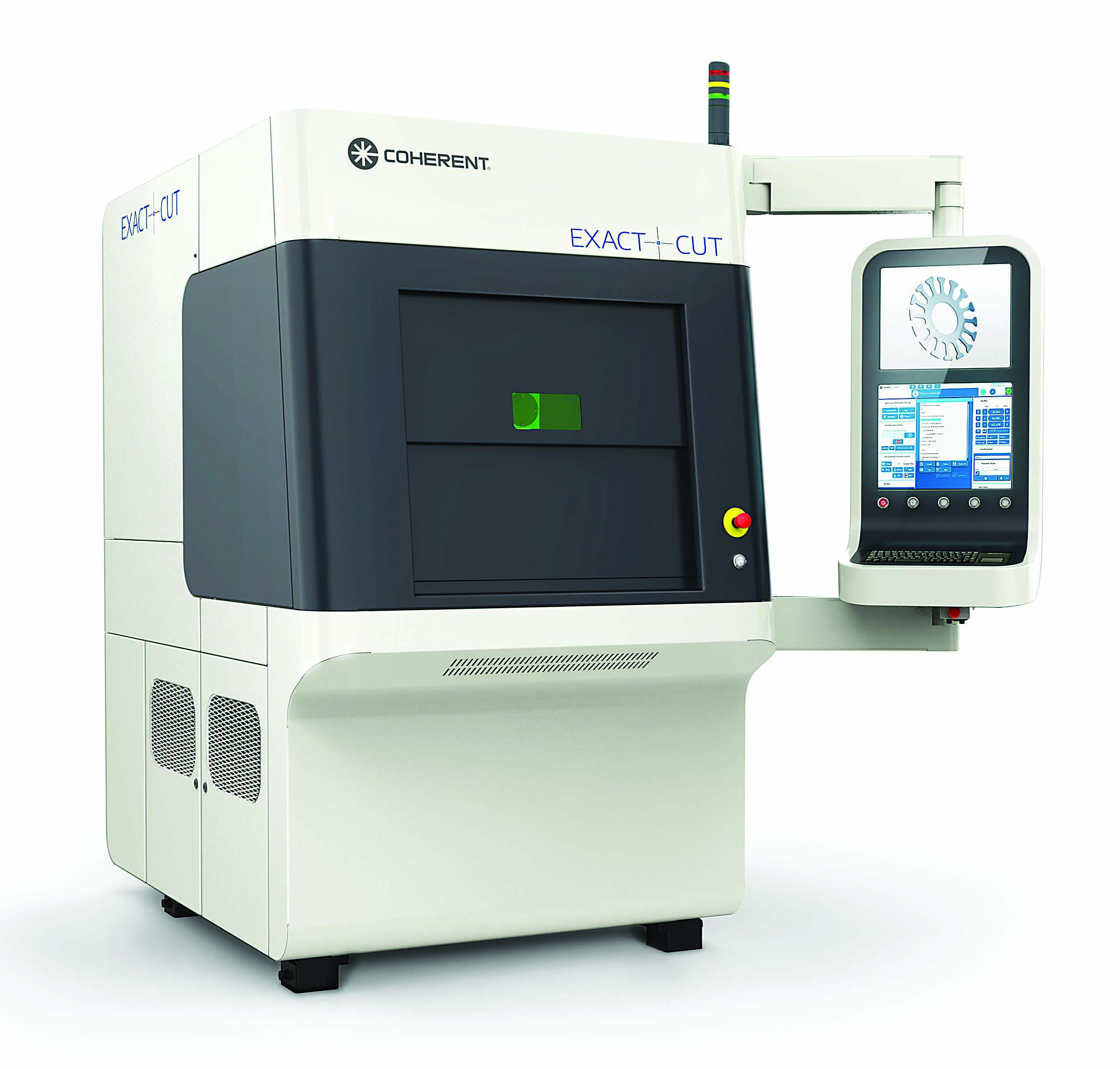
Ready for Industry 4.0 and the industrial internet of things, the ExactCut is a fully self-contained laser cutting system for medical devices. Image courtesy Coherent
“For example, (quasi-continuous wave) 1µ (0.00004″) lasers are versatile and can cut both metals and many nonmetals,” he said. “There is a specialized laser type for virtually any cutting requirement while the same waterjet can easily switch from paper to metal to rubber. Also, CO2 gas lasers operating at 10 µ wavelength give versatility similar to waterjet, capable of cutting a wide range of metals and nonmetals.”
Laser cutting is faster and more energy efficient than plasma cutting for thin or medium-thickness sheet metal, most commonly steel or aluminum. Laser cutting generally has not been possible for thicker stock, but today’s higher-wattage machines — 7-kW and up — are approaching the capabilities of plasma cutting.
Importantly, fiber laser technology effectively eliminates bend mirrors and the need for beam adjustment and alignment, which improves consistency.
The optimal thickness for cutting with a waterjet machine is between 10.2 mm (0.4″) and 50.8 mm (2″) while for a laser machine it is 3 mm (0.1″) and 10.2 mm.
Markevitch said laser cutting is much more precise than waterjet cutting.
“The minimum size of the cutting slit is 0.006″ (0.152 mm) for laser cutting and 0.02″ (0.51 mm) for waterjet,” he said. “As for their processing tolerance, it is of approximately 0.002″ (0.051 mm) for laser cutting and 0.008″ (0.203 mm) for waterjet cutting.”
Danger of Delamination
Each technique poses its own problems regarding part integrity. Laser and waterjet machines both can slightly damage material during manufacturing.
Laser cutting can cause burn marks on material and make the cut sides dark. In some cases, the marks may be removed by cleaning.
While waterjet cutting doesn’t require heat, it applies very high forces to material. This might result in difficulties for small parts, which could become deformed or impossible to cut.
Laser cutting involves low risk, little waste and not much cleanup. But with some materials, produced dust and smoke can be slightly toxic, so proper ventilation is essential. Noise pollution also is low with laser cutting, and a machine doesn’t need much cleaning, though thermal stress can occur in heat-affected zones.
Waterjet cutting involves more risk, much noise pollution and more cleanup. Also, a cutting area becomes quite messy, with large quantities of cutting waste caused by mixing water and abrasives.
Heat-affected zone charring, delamination and epoxy recession due to intense thermal damage have been major obstacles for industrial applications of laser machining composites, Naeem said.
Prima Power Laserdyne has used fiber lasers to machine CFRP. He said the big advantage of a fiber laser is its high-quality beam, which results in a very small focal point, allowing composite material to be processed with minimal thermal damage to the matrix.
Surface texturing composites is a viable replacement for mechanical abrading, enabling better control over the final structured surface. This ability to machine on a microscale could create a role for fiber lasers in the aerospace industry as a new tool for laser milling fine structures involving CFRP.
Naeem said it is possible to use the new generation of fiber lasers for both the macroapplication of laser cutting and the microapplication of laser surface texturing.
“The cut-edge quality compared with mechanical cutting is superior, though surface damage may remain an issue,” he said. “Work is in progress to reduce this damage further and increase the cutting speed.”
Who Needs It?
Not all shops need a high-powered laser, particularly if they don’t have enough work to load their current laser cutting machine. If laser cutting work is not expected to grow and consumes just half a workshift, then paying for a more powerful laser to reduce the workload to a quarter of a shift likely won’t deliver a good return on investment.
But shops that have maximized their laser cutting capacity and are looking to add a shift should consider a high-powered laser. This is especially true if they use old laser technology. At a time when shops struggle to find reliable, experienced operators, investing in a fast, efficient fiber laser also may reduce the number of needed laser operators.
What Wattage
How powerful of a fiber laser does a shop need? A company should look at the thickness range that makes up 80% of shop work. If work is really thin gauge, a 15-kW laser likely is not needed.
Here are general rules for cutting common metals, such as steel, stainless steel or aluminum with nitrogen:
- Up to 9 gauge — 6-kW to 8-kW
- 6.35 mm (0.25″) to 19.05 mm (0.75″) — 8-kW to 10-kW
- Over 19.05 mm — 8-kW to 15-kW
Keep in mind that a shop with a high-powered machine can produce more parts per hour and part cost plummets as power goes up. But this occurs only if a laser cutting machine is quick enough to maximize the power.
Operating costs probably will rise as the power level of a fiber laser cutting machine goes up. Doubling the power generally increases laser operating costs by 20% to 30%. It’s very important for a fiber laser to operate at peak efficiency so part cycle time can be decreased to offset higher operating costs. By decreasing cycle time, a shop can reduce the impact of variable and fixed costs and increase profitability.
— Yesenia Duran
Glossary terms in this article