

Swap toolholders in 30 seconds or less
Swiss-Style Machining: The Arno Fast Change system from Arno-Werkzeuge provides fast setups and reduces the downtime.
Anyone who’s set up a Swiss-style automatic lathe knows that replacing cutting tools can be challenging, frustrating and time-consuming. The quarters are cramped, and the screws and inserts are often tiny. For shops applying through-coolant tools, the lines and hoses needed to plumb toolholders are harder to reach than those underneath a kitchen sink. Worse, they tend to snag long, stringy chips, presenting the possibility of a crash if a nest of chips gets caught between the main spindle and subspindle when transferring a part or when using some type of autoloader.
Arno-Werkzeuge USA LLC, Harvard, Illinois, introduced a line of Swiss-style tooling named the Arno Fast Change system to provide fast setups and reduce the downtime associated with in-process tool changes. The AFC holder also eliminates the need for the chip-snagging copper or plastic lines commonly used to plumb the toolholders.
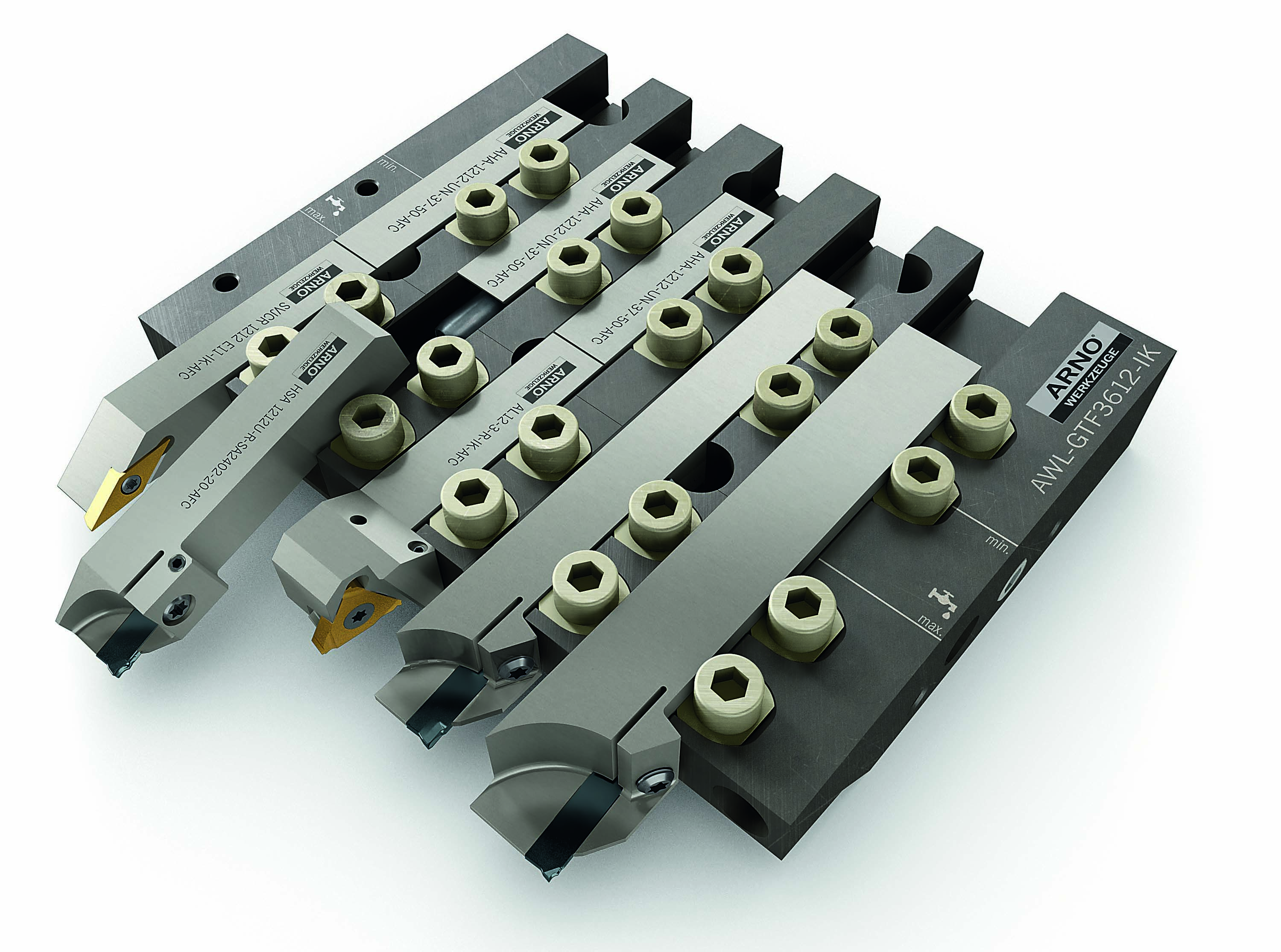
The AFC system is available for Citizen A20 and L20 machines but will soon expand to include other makes and models of Swiss-style lathes. Image courtesy of Arno-Werkzeuge USA
The company does mean fast. “You can swap toolholders in 30 seconds or less,” said Martin Gardner, president of Arno USA. “It typically takes 15 to 20 minutes to prep another standard nonquick-change system with through coolant.”
The system features two pieces: a universal fixed stop that resides in the machine and a quick-change toolholder that slides into the end of the stationary block and easily locks in place. The plumbing is all internal—no hoses or fittings and nothing to catch chips or create interference problems.
“Quick-change toolholding systems are not a new concept for Swiss-style machining, but Arno has improved the concept with the features and capabilities included in our new AFC system,” Gardner said. “For example, the integral plumbing differentiates the system from others.”
Review the print ads from this magazine to continue
This quick advertiser review unlocks the rest of the article and keeps the full-screen reader focused on the ads instead of the page chrome.
Advertisers included in this article experience
Print placements connected to this article
komaprecision.com [email protected] 1.800.249.5662
From entry level to advanced models, Koma Presetters are designed to reduce set
up time & optimize manufacturing performance at a price every shop can afford. New state of the art tool Larger tool capacity & the ability to Egonomic design, large HD management software. Complete capture a multitude of data about the screen & user friendly with PC on board, and full cutting tools. Tool wear & complex interface allow operators of all.
From entry level to advanced models, Koma Presetters are designed to reduce set up time & optimize manufacturing performance at a price every shop can afford. New state of the art tool Larger tool capacity & the ability to Egonomic design, large HD management software. Complete capture a multitude of data about the screen & user friendly with PC on board, and full cutting tools. Tool wear & complex interface allow operators of all capability to communicate geometric features are easily skill levels to set tooling. directly with CNC machines. measured & exported in a variety of formats. komaprecision.com [email protected] 1.800.249.5662
Visit komaprecision.com [email protected] 1.800.249.5662 View this placement in the issue recordPrint ads from this magazine
up time & optimize manufacturing performance at a price every shop can afford. New state of the art tool Larger tool capacity & the ability to Egonomic design, large HD management software. Complete capture a multitude of data about the screen & user friendly with PC on board, and full cutting tools. Tool wear & complex interface allow operators of all.
From entry level to advanced models, Koma Presetters are designed to reduce set up time & optimize manufacturing performance at a price every shop can afford. New state of the art tool Larger tool capacity & the ability to Egonomic design, large HD management software. Complete capture a multitude of data about the screen & user friendly with PC on board, and full cutting tools. Tool wear & complex interface allow operators of all capability to communicate geometric features are easily skill levels to set tooling. directly with CNC machines. measured & exported in a variety of formats. komaprecision.com [email protected] 1.800.249.5662
Continue reading
December 2018
He explained that the side of the block has five inlets for coolant. An operator can plumb into any one inlet or use two to supply different coolant pressures to the block and run independent lines up to 1,800 psi by changing one screw. “Just as important, it is clean and safe. There are no little pieces of copper pipe to bend and push around until you get them aimed in the right location. Coupled with the fast-change capabilities, the system delivers cost savings by eliminating problems and delays caused from plumbing a toolholder system.”
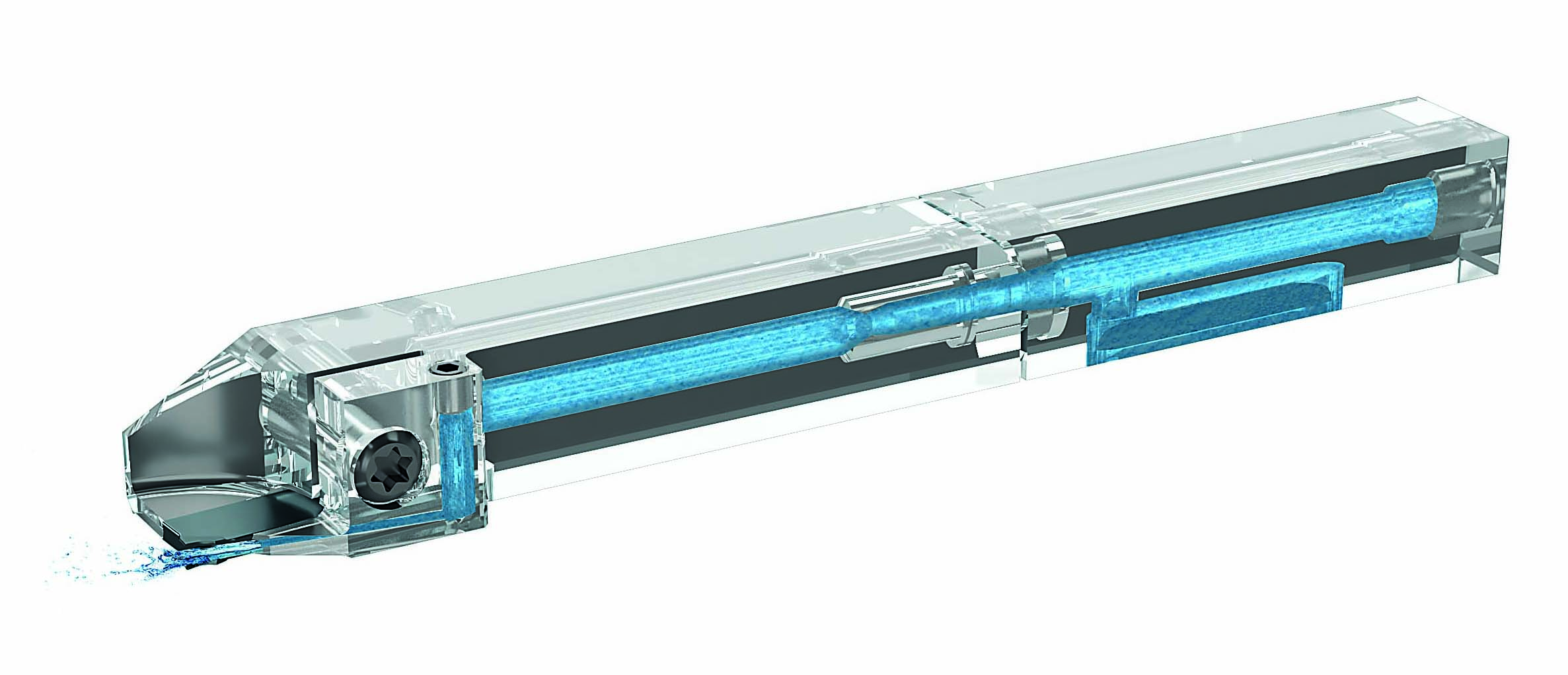
Equipped with an internal plumbing system, AFC toolholders eliminate the need for hoses and lines. Image courtesy of Arno-Werkzeuge USA
An Arno customer that equipped all its Swiss-style machines with AFC holders told Gardner they gave operators the ability to easily and precisely aim the coolant directly at the cutting area and eliminated the need to stop the machine to clear wads of chips.
The system is repeatable to within 0.0008″, Gardner noted, so there’s no need to change inserts inside the machine; the operator can inspect the inserts and properly maintain the toolholder while the machine is making parts. Because each tool has the same gage length, operators can change from a cutoff to a grooving to a profiling tool and get “within a few thousandths” without touching the offsets.
Arno makes the AFC system for Citizen A20 and L20 machines but plans to expand the program within six months for use on popular Star and Tsugami machines.
“In addition to being flexible,” Gardner said, “we focus on select markets, industries and cutting tool applications, which allows us to go deeper and provide a comprehensive portfolio to solve unique requirements. The AFC system demonstrates how we refined the quick-change concept for Swiss automatic lathes.”
He added that Arno has a wide selection of grades and chipbreakers, many with the high-shear, positive rake geometries needed to cut superalloys and medical-grade materials.
Glossary terms in this article
Related




Subscribers can use MFGAxis notes, saves and discussion tools with their innoNET account.


