Ceramics Take a Turn: Turning Performance
Author describes applications for the two basic types of ceramic turning inserts–alumina and silicon nitride–as well as the types of parts and materials users have turned with them. Specifics about speeds, feeds and DOCs are given.
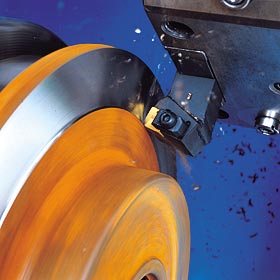
Improving turning productivity with ceramic inserts.
Ceramic inserts can be broken into two basic groups: alumina and silicon nitride.
Alumina-based ceramics are subdivided into a white-colored, pure aluminum oxide and a dark-colored alumina composite that has aluminum oxide as its primary component. Additives such as titanium- or silicon-carbide whiskers are used to improve toughness. Alumina-based inserts are used for making medium and finishing cuts in cast irons and steels.
Silicon nitride is a dark-colored composite of silicon and one of several metal oxides designed to improve performance. Inserts made from this material are used primarily for the medium and rough turning of high-temperature alloy steels, including stainless. Silicon-nitride inserts are also used for roughing gray and nodular cast irons.
Differing Views
One user of ceramic inserts is Tri-Cell, which manufactures endmills, reamers and taps from tool steel. The work at Tri-Cell requires inserts able to turn materials hardened to Rc 60 to 68.
The Cheektowaga, N.Y., company’s president, Tim Brossius, likes ceramics—but only for continuous-cut roughing operations on small-volume and prototype jobs.
He said that if a customer ordered 12 custom drills, he would assign a machinist to rough the blanks from soft tool steel with a carbide insert and then send them out for heat treating. Once heat-treated, the machinist would finish-turn with an insert made of polycrystalline cubic boron nitride (PCBN).
If the order were for two drills, the machinist would start with a steel rod prehardened all the way through. He would turn the drills with a ceramic insert, completing the job in a single setup.
Brossius said that ceramic is a lot cheaper to run than PCBN. The former costs him about $14 to $15 per cutting edge, while a PCBN insert is priced anywhere from $28 to $65 per edge.
So, why does he choose the costlier PCBN over ceramic for higher-volume jobs? Consistency. “We find tool management a struggle when we rough with ceramic,” said Brossius.
In a roughing pass in tool steel, his machinists normally take a 0.050″ DOC. He maintains that, unlike PCBN, ceramic chips and breaks in an unpredictable manner. The only way he has found to manage ceramic effectively during longer jobs is to load a roughing tool and a finishing tool in the turret—something he doesn’t have to do with PCBN.
Others say that ceramic inserts are a good choice for short- and long-run jobs that require continuous turning or moderately interrupted cuts, especially in superalloys and steels harder than Rc 45.
Horton Industries, Britton, S.D., has enjoyed success with ceramics in gray cast iron. The company’s CNC programmer, Gary Hegen, uses ceramic inserts to make highly interrupted cuts in G4000 gray cast iron with a 189 to 229 Bhn.
The workpiece—part of the fan cooling system on a diesel engine—requires a highly interrupted OD cut that is 1/2″ long. It’s followed by another highly interrupted facing cut, 2″ across.
Horton machinists use a pure silicon-nitride, CNMG-style ceramic insert to cut both the OD and the face at 2,200 sfm and a feed rate of 0.005 ipr. The ceramic insert averages 15.6 minutes of cut time per edge.
Another company that finds ceramic inserts tough enough is Lorain (Ohio) Tubular Co. LLC, a producer of tubular steel. It utilizes ceramic tools to repair the rolls used to form tubular products.
The manager of the company’s tool-and-die shop, Robert Guenther, explained that the steel rolls are constantly exposed to the heat-and-quench process, which can harden them to Rc 57.
When repairing the rolls, machinists perform a boring operation to clean up an area that is 17 1/4″ in diameter by 17″ in length. The roughing DOC varies from 0.025″ to 0.150″.
Initially, the company tried to machine the bores with a silicon-nitride insert. But the tool only penetrated the bore about 2″ before the cutting edge started chipping. Then the shop switched to an aluminum-oxide/titanium-carbide insert that allowed machinists to complete three or four parts before indexing.
The CNG 543-style insert has a 0.006″ T-land edge preparation located at a 30° angle. After a little experimenting, it was determined that the optimal cutting parameters for cleaning up the bores were a 450-sfm speed and a 0.012-ipr feed.
The bonus, according to Guenther, is that the work can be done on an old American engine lathe. He has a newer CNC machine, but doesn’t want to give up CNC machine time for the infrequent repair of the steel rolls. Guenther has become a believer in ceramics—even on older machines.
Adding ceramics, he said, “put another weapon in our arsenal.”
When considering ceramics for interrupted cuts, users need to know about one key difference between alumina and silicon-nitride, said Gary Morsch, cutting-edge scientist at Kennametal Inc., Latrobe, Pa. Aluminum oxide is a thermal insulator and silicon nitride is a thermal conductor, he explained. The practical advantage this gives to silicon nitride is a high degree of protection against thermal shock caused by the introduction of coolant into the machining process. While thermal shock is always present to some degree when using coolant, it is most pronounced in severely interrupted cuts. The extreme example is long cut lengths with short interruptions that are located 180° apart.
Morsch recommends silicon-nitride inserts for severely interrupted cuts in most cast and ductile irons.
Moshe Tarakanov, product manager for turning products at Iscar Metals Inc., Arlington, Texas, said that a ceramic insert turning in cast iron typically cuts at speeds of 2,000 sfm. Compare that to 500 to 600 sfm for a carbide tool and it’s readily apparent that long-cycle turning jobs can be one of the most profitable uses for ceramic inserts.
For finishing applications, ceramic inserts can dramatically increase productivity. Morsch cited an example that involved machining premium gray cast iron. A CNGA 432 carbide insert is commonly run at 1,000 sfm in this material, with a feed rate of 0.008 ipr to generate a finish that ranges, over the life of the cutting edge, from 80µin. to 125µin. Ra. Depending on the capability of the machine and workholding system, a ceramic insert can run anywhere from 2,000 to 3,000 sfm with the same feed rate, thereby tripling productivity.
However, Morsch cautioned, be aware that ceramics cannot tolerate high feed rates. Unlike carbide, don’t expect to run a ceramic tool at 0.020 ipr in cast iron.
Tom Helderle, president of Sahler Manufacturing and Engineering in Rockford, Ill., uses ceramic inserts for finishing. His company makes a slitting-saw blade for the corrugated cardboard industry. The material is tool steel hardened to Rc 58 to 62.
The finishing cut is continuous and requires a 32µin. Ra finish. Helderle said he uses an aluminum-oxide/titanium-carbide insert at a speed of 150 sfm, a DOC of 0.010″ and a feed of 0.004 ipr. The ceramic insert has eliminated the finish-grinding operation.
Toughened Up
There’s no question that a carbide insert is tougher than a ceramic one.
Transverse-rupture strength, the stress required to break a specimen, is commonly used to measure insert toughness. A typical carbide insert has a TRS ranging from 250,000 to 450,000 psi. This compares to silicon-nitride at 180,000 psi, aluminum-oxide/titanium-carbide at about 110,000 psi and pure aluminum oxide at roughly 60,000 psi.
Manufacturers strengthen inserts by modifying their cutting edges. The edge preparations for ceramics serve to improve tool life while allowing the inserts to be used in a much wider range of applications.
William Shaffer is president of Solo Solutions, Greensburg, Pa., and the designer of the IXM-50 CNC honing machine (see March 2000 issue of CTE). Shaffer said that ceramic inserts receive two types of edge preparations: the T-land and the honed edge.
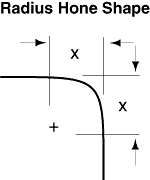
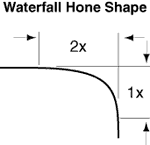
Figure 1: Honing the edge of a ceramic insert increases its strength. The radius hone is used in combination with a T-land. The waterfall hone is applied when a T-land is not required.
The T-land is a ground edge that is typically 0.008″ wide and has an angle that can vary from 8° to 30°. The honed edge has a radius that typically ranges from 0.002″ to 0.005″ (Figure 1). Shaffer said that ceramic inserts have one of two hones applied: radius or waterfall. If there is no T-land, the waterfall hone is used to create a stronger cutting edge.
For extreme cutting conditions, some manufacturers offer a hybrid that has a T-land and a honed edge. Shaffer said that the radius-shaped hone is applied in these situations.
DOC notching is a common mode of failure for ceramic inserts. Morsch said that the edge is exposed to coolant, experiences a temperature differential between the shear zone and the coolant area, and sees the rotating chip separating from the insert. In tough materials, such as Inconel, these conditions combine with the work hardening that has occurred, either during the current or prior machining operations, and can create a notch in the cutting edge. If DOC notching occurs, a honed edge (alone or with a T-land) will substantially reduce the problem.
Sherry Bradford, director of product development at RTW, Evans, Ga., warned machinists to be aware of a condition known as “tool push-off.” If the nose radius is too large, the insert will tend to push away from the part as it cuts. This condition might not be noticed unless very tight tolerances are being held.
Bradford cited one job where a customer was holding a tolerance of +0.0000″/-0.0005″. The push-off condition was not apparent by looking at the finish. But it showed up when the part was measured for size.
Taking Another Look
In the past, some people have had bad experiences with ceramic inserts because of product inconsistency or inadequate machine tools. These problems have been addressed in the last few years.
The manager of ceramic technology at Kennametal, Pankaj Mehrotra, offered two major reasons for improved ceramic inserts. First, the process for manufacturing the raw material yields a purer, more consistently sized particle. The second reason is an improved insert-production process.
The traditional method of producing ceramic inserts is hot pressing. A heated powder is compressed, with pressure provided by two opposing rams in a mechanical press.
Another method is sintering, a pressureless heat process that has led to greater consistency in the ceramic substrate. Sintering generally requires some post-process grinding, which can increase costs. Improved grinding technologies have minimized these costs, but the goal is to eliminate the grinding process all together, said Mehrotra.
Hot-isostatic pressing is a process that has improved both the consistency and uniformity of ceramic substrates. During the HIPing process, heat is applied under pressure (30,000 psi) in a chamber containing nitrogen, argon or helium. HIPing reduces voids in the substrate, commonly known as porosity. Improved furnace controls have led to better control over temperatures and pressures, allowing inserts to be formed very close to their final shape, reducing the need for post-process grinding.
Another process, which combines attributes of HIPing and sintering, is pressure-assisted sintering. It is characterized by heat applied at a low atmospheric pressure, generally around 1,500 psi.
Lastly, Valenite Inc., Madison Heights, Mich., said that it has found a way to sinter ceramic inserts by microwaving them. The process reportedly provides better particle-size control, improving substrate uniformity and consistency.
According to Mehrotra, HIPing, pressure-assisted sintering and microwave sintering have all brought ceramic-insert production close to the point that they can be molded to a finished size, on a par with carbide inserts.
Besides improvements in insert-manufacturing technology, turning with ceramics has benefited from the increased rigidity of today’s CNC machine tools. Many people who have tried ceramics in the past were put off because the inserts didn’t work on their machines.
That’s not the case with today’s equipment, said Roger Gary, grade-development specialist at Sandvik Coromant Co., Fairlawn, N.J. “Today’s machine tools have a greater ability to create the fast, rigid and reliable cutting conditions needed to effectively turn with ceramics,” he said.
Glossary terms in this article
Related


Subscribers can use MFGAxis notes, saves and discussion tools with their InnoNet account.