

Stabilizing gummy metal for more efficient cutting
Throughout the years, soft metals such as aluminum, nickel, copper and stainless steel have been more challenging to cut than hard metals—for example, these same metals hardened by heat treatment or strain hardening. Often described as gummy, the softer metals have a malleability that makes them ideal for a range of applications, from compressor components for the aerospace industry to medical implants and instruments.
Throughout the years, soft metals such as aluminum, nickel, copper and stainless steel have been more challenging to cut than hard metals—for example, these same metals hardened by heat treatment or strain hardening. Often described as gummy, the softer metals have a malleability that makes them ideal for a range of applications, from compressor components for the aerospace industry to medical implants and instruments. However, these softer, gummy metals are less stable during the cutting process and more prone to burr formation.
Researchers at Purdue University and University of West Florida set out to address these challenges. “Gummy metals characteristically deform in a very unsteady and ‘wiggly’ manner,” said research leader Srinivasan Chandrasekar, industrial engineering professor at Purdue. As a result, they tend to require more energy and force to cut than harder metals.
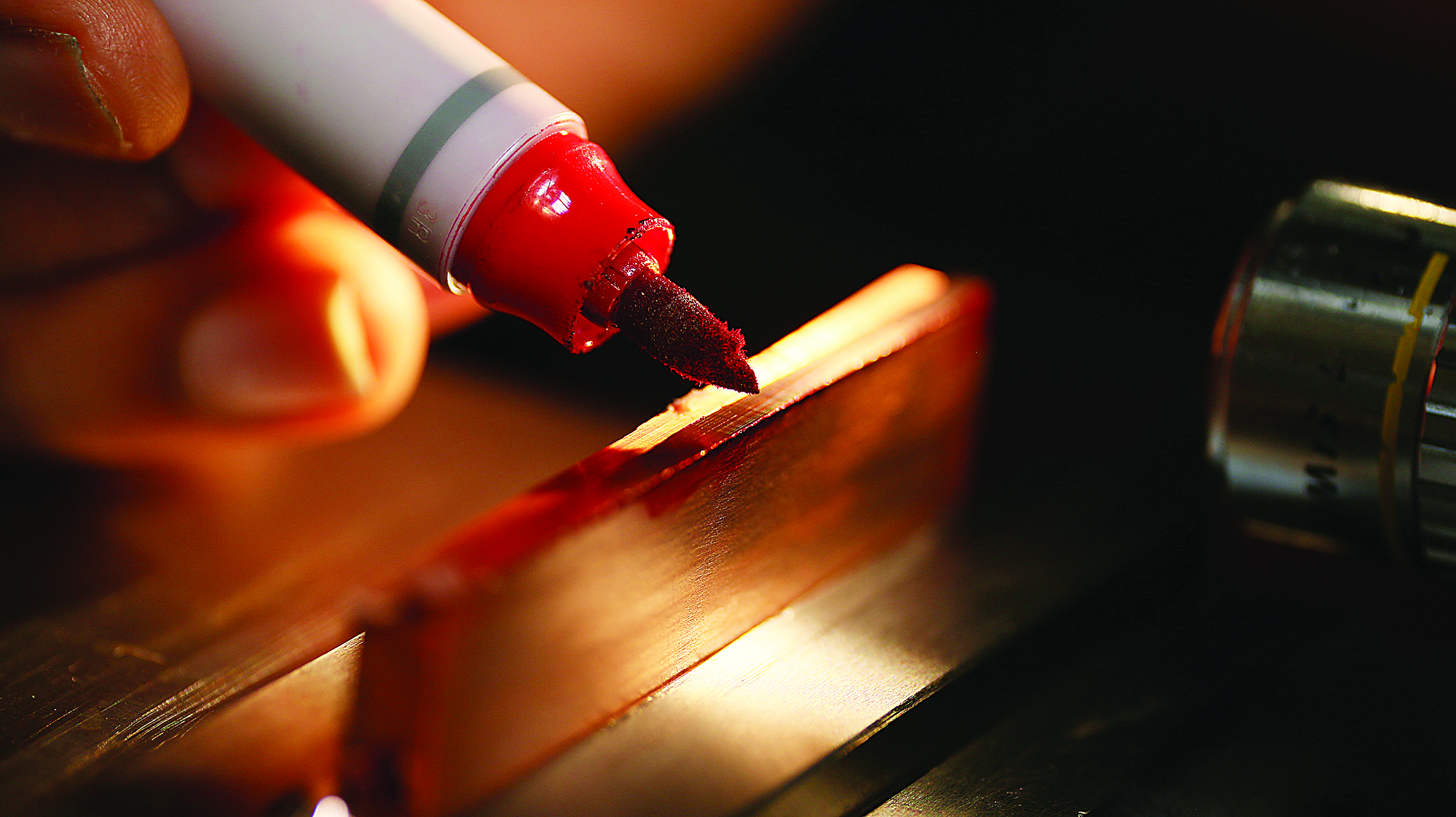
Researchers found that the use of permanent markers, as well as correction fluid and glue sticks, can improve the process of cutting soft, gummy metals. Image courtesy of Purdue University image/Erin Easterling
The goal was to minimize, if not eliminate, this wiggly deformation, making the soft metals behave more like hard metals. One proposed solution was to coat the workpiece with a liquid metal, such as gallium. However, as the liquid metal was essentially absorbed by the soft metal through its surface, the entire workpiece eventually became brittle and crumbled into powder.
The researchers tried coating the soft metals with a variety of media prior to cutting and found they fell into one of three groups. Some media worked across a wide spectrum, leading to an approximate 60 percent drop in the force needed. A second group was metal-specific—effective with some metals but not others. The third group, including paraffin wax, did not work at all. As it turned out, the media that worked best were hiding in plain sight: permanent markers, correction fluid and glue sticks.
Review the print ads from this magazine to continue
This quick advertiser review unlocks the rest of the article and keeps the full-screen reader focused on the ads instead of the page chrome.
Advertisers included in this article experience
Print placements connected to this article
Nachiamerica
IMPROVE TOOLING COST
REDUCE CYCLE TIME NACHI IS YOUR CUTTING TOOL SOLUTION.
IMPROVE TOOLING COST REDUCE CYCLE TIME NACHI IS YOUR CUTTING TOOL SOLUTION www.nachiamerica.com 888-340-8665
Visit Nachiamerica View this placement in the issue recordPrint ads from this magazine
REDUCE CYCLE TIME NACHI IS YOUR CUTTING TOOL SOLUTION.
IMPROVE TOOLING COST REDUCE CYCLE TIME NACHI IS YOUR CUTTING TOOL SOLUTION www.nachiamerica.com 888-340-8665
Continue reading
October 2018
“By applying certain media to the surfaces of these soft metals,” said researcher James Mann, assistant professor at University of West Florida, “we are able to create a condition where the metals behave as if they have been hardened.”
At first, the researchers thought the key factor would be some commonality in the chemical makeup of the media. Instead, stickiness of the media was the key. In that regard, the distinction was absorption versus adsorption. The earlier coatings, like gallium, were completely absorbed by the metals. But with the markers, fluid and sticks, adsorption was the central characteristic, with little or no absorption, and the successful media created a film over the metals’ surface. This film was instrumental in arresting the unsteady, wiggly flow, leading to more successful, efficient cutting. Thus far, the research has not indicated any environmental hazards generated by these media.
The work goes on in several ways. Chandrasekar and his team will continue to research the stickiness factor, trying to determine the level of stickiness that will contribute to ideal cutting results. The approach may also be viable for nickel-base alloys, such as Inconel 718, and commercially pure titanium.
The researchers will also examine how their findings can help manufacturers gain process stability while reducing costs. “What we need to see is this work move from the lab to the commercial application,” Mann said.
Glossary terms in this article
Related



Subscribers can use MFGAxis notes, saves and discussion tools with their innoNET account.


