

New life for an old machine
Are you about to scrap an old machine tool and replace it with a new one? Before you do, consider what could be a much less expensive way of getting a better machine: having the old one remanufactured.
Are you about to scrap an old machine tool and replace it with a new one? Before you do, consider what could be a much less expensive way of getting a better machine: having the old one remanufactured.
Remanufacturing a machine tool “is completely bringing it back to the way it was manufactured,” explained Jerry Remick, president of Orange Coast Rebuilding Inc., Anaheim, Calif. (Editor’s note: Compared to retrofitting and rebuilding, remanufacturing is often considered the most comprehensive type of machine upgrade, but “rebuilding” is sometimes used interchangeably with “remanufacturing.”)

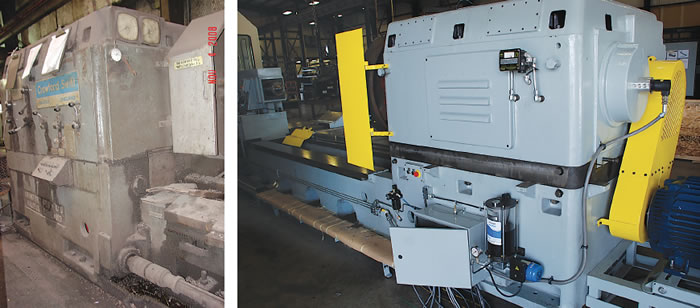
Left: A worn-out, manually operated lathe that Texas Machine-Tool International remanufactured, which included adding ground ballscrews and low-backlash planetary gearboxes coupled to an A/C servo system. Images courtesy Texas Machine-Tool International.
The remanufacturing process can produce a machine that’s actually better than when the machine was new, claimed Michael Sullivan, president of Texas Machine-Tool International LLC (TMI), a machine remanufacturer and rebuilder in Waco, Texas. “There are a lot of enhancements that we can offer a customer that go beyond restoring [a machine tool] to its original condition,” he said. These include converting a manual machine to CNC and adding pressure-monitoring load cells, as well as revamping machine axes so that they exceed the original OEM specifications.
But why remanufacture rather than buy a new machine with all the desired features and capabilities? One reason is cost. The cost of remanufacturing is generally only 40 to 60 percent that of purchasing a comparable new machine, according to Remick.
In addition, many old machines have a quality edge over their new counterparts. For example, Sullivan said many of today’s machine tools are built from weldments instead of castings, which have better damping characteristics and are more rigid structures.
On the other hand, it probably makes sense to buy new if an old machine has been problematic and you covet the latest control and automation features, Sullivan said. In many cases, getting these features with a new machine is a more cost-effective route than adding them to an old machine.
Review the print ads from this magazine to continue
This quick advertiser review unlocks the rest of the article and keeps the full-screen reader focused on the ads instead of the page chrome.
Advertisers included in this article experience
Print placements connected to this article
Mastercam
SEEING
IS BELIEVING Amazing! ¡Fantástico! Incredible! Wow! Ótimo! ONCE YOU SEE IT, YOU’RE GOING TO NEED TO TRY IT. We challenged large and small shops around the world to try Dynamic toolpaths. The results are nothing short of amazing. Dramatically shorter cycle times, with extended tool life and less strain on machines. NOW RELEASED.
SEEING IS BELIEVING Amazing! ¡Fantástico! Incredible! Wow! Ótimo! ONCE YOU SEE IT, YOU’RE GOING TO NEED TO TRY IT. We challenged large and small shops around the world to try Dynamic toolpaths.
Visit Mastercam View this placement in the issue recordHornusa
Micro-Precision Taken to the Extreme
Machine the smallest of parts with maximum precision – accurate to tolerances in the micron range. Authentic Supermini®. The high-production tooling system handles the most challenging jobs starting in bore diameter 0.2mm (.008 ). More than 1,000 standard carbide inserts with ideal geometries are HORN – EXC ELLENCE IN TECHNOLOGY.
Micro-Precision Taken to the Extreme Machine the smallest of parts with maximum precision – accurate to tolerances in the micron range. Authentic Supermini®. The high-production tooling system handles the most challenging jobs starting in bore diameter 0.2mm (.008 ). More than 1,000 standard carbide inserts with ideal geometries are available. All standard and custom solutions fit the same toolholder for use with or without coolant. www.hornusa.com Expertise meets the high-tech production of miniature parts. www.hornusa.com HORN – EXC ELLENCE IN TECHNOLOGY GROOVING PARTING OFF GROOVE MILLING BROACHING PROFILE MILLING REAMING
Visit Hornusa View this placement in the issue recordPrint ads from this magazine
IS BELIEVING Amazing! ¡Fantástico! Incredible! Wow! Ótimo! ONCE YOU SEE IT, YOU’RE GOING TO NEED TO TRY IT. We challenged large and small shops around the world to try Dynamic toolpaths. The results are nothing short of amazing. Dramatically shorter cycle times, with extended tool life and less strain on machines. NOW RELEASED.
SEEING IS BELIEVING Amazing! ¡Fantástico! Incredible! Wow! Ótimo! ONCE YOU SEE IT, YOU’RE GOING TO NEED TO TRY IT. We challenged large and small shops around the world to try Dynamic toolpaths.
Continue reading
December 2016
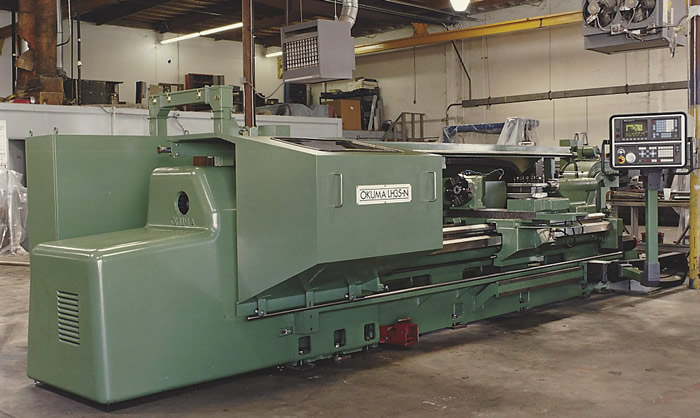
This machine looks as good as new after a rebuild by Orange Coast Rebuilding. The process included upgrading the control, regrinding the ballscrews and hand scraping mating components. Image courtesy Orange Coast Rebuilding.
At TMI, remanufacturing involves completely disassembling a machine down to its frame, which is steam-cleaned and inspected for cracks and other damage. In addition, components such as ballscrews, thrust bearings and wiring are replaced, as is the lubrication system, if it’s deemed inadequate for an up-to-date machine. Old components that remain are individually painted before the machine is reassembled.
Another important part of the process is restoration of the ways. OCR works on the ways until they meet or exceed the original factory tolerances. The key: “We do a tremendous amount of hand scraping,” Remick said. “We probably have more hand scrapers than anybody west of the Mississippi.”
OCR’s rebuild process also includes the addition of state-of-the-art controls. When all the work is finished, the customer comes to OCR’s facility and runs some parts on the rebuilt machine to test it. Then the machine is returned to the customer’s facility, where it’s set up and leveled by OCR personnel.
Remick said a rebuild typically takes from 8 weeks to 3 months. Sullivan said TMI rebuilds can take anywhere from 12 weeks for smaller machines to 26 weeks for large units. Along with a rebuilt machine, TMI customers get a report containing laser measurements of the straightness, flatness, pitch, roll and yaw of the machine’s axes.
Both companies back their work with a 1-year warranty.
Related




Subscribers can use MFGAxis notes, saves and discussion tools with their innoNET account.


