

High-Pressure Work: General Industry Coverage
Components used in the manufacture of combustion hardware for a Mitsubishi gas turbine begin life as sheet or plate stock. Because our components come from large sheets, we start every manufacturing process by cutting the desired shape or profile.
Components used in the manufacture of combustion hardware for a Mitsubishi gas turbine begin life as sheet or plate stock. Because our components come from large sheets, we start every manufacturing process by cutting the desired shape or profile.
When we started planning our shop, we considered the materials to be cut and evaluated cutting methods. Cutting sheet and plate is usually performed via mechanical methods such as sawing or shearing, which are economical. But mechanical methods are often limited by the complexity of the shape being cut or the thickness of the material. Other options, such as oxy-fuel, plasma arc and most laser systems, cut via thermal means.
For us, mechanical methods are not viable options because we have to cut thicknesses from 0.06″ (1.524mm) up to 1.0″ (25.4mm), and many of the shapes are too complex to be cut with a saw or a shear. Thermal methods are effective but not desirable because the heat-affected zone can cause weld defects. Removing the heat-affected zone before welding adds cost to the process. To bypass these problems, we turned to waterjet machining.
Under Pressure
Waterjet machines work by pressurizing water to high levels—our machines operate at 60,000 psi (4,137 bar)—and passing the water through a small-diameter orifice. Restricting the high-pressure water accelerates it to velocities several times the speed of sound. Garnet, the same material used for sandpaper, is injected into the stream of water. The speed of the water combined with the garnet generates an abrasive cut similar to that of a grinding wheel or abrasive cutoff wheel.

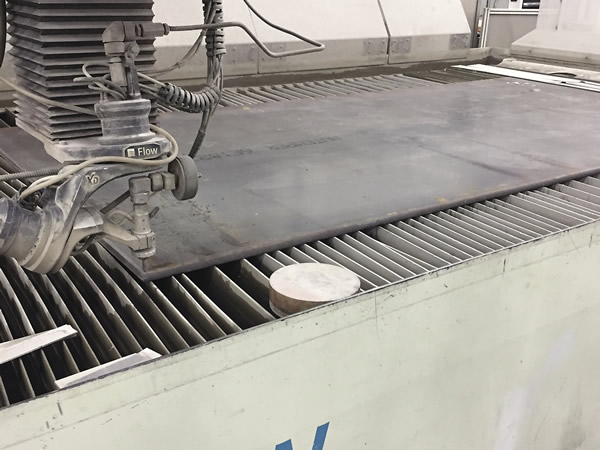
A 60″×120″ piece of steel is cut on a waterjet machine at Savannah Machinery Works. All images courtesy C.Tate.
Waterjet cutting has performed well for us. Waterjets are not like traditional chip-making machines and, when we started using the process, it was new to everyone on my team. Although we had a basic understanding of its capabilities, we were not prepared for the transition to waterjet cutting. We learned some valuable lessons during that transition.
Care and Considerations
For example, waterjet cutting generates a large volume of waste. Over time, spent garnet and swarf will fill the tank. Waste removal requires draining the tank and hiring a contractor with a special truck to vacuum out the sludge, which is similar to grinding swarf.
Review the print ads from this magazine to continue
This quick advertiser review unlocks the rest of the article and keeps the full-screen reader focused on the ads instead of the page chrome.
Advertisers included in this article experience
Print placements connected to this article
Smart Cosensaws
Lessons learned under laser systems, cut via thermal means.
For us, mechanical methods are not viable pressure while transitioning options because we have to cut thicknesses to waterjet cutting. from 0.06" (1.524mm) up to 1.0" (25.4mm), and many of the shapes are too complex to be cut Components used in the manufacture of with a saw or a shear. Thermal methods are combustion hardware for a Mitsubishi gas effective but not desirable because the heat-.
Lessons learned under laser systems, cut via thermal means. For us, mechanical methods are not viable pressure while transitioning options because we have to cut thicknesses to waterjet cutting. from 0.06" (1.524mm) up to 1.0" (25.4mm), and many of the shapes are too complex to be cut Components used in the manufacture of with a saw or a shear. Thermal methods are combustion hardware for a Mitsubishi gas effective but not desirable because the heat- turbine begin life as sheet or plate stock. affected zone can cause weld defects. Re- Because our components come from large moving the heat-affected zone before weld- sheets, we start every manufacturing process ing adds cost to the process. To bypass these
Visit Smart Cosensaws View this placement in the issue recordPrint ads from this magazine
For us, mechanical methods are not viable pressure while transitioning options because we have to cut thicknesses to waterjet cutting. from 0.06" (1.524mm) up to 1.0" (25.4mm), and many of the shapes are too complex to be cut Components used in the manufacture of with a saw or a shear. Thermal methods are combustion hardware for a Mitsubishi gas effective but not desirable because the heat-.
Lessons learned under laser systems, cut via thermal means. For us, mechanical methods are not viable pressure while transitioning options because we have to cut thicknesses to waterjet cutting. from 0.06" (1.524mm) up to 1.0" (25.4mm), and many of the shapes are too complex to be cut Components used in the manufacture of with a saw or a shear. Thermal methods are combustion hardware for a Mitsubishi gas effective but not desirable because the heat- turbine begin life as sheet or plate stock. affected zone can cause weld defects. Re- Because our components come from large moving the heat-affected zone before weld- sheets, we start every manufacturing process ing adds cost to the process. To bypass these
Continue reading
July 2016
Depending on the materials being cut, this waste might have to be treated as a hazardous material, which can be extremely expensive to dispose of. Therefore, disposal should be considered during the purchasing process. Researching statutes governing the disposal of waste is the only way to be certain if disposal will be a serious consideration; the waterjet manufacturer can provide assistance.
Keeping waterjet machines in proper working condition requires daily maintenance. High-pressure water lines, abrasive feed lines and high-pressure pumps wear quickly and must be serviced at the prescribed intervals or you risk significant downtime. Misalignment during installation of the expensive, small-diameter orifice can cause it or other components to fail. If the manufacturer offers a basic maintenance course, it would be wise to invest in the training.
Accuracy of waterjet cutting is something that is debated. Manufacturers often claim accuracy of 0.005″ (0.127mm), with some claiming 0.001″ (0.025mm). While such accuracies are not impossible, they are difficult to achieve for operators who are new to the technology. Accuracy depends on the machine, the material, the operator and several other factors. Carefully discuss your requirements with the supplier’s applications engineer and make test cuts to determine the capability of the machine.
Many new machines have options such as dynamic heads that can compensate for inherent waterjet characteristics that lead to inaccuracy. Our shop has never had accuracy issues because our tolerances are well within the capability of the machines; however, if you need accuracy better than 0.01″ (0.254mm), it is a good idea to get the manufacturer to guarantee the capability of the machine before purchasing.
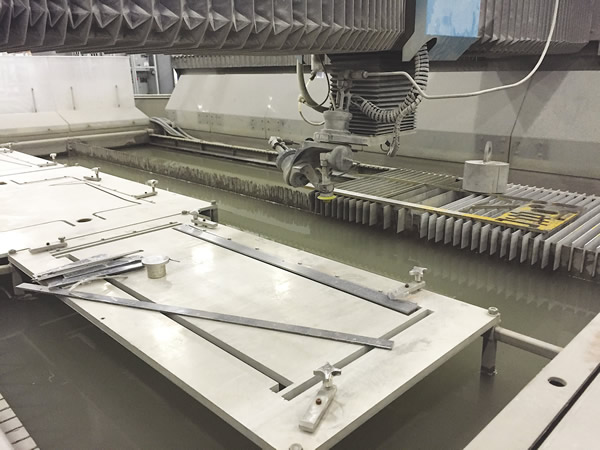
The use of dedicated fixtures on flatbed waterjet machines reduces opportunities for error and decreases setup times. These stainless steel fixtures are welded to the tank.
Waterjet controls are not like those on other CNC machines. Our machines use proprietary PC-based software to generate the cut path from graphical inputs, much like 2D CAD software does. The code used to control the machine is not visible to the operator and all changes to the cutting path require the programmer or operator to change graphical information. Programming the machine is different and requires experienced CNC operators to adopt a new approach to programming, but it’s not difficult to learn and can be as easy as using an office printer.
Raw materials are typically supported by slats that traverse the waterjet tank. Cutting parts that are smaller than the gap between the slats can be challenging, as the parts tend to fall away from the stock and sink to the bottom of the tank, which is inconvenient. Be aware that you will need to develop special techniques or purchase special items, such as waterjet bricks, to help cut small parts. Dealing with small parts is not a problem if you are prepared; again, the applications engineers from the manufacturer can help.
Waterjet cutting is a versatile and easy-to-use technology that can enhance the capabilities of the traditional machine shop. It can also be a suitable replacement for processes found in a sheet metal shop, such as laser and plasma cutting. In any case, careful research, planning and testing will be the key to finding the shortest path to successful implementation.
Glossary terms in this article
Related




Subscribers can use MFGAxis notes, saves and discussion tools with their innoNET account.


