


Up to Speed: 5-Axis Machining
Advanced machine technology requires advanced training options.
Advanced machine technology requires advanced training options.
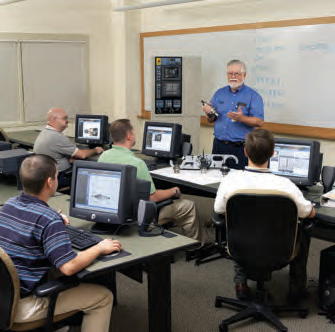
Courtesy of Makino
Makino conducts a training session at one of the machine tool builder’s facilities.
Consider the following scenario: Realizing that advanced machining capabilities are needed to effectively compete and grow your business, you buy a new 5-axis horizontal machining center. Your shop’s staff includes competent and experienced machinists, programmers and maintenance technicians, but they’re not familiar with this type of equipment, having only worked in the 3- and 4-axis machining realm.
That means they need training. But how much is needed? Where should it take place? Who should be trained? What courses should they take? And how much is it going to cost?
Metalworking professionals know the cost of an insert, toolholder, high-pressure coolant system and machine tool, but often have no idea what training costs, according to Rod Jones, chief learning officer for DMG/Mori Seiki University at DMG/Mori Seiki USA Inc., Hoffman Estates, Ill. “When I talk to people in the manufacturing environment about training, they have no value benchmark to measure against because most shops have not done training,” he said. “If I tell someone the training program is going to cost $5,000 or $50,000, I get about the same reaction because he doesn’t know how much it should cost.”
Although having trained workers is invaluable, Jones added that training is a difficult activity to justify because determining its return on investment is a struggle. “I had my own business before I came here, and I would tell people the training program is going to cost you $5,000. If you want to measure the results of it that’s a $50,000 research study afterwards,” he quipped, noting that the statement is true.
Training requires an investment not only from the end user but from the machine tool builder as well. Jones pointed out that DMG/Mori Seiki’s main training facility consumes 12,000 sq. ft. of space, has 10 machine tools worth more than $3 million and is staffed by 10 workers. “People come to our facility and think, ‘This costs you guys money.’ You’re darn right it does,” he said. “We’re not a profit center. It is part of the value of buying our machines and is subsidized by the purchase.” Although the average cost of industrial training in a facility is about $2,000 per week per person, DMG/Mori Seiki charges a third of that, according to Jones.
Training Credits
Machine builders typically provide various options for training customers that purchase a new piece of capital equipment. Mason, Ohio-based Makino Inc., for example, provides customers with two training credits when buying a new machine, and each credit is good for one person to attend a class at a Makino facility, explained Joe Dermody, the company’s training project leader. Those 2½- to 4½-day classes include operations, manual part programming, macro programming and maintenance, and, if needed, Makino provides an interpreter for courses held in Mexico and the Montreal area.
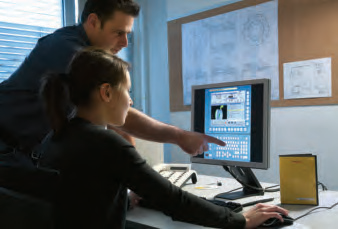
Courtesy of EMAG
A classroom session covers a machine’s control at EMAG Academy.
Operations instruction is the most popular class for users who don’t already have a Makino machine, and maintenance tops the list for those who already have one with similar controls, Dermody noted. “Understanding what it takes to take care of that machine is very important to get the most out of it, and you get that information during the training classes,” he said.
Dermody added that customers typically receive training a week before or within a month after taking delivery. “That’s when we’d like to see them come in,” he said. “We don’t like to see a machine sit there on the floor with untrained people and not making the customer money.” However, training credits are good for 1 year after the purchase. Customers can also purchase additional credits.
Purchasing on-site training is another option at the point-of-sale. For that type of training, customers typically send operators from each shift to one class, or send shift leaders who then teach the operators, Dermody noted. When one of Makino’s larger machines is purchased, such as the T2 or T4 5-axis HMC, customers receive a week of on-site support from an application engineer to help get the machine up and running, including programming and operations assistance.
Although training at a machine builder’s facility involves travel and lodging expenses and requires workers to be out of the shop, the knowledge gained to run a machine or work cell more efficiently can justify the cost. “All in all, it’s a better scenario,” Dermody said.
He pointed out that customers who purchase an MMC (Makino Machining Complex) pallet-managed work cell participate in cell controller classes a week before installation to ensure they input data correctly so pallets move efficiently from the machines to the various work setting stations. “That is probably one of our most structured training schemes,” Dermody said.
When training operators, EMAG LLC recommends training operators from all shifts at the same time after shipment, according to Peter Loetzner, CEO of the Farmington Hills, Mich., machine builder. “If you want to have all three shifts being trained, you must have it at the end user’s site,” he said. “Hands-on training in their own environment turns out to be the best for the operators.”
On the other hand, programmable logic controller and CNC programming can occur while a machine is being built, and setup training usually occurs when the machine acceptance date is approaching or the shipment date is known, according to Loetzner. “Then we usually bring the setup personnel up to speed during that time,” he said, “but every customer does it differently, and it’s really the end user’s philosophy that we follow.”
Triad of Training
Training at a customer’s site during machine installation represents the best of times and the worst of times, according to DMG/Mori Seiki’s Jones. That training, which can last a couple of days to a couple of weeks, is effective because operators and other personnel are working with their machine, on their shop floor and producing their parts. However, taking care of problems in the plant and other interruptions disrupt the learning process, and the pressure to get the machine into production as fast as possible can send the builder’s application engineer packing before training is completed.
Therefore, Jones recommends a triad of training. The first part begins between the time an end user orders a machine and the delivery date and involves online training courses using interactive, Flash-based programming. “People are actually operating the machine in the virtual world, pushing all the buttons, dials and switches and watching the machine move on the screen,” he said. “They get two free seats per machine serial number they purchase, good for 6 months.”
That online training—in which courses can be repeated as many times as needed—enables shop personnel to understand a machine’s basic operations and terminology prior to machine delivery. Then, when it arrives, the application engineer can focus on more advanced functionality at a customer’s site to help the shop achieve the desired machine productivity, Jones noted about the triad’s second part.
The third part is advanced training at DMG/Mori Seiki University or at the company’s facilities in Houston, Charlotte, N.C., or Davis, Calif. Course length is from 2 to 5 days and covers machine operation, programming, maintenance and repair, and electrical and mechanical systems. “Then we can also send instructors and/or application engineers to the customer on a daily rate basis to work on more in-depth issues,” Jones said.
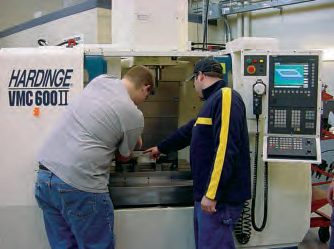
Courtesy of Siemens Industry
Training at a machine shop in a machine builder’s facility can make a significant difference in the bottom line, according to training experts.
View print ads from this spread
Review the ads on this magazine spread to continue reading. Each ad takes two seconds; a two-page ad counts once.
Advertisers on this magazine spread
Print placements on this magazine spread
800.521.9520 | mscmetalworking.com
Available exclusively at MSC Industrial Supply Co.®
IS #42.
Available exclusively at MSC Industrial Supply Co.® IS #42 800.521.9520 | mscmetalworking.com
Visit 800.521.9520 | mscmetalworking.com View this placement in the issue recordPrint ads from this magazine
IS #42.
Available exclusively at MSC Industrial Supply Co.® IS #42 800.521.9520 | mscmetalworking.com
Continue reading
July 2011
According to Jones, one area in which shops are requesting more instruction is 5-axis programming. That type of training is especially important for manufacturers targeting aerospace and medical work, he emphasized. “It’s a whole different world going from 3- and 4-axis machining to 5-axis machining,” Jones said. “There’s a lot more going on, and that kind of training is fairly intense.”
He added that 5-axis training involves learning CAM software because programming with G code is not an option, as well as understanding the software’s machining simulation tools for crash protection. “When you have five axes moving at very high rates of speed, most people don’t understand ahead of time where that tool is going to go,” Jones said, adding that even a CNC with a crash protection function needs to be properly set up and programmed.
Get with the Program
When a user isn’t familiar with a particular type of control or hasn’t had much CNC experience, machine tool builders are an effective source for CNC programming training, according to Phil Tardiff, manager of the machinery division for distributor KBC Tools & Machinery Inc., Sterling Heights, Mich. That’s the case even when the controls are conversational. “It helps as long as you have a machinist background and as long as somebody can show you how and what the steps are in getting a job set up and running,” he said. “Once you’re trained on a specific control, you know where to look on different CNC brands without standing at the screen, playing around and wasting time.”
In the past, a lack of CNC machining experience was a big impediment to effective training when a shop purchased a new machining center, but that isn’t as much of an issue today as older manual machinists who had trepidation about operating CNC machines retire, according to Tardiff. He said: “I’ve noticed in the past few years as us old guys retire, the younger crowd doesn’t need as much help. They’ve had experience with CNCs. That fear of the control has gone away.”
Having in-depth knowledge of the control typically provides a significant dividend. Shops of all types can realize a 20 percent or better improvement in their performance from the first part produced when a machine tool and its controls are properly and fully utilized, according to Randy Pearson, sales support manager for U.S. dealers and OEMs, Siemens Industry Inc., Elk Grove Village.
And rapid advances in CNC and PLC technology require end users to keep their knowledge updated so they can use the additional machine functionality that technology provides, according to EMAG’s Loetzner. In addition to keeping its customers knowledgeable about controller changes, he noted that the company also provides classes for part manufacturers who don’t have one of its machines. One example is the gear school in South Elgin, Ill., that’s run by the company’s Koepfer brand.
With the ever-present challenge of maintaining a skilled workforce in order to compete globally, manufacturers are realizing more than ever the value of training and are willing to pay for it to keep up with the rapid pace of equipment development.
“The simple fact is that technology is ramping up at a very fast rate and ‘the way we’ve always done it’ just won’t work anymore,” stated Siemens Industry’s Pearson. “In a sentence, the industry needs to realize that training is not a cost, it’s an investment. And, it’s an investment we all need to make if the industry is to remain solvent in the U.S.” CTE
About the Author: Alan Richter is editor of CTE, having joined the publication in 2000. Contact him at (847) 714-0175 or alanr@jwr.com.
Contributors
DMG/Mori Seiki USA Inc.
(877) 275-6674
www.dmgmoriseikiusa.com
EMAG LLC
(248) 477-7440
www.emag.com
KBC Tools & Machinery Inc.
(800) 521-1740
www.kbctools.com
Makino Inc.
(800) 552-3288
www.makino.com
Siemens Industry Inc.
(847) 640-1595
www.usa.siemens.com/cnc
Simonds International
(800) 343-1616
www.simondsinternational.com
Online training enables doing more with less
Manufacturing has entered a new era of doing more with less. One shift is being asked to do the work of two shifts, one employee must work as productively as three and the call for efficiency continues to grow.
But cutting training programs and departments as businesses reorganize and trim staff makes this difficult to achieve. This strategy is counterproductive because employee training is an investment that helps manufacturers achieve maximum benefit from new equipment. Employee training also protects capital assets, helping employees avoid making mistakes that could damage machines and tools.

Dale Petts
Manufacturers that recognize the value of training but want to avoid the cost of on-site or classroom training have another option. Proactive suppliers have developed online employee training programs and learning centers, which are available to end users 24/7. Online access allows employees to update their skills when and where it is convenient for them. This is especially important to companies that operate multiple shifts and sites. By providing training programs online, suppliers have made it possible for large numbers of employees to access critical information.
These training programs can offer detailed information about material composition, chemistry, technical terminology, machining tips and troubleshooting techniques in a visual and interactive format. The material is updated in real time to include new information. Because the information is standardized, all employees receive consistent training.
Online training centers are typically housed on a supplier’s Web site, allowing qualified trainees (usually customers) to register. Content can be specific. For example, in the materials sawing industry, an online training center can include technical sessions that cover such topics as blade terminology, the design and function of various types of saw blades and machines, the physical composition of materials to be cut, how they respond to different blade types and sawing techniques, how to eliminate waste and how to cut with precision. Programs are tailored to apprentice or master-level professionals.
Generally, Web-based training allows employees to learn at their own pace and take a self-administered exam after they have finished a module. Employees often receive immediate feedback and can track their progress. The scores may be registered within the online training program, and employees receive a certificate once they pass all the training modules.
In some cases, supervisors can track their employees’ progress. Online training is also useful to supervisors who can benefit from a refresher course.
Employee training programs offer multiple benefits. For example, managers groom the next generation of plant leaders and help attract and retain the next generation of employees. Many younger workers are interested in learning and acquiring new skills while getting paid. Employees also take online training courses to become more attractive to their current employers or to feel more secure in their job.
John Tschohl, founder and president of the Service Quality Institute, Minneapolis, said: “Workers must utilize all of their skills and talents to sell themselves to their customers and their employers every day and in every undertaking. They must be more agile, multitalented and, above all, empowered. Those who reject empowerment—who fear risk and cling to the status quo—will lag behind and get left in the dust. Empowered employees take control; they make decisions quickly to help a customer, move a project forward or solve a problem. In the process they find their jobs more enjoyable.”
While a key objective of employee training is to improve worker performance and increase tenure, online training programs offer additional value to companies that have high levels of turnover. Constantly training new employees is expensive, but it is an avoidable cost when vendors actively contribute to the training.
In a doing-more-with-less environment, manufacturers and suppliers can expect more partnering to train employees and gain the benefits a more knowledgeable workforce brings.
—Dale Petts, global product manager of metal products, Simonds International, Fitchburg, Mass., (800) 343-1616.
Glossary terms in this article
Related



Subscribers can use MFGAxis notes, saves and discussion tools with their innoNET account.