

Flexible productivity: General Industry Coverage
The Look Ahead feature in the October 2011 issue of Cutting Tool Engineering magazine mentions a CNC rotary transfer machine that approaches the productivity of a mechanically controlled machine and can produce microscale parts.
A mechanically controlled rotary transfer machine can produce parts faster than a CNC one because there is no inversion of a stepping motor like on an NC axis. However, a CNC one—where all axes are programmable—significantly reduces the downtime that occurs when switching from one part to another because changeover is done primarily through software programming. “You can freely program your speeds and feeds to use other tools,” said Oskar Weder, general manager and CEO of Mikron Corp. Monroe. “Programming on the CNC machine is much simpler than making a cam and mounting it on a machine.”
To more closely bridge the mechanical/CNC gap in output capability while offering the flexibility to do part volumes of even a few hundred, including parts as small as 0.8mm, the machine tool builder and toolmaker introduced the Multistar NX-24 CNC rotary machining system. According to Mikron, the machine is slightly less productive than a mechanical one but the control’s operator interface simplifies rapid programming and changeovers. For instance, it might take 12 hours to change from one part to a significantly different one on a mechanical machine, Weder noted, but only 4 hours on the Multistar.
Courtesy of Mikron SA Agno
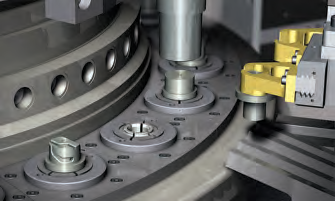
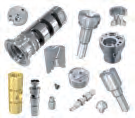
A blank is fed into the Multistar NX-24 CNC rotary transfer machine’s first workstation and clamped in the collet (above), and the completed part is unloaded from the machine in the last station. Below: End users can produce a variety of parts on the machine.
Review the print ads from this magazine to continue
This quick advertiser review unlocks the rest of the article and keeps the full-screen reader focused on the ads instead of the page chrome.
Advertisers included in this article experience
Print placements connected to this article
2linc
ad index
I.S. # ADVERTISER NAME PAGE # CONTACT NAME CONTACT PHONE CONTACT E-MAIL / WEB SITE.
ad index I.S. # ADVERTISER NAME PAGE # CONTACT NAME CONTACT PHONE CONTACT E-MAIL / WEB SITE 1 2L Inc. 44 Customer Service 978-567-8867 [email protected] / www.2Linc.com 2 Abanaki Corp. 58 John Logar 800-358-SKIM (7546) [email protected] / www.abanaki.com/021 79 AccuteX EDM, a div. of Absolute Machine Tools 25 Pete Intihar 513-701-5550 [email protected] / www.accuteXEDM.com 3 Advent Tool & Mfg. Inc. 81 Jim Hartford 800-THREAD-4 [email protected] / www.advent-threadmill.com 45 Allied Machine and Eng. Corp. 5 Heather Kaiser 800-321-5537 [email protected] / www.alliedmachine.com 4 AMAMCO Tool 29 Andrew Gilpin 800-833-2239 [email protected] / www.amamcotool.com 5 Bal-Tec 78 Patricia Johnson 800-322-5832 [email protected] / www.precisionballs.com 6 Briney Tooling Systems 43 Donna Strozeski 800-752-8035 [email protected] / www.brineytooling.com
Visit 2linc View this placement in the issue recordPrint ads from this magazine
I.S. # ADVERTISER NAME PAGE # CONTACT NAME CONTACT PHONE CONTACT E-MAIL / WEB SITE.
ad index I.S. # ADVERTISER NAME PAGE # CONTACT NAME CONTACT PHONE CONTACT E-MAIL / WEB SITE 1 2L Inc. 44 Customer Service 978-567-8867 [email protected] / www.2Linc.com 2 Abanaki Corp. 58 John Logar 800-358-SKIM (7546) [email protected] / www.abanaki.com/021 79 AccuteX EDM, a div. of Absolute Machine Tools 25 Pete Intihar 513-701-5550 [email protected] / www.accuteXEDM.com 3 Advent Tool & Mfg. Inc. 81 Jim Hartford 800-THREAD-4 [email protected] / www.advent-threadmill.com 45 Allied Machine and Eng. Corp. 5 Heather Kaiser 800-321-5537 [email protected] / www.alliedmachine.com 4 AMAMCO Tool 29 Andrew Gilpin 800-833-2239 [email protected] / www.amamcotool.com 5 Bal-Tec 78 Patricia Johnson 800-322-5832 [email protected] / www.precisionballs.com 6 Briney Tooling Systems 43 Donna Strozeski 800-752-8035 [email protected] / www.brineytooling.com
Continue reading
October 2011
A unique feature of the Multistar NX-24 is its 24 workstations (22 for machining, one for clamping the workpiece in the collet and one for ejecting the finished part). The machine also has 44 machining units and 60 axes. All axes work simultaneously, which is how the machine achieves its high output. “It’s quite a marvel—there are so many axes working simultaneously,” Weder said.
In addition to the workstations machining simultaneously, each workstation can machine two sides of a part at the same time: from above and below, from above and from one side or from below and from one side.
The Multistar offers a maximum spindle speed of 32,000 rpm, which is effective for applying microtools, such as Mikron’s 0.7mm-dia. through-coolant CrazyDrill, according to Weder. “This machine has the capability,” he said. “The spindles are extremely accurate and smooth running.” Part accuracies are in the hundredths of a millimeter range, the company reports.
For more information about Mikron Corp. Monroe, Monroe, Conn., call (203) 261-3100 or visit www.mikron.com.
Glossary terms in this article
Related


Subscribers can use MFGAxis notes, saves and discussion tools with their innoNET account.


