

Go with the flow: Industry Trends & Analysis
Productive Times challenge: Ensure there are no machining issues with a flexible manufacturing system. The solution: Machine simulation and optimization software.

END USER: Great Plains Industries Inc., (316) 686-7361, www.gpi.net. CHALLENGE: Ensure there are no machining issues with a flexible manufacturing system. SOLUTION PROVIDER: CGTech, (949) 753-1050, www.cgtech.com. SOLUTION: Machine simulation and optimization software.
When a company spends several million dollars on a flexible manufacturing system (FMS) to compete with offshore suppliers and revitalize the shop floor, it’s important to make the most of the investment. Above all, there must be assurance it will never crash.
Great Plains Industries Inc., Wichita, Kan., has taken steps to do just that. Beginning in June 2015, GPI kicked off “Project One,” the installation of four MB-5000H Okuma horizontal machining centers equipped with 15,000-rpm spindles and 218- tool matrices, together with an integrated Palletace 60-pallet M-1100 material-handling system built for Okuma by automation provider Fastems, West Chester, Ohio. The FMS includes spindle probing, tool life management, remote monitoring and every lights-out bell and whistle.
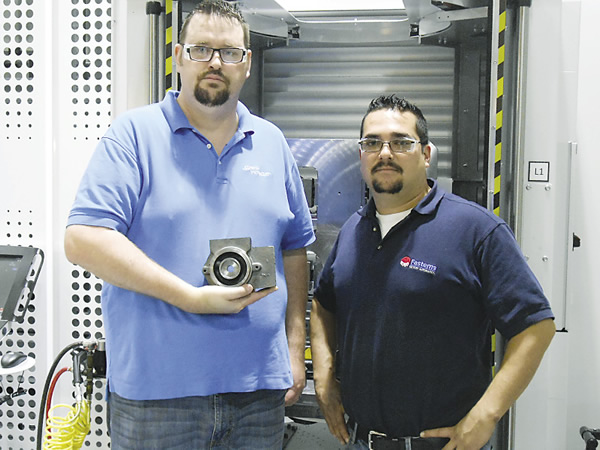
Programmer Matt White (left) and Jean Alcala, machine shop manager, with a cast iron part that GPI simulated the machining for using VERICUT. Images courtesy GPI.
Jean Alcala, the company’s machine shop manager, recalled GPI’s situation 7 years earlier. “We’d made a good deal of progress as far as modernizing our workholding and increasing throughput, but there was only so much we could do with stand-alone machine tools. When the shop couldn’t keep up with increasing demand, the decision was made to outsource all our cast iron machining to China.”
However, GPI struggled with quality and supply chain issues when outsourcing, so the company investigated bringing its outsourced work back home.
“The problem with offshoring is that, when there’s a problem, you can’t send it back,” Alcala said. “Then you’re faced with rework and late delivery of products. That’s why we looked at the FMS. We knew having our own in-house flexible manufacturing system would eliminate nonconformance, provide better service to our customers and help optimize the organization overall.”
Review the print ads from this magazine to continue
This quick advertiser review unlocks the rest of the article and keeps the full-screen reader focused on the ads instead of the page chrome.
Advertisers included in this article experience
Print placements connected to this article
Kennametal
Simply a smarter insert. That’s Beyond Drive. ™ ™
That’s With Wear Detection Technology Black Insert Hard to detect wear BEYOND™ DRIVE™ Our most advanced surface treatment: • Bronze outer layer simplifies wear detection • Reduces coating stresses • Improves coating adhesion At Kennametal, our inspiration is driven by asking “what if?” Engineering a complete portfolio of inserts that utilizes.
Simply a smarter insert. That’s Beyond Drive. ™ ™ That’s With Wear Detection Technology Black Insert Hard to detect wear BEYOND™ DRIVE™ Our most advanced surface treatment: • Bronze outer layer simplifies wear detection • Reduces coating stresses
Visit Kennametal View this placement in the issue recordPrint ads from this magazine
That’s With Wear Detection Technology Black Insert Hard to detect wear BEYOND™ DRIVE™ Our most advanced surface treatment: • Bronze outer layer simplifies wear detection • Reduces coating stresses • Improves coating adhesion At Kennametal, our inspiration is driven by asking “what if?” Engineering a complete portfolio of inserts that utilizes.
Simply a smarter insert. That’s Beyond Drive. ™ ™ That’s With Wear Detection Technology Black Insert Hard to detect wear BEYOND™ DRIVE™ Our most advanced surface treatment: • Bronze outer layer simplifies wear detection • Reduces coating stresses
Continue reading
December 2015
GPI also knew that it needed a way to ensure there weren’t any machining issues for the FMS and to monitor and validate machine kinematics in real time before cutting any metal. “That way there’s no chance of harming an operator or wrecking a $30,000 spindle and being down for a week while it’s being replaced,” Alcala added.
GPI determined that the safety net that should sit beneath it all is VERICUT machine simulation and optimization software from CGTech, Irvine, Calif. Programmer Matt White has used VERICUT for nearly 10 years and said he was confident that there was no need to examine or test any other verification software packages, adding that the software prevents mistakes—however rare.
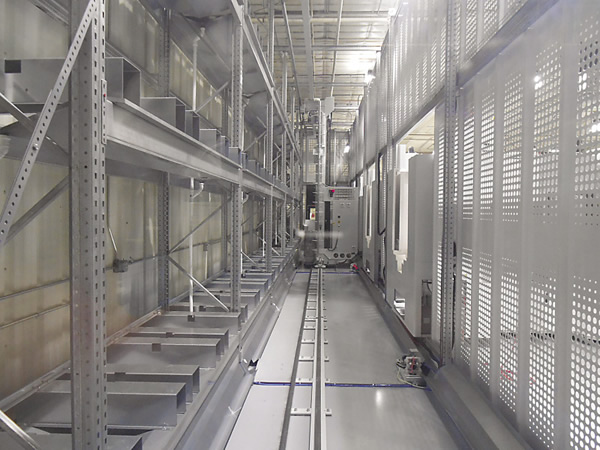
GPI installed a flexible manufacturing system to compete with offshore suppliers and revitalize the shop floor.
“Even programmers mess up sometimes,” he said. “When they do, VERICUT is there to prevent catastrophic damage to expensive equipment. It saves us in so many ways: money for repairs, machine availability, operator injury, tool damage and, ultimately, time. That’s the one thing we can’t get back.”
Just as important is program accuracy, White added. By using the software’s AUTO-DIFF function, which compares the part’s CAD model to the toolpaths used to machine it, errors such as gouging and out-of-tolerance conditions are detected in advance, avoiding costly rework. In addition, because toolpaths are graphically displayed, it’s easy for a programmer to minimize idle time and reduce inefficient code.
GPI split the initial project into two phases. The first phase involved installing two machines. The second pair will be delivered in early 2016. “We opted to go with two machines at first,” Alcala said. “This gives us a chance to figure out our processes and make sure everything is bulletproof before introducing the next set of machines. By March, we expect to have all of our cast iron running in-house.”
Implementing FMS is not simply a matter of installing the machines. GPI has been on a steep hill of process improvement, such as switching side-lock toolholders to balanced shrink-fit holders and working with a nearby tooling house to design and build a lean, SMED-style (single-minute exchange of die) hydraulic fixturing system. That system provides quick changeover between jobs, rigid workpiece clamping and repeatability.
VERICUT can also simulate probing cycles. Implementing this feature is another item on GPI’s process-improvement checklist, but Alcala said it’s nice to have. “Our first priority is to avoid causing harm to our employees. Anytime you must stick your head in the machine to prove out a program, it’s very dangerous. I’ve seen where a retention knob breaks off in-process and the tool is bouncing around inside the machine. Imagine what would happen if one of my employees were struck by that.”
Glossary terms in this article
Related




Subscribers can use MFGAxis notes, saves and discussion tools with their innoNET account.


