

Effective flute grinding
Whether you are grinding HSS or Tungsten Carbide, the flute grinding process is the most difficult feature to grind in round tool manufacturing. Though there are many reasons why, the main reason is that this operation is where most material is being removed from the tool, introducing the most heat and spindle load.
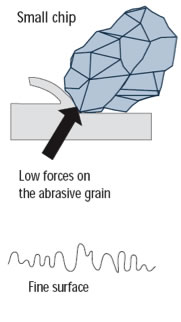
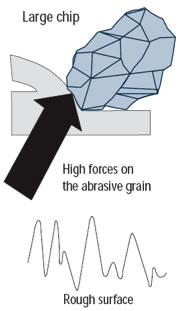
Whether you are grinding HSS or Tungsten Carbide, the flute grinding process is the most difficult feature to grind in round tool manufacturing. Though there are many reasons why, the main reason is that this operation is where most material is being removed from the tool, introducing the most heat and spindle load. There are several techniques that can be used to allow the grinding wheel to perform this operation more effectively. Before these techniques can be applied, understanding the concept of contact surface area and how it relates to force per grit is very important. From a microscopic perspective, a grinding wheel consists of thousands of cutting points. The more of these cutting points in contact with the part being ground, the more the work being done is “shared.” This allows each cutting point to remove smaller chips. As the surface area increases, this will decrease the force being done per grit, and allow the abrasive to continue working until dulling, or abrasive “pull out” occurs. A reduction in chip size will also produce a finer work piece surface finish and will cause the grinding wheel to act harder.
 |
 |
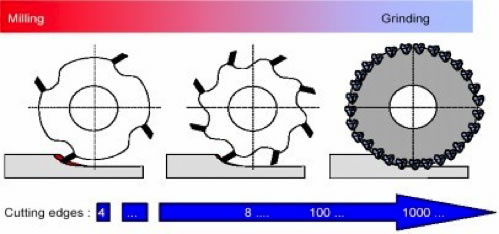
Since the grinding wheel peripheral speed directly affects the number of cutting points in contact with the work piece, a higher wheel speed will decrease the chip thickness, thus reducing the force/grit and causing the wheel to “act” harder. Lowering the wheel speed will have the adverse effect. Another method of lowering the force/grit is through abrasive concentration. Higher abrasive concentration adds more cutting points to the grinding process and would also provide better finishes and cause the wheel to act harder. Lowering the concentration will have the adverse effect.
 |
Another way to increase the effectiveness of the flute grinding process is to understand how the approach angle, or “Sku” angle, affects both the grinding wheel and tool being ground and the shape of grinding wheel. In general, an angled fluting wheel will grind with less spindle load than a straight faced wheel. The angled face tends help the wheel penetrate the work material more easily and creates less plowing. In Figure 1 courtesy of Walter United Grinding using Tool Studio shows where the energy is being applied on both the tool and the grinding wheel.
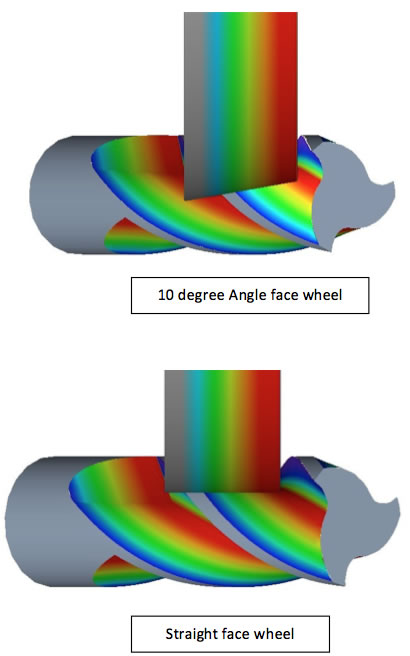
Figure 1
In the manufacturing of drills, the flute grinding process is much different than on end mills. The contact area is higher and the force/grit is much higher. There are two methods companies use to flute these tools. Method 1 utilizes straight faced wheels as this greatly reduces the amount of grinding wheel inventory used for many sized tools. However, this method tends to create high machine load and wheel wear. Most of the work being done is at the leading edge of the wheel as depicted in figure 2. Another drawback using this method is since the wheel travels below the tool, companies cannot use steady rests to help with deflection. (See figure 3).
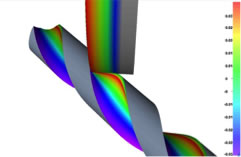
Figure 2
Review the print ads from this magazine to continue
This quick advertiser review unlocks the rest of the article and keeps the full-screen reader focused on the ads instead of the page chrome.
Advertisers included in this article experience
Print placements connected to this article
Nachiamerica
PERFECTION...
E W N AQUA DRILL EX CARBIDE DRILL SERIES AQDEXS | AQDEXR | AQDEXOH3D | AQDEXOH5D | AQDEXOH8D Ideally Suited for Hi-Temp Alloys & Stainless Steel Guaranteed “Cost per Hole” Savings 30% More Tool Life than TialN Coated Carbide Drills USA Stock (Metric & Fractional Sizes) ...PERFECTED!
E W N PERFECTION... AQUA DRILL EX CARBIDE DRILL SERIES AQDEXS | AQDEXR | AQDEXOH3D | AQDEXOH5D | AQDEXOH8D Ideally Suited for Hi-Temp Alloys & Stainless Steel Guaranteed “Cost per Hole” Savings 30% More Tool Life than TialN Coated Carbide Drills USA Stock (Metric & Fractional Sizes)
Visit Nachiamerica View this placement in the issue recordPrint ads from this magazine
E W N AQUA DRILL EX CARBIDE DRILL SERIES AQDEXS | AQDEXR | AQDEXOH3D | AQDEXOH5D | AQDEXOH8D Ideally Suited for Hi-Temp Alloys & Stainless Steel Guaranteed “Cost per Hole” Savings 30% More Tool Life than TialN Coated Carbide Drills USA Stock (Metric & Fractional Sizes) ...PERFECTED!
E W N PERFECTION... AQUA DRILL EX CARBIDE DRILL SERIES AQDEXS | AQDEXR | AQDEXOH3D | AQDEXOH5D | AQDEXOH8D Ideally Suited for Hi-Temp Alloys & Stainless Steel Guaranteed “Cost per Hole” Savings 30% More Tool Life than TialN Coated Carbide Drills USA Stock (Metric & Fractional Sizes)
Continue reading
September 2015
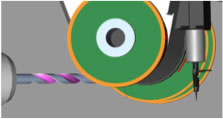
Figure 3
The other method of flute grinding drills is using full radius or gothic radius wheels. This allows stock removal to take place across the full width of the wheel thus maximizing wheel life. (See figure 4)
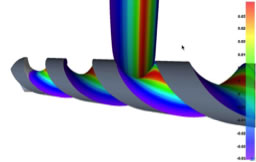
Figure 4
However this method requires the width of the grinding wheel to be very specific to the size of the drill being ground and will require many different wheel widths to accommodate different drill sizes. Because the shape of the wheel is producing the shape of the flute and not relying on the machine to generate the same geometry using severe axis repositioning as with the first method, it allows for very uniform temperature distribution and allows the use of steady rest for long flute grinding and minimize deflection. (See figure 5)
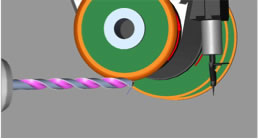
Figure 5
Glossary terms in this article
Related




Subscribers can use MFGAxis notes, saves and discussion tools with their innoNET account.


