

How flame straightening works
Metals, like all materials, expand when heated. In the case of steel, it expands 0.000006 " per inch per degree of temperature change. By using flame straightening, the technique of localized, intense heating, you can cause a small cross section of material to expand considerably and form an actual material upset, as well as the subsequent mechanical contraction of the material as it cools.
Metals, like all materials, expand when heated. In the case of steel, it expands 0.000006 ” per inch per degree of temperature change. By using flame straightening, the technique of localized, intense heating, you can cause a small cross section of material to expand considerably and form an actual material upset, as well as the subsequent mechanical contraction of the material as it cools.
The goal is to induce a large temperature difference between the area being heated and the surrounding, cooler metal. The contraction, or shrinking effect, is created by the temperature difference, or gradient. You are, in effect, creating the same conditions seen when welding: very hot, intense localized heating surrounded by a cooler base material.
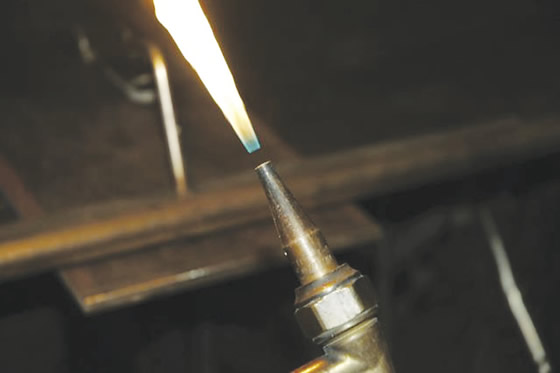
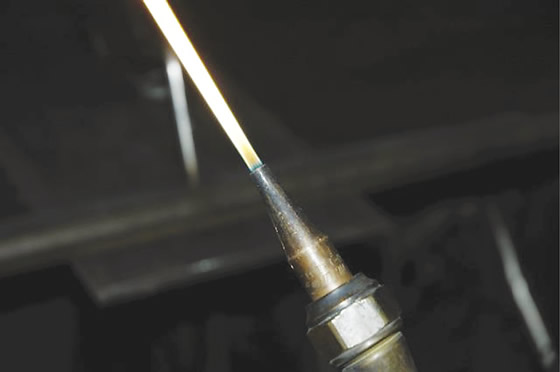
Open the fuel valve until there is a separation between the base of the pure fuel flame and the tip (left), then slowly close the fuel valve until the base of the flame reconnects with the torch tip (right). All images courtesy T. Lipton.
As this local area is heated, it tries to expand rapidly. It encounters resistance from the cooler, surrounding material, which creates pressure. This pressure flows in the path of least resistance which, in most cases, is upward along the area softened by heating. This upward swelling forms the upset. As it cools, the upset area contracts and acts like a tiny, heavy-duty turnbuckle, pulling the surrounding metal with it. This upset can be seen as a bulge on thinner materials.
One of the secrets to using this technique is controlling the heat input. The trick is to heat the material as quickly as possible in as small an area as possible. If you use a normal rosebud-type heating tip, you cannot confine the heat to a small, weld-sized zone.
The best tips for most flame straightening jobs are cutting tips. Only the preheat flame is used to form the upset. These tips heat a small area quickly, so they work well for the rapid heat input into a small area. Rosebud tips are best for large-area heating—or for burning weeds in back of the shop.
When flame straightening, always use the correct flow and fuel-and-oxygen pressure for the tip size. There is some confusion as to how far to open the fuel valve when setting a flame for a particular size. The best approach is to open the fuel valve and light the torch in the normal manner with the correct regulator pressure settings for the tip size you are using. After you have it lit, open the fuel valve until there is a separation between the base of the pure fuel flame and the tip. Slowly close the fuel valve until the base of the flame just reconnects with the torch tip. This is the correct amount of fuel for the tip. More than this and the flame will be hard and forceful; less and you are not heating efficiently.
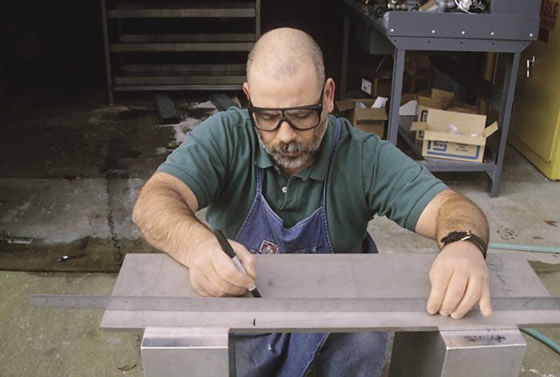
Plot the direction of the worst distortion, and move the straightedge perpendicular to the edge of the plate.
The first step in any correction job is mapping the high points with a straightedge. As a demonstration, let’s map and correct the distortion in a typical mill-supplied plate.
You will need a few tools to help you: Several straightedges of different lengths and markers that won’t wash off with water are used to plot the typical wandering distortion found in plates. I like the faithful Sharpie. It leave a hazy reminder of where you have applied shrinks even after the intense heating.
Review the print ads from this magazine to continue
This quick advertiser review unlocks the rest of the article and keeps the full-screen reader focused on the ads instead of the page chrome.
Advertisers included in this article experience
Print placements connected to this article
888-340-8665 • 888-383-8665 Fax • www.nachiamerica.com
AQUA EX FLATSERIES
A Break-Through in ak-Th Cutting ec Technology #1 Selling Flat Bottom Drill One Step Drilling with Minimal Burr 715 Pushville Rd, Greenwood, IN 46143.
AQUA EX FLATSERIES A Break-Through in ak-Th Cutting ec Technology #1 Selling Flat Bottom Drill One Step Drilling with Minimal Burr 715 Pushville Rd, Greenwood, IN 46143 888-340-8665 • 888-383-8665 Fax • www.nachiamerica.com
Visit 888-340-8665 • 888-383-8665 Fax • www.nachiamerica.com View this placement in the issue recordPrint ads from this magazine
A Break-Through in ak-Th Cutting ec Technology #1 Selling Flat Bottom Drill One Step Drilling with Minimal Burr 715 Pushville Rd, Greenwood, IN 46143.
AQUA EX FLATSERIES A Break-Through in ak-Th Cutting ec Technology #1 Selling Flat Bottom Drill One Step Drilling with Minimal Burr 715 Pushville Rd, Greenwood, IN 46143 888-340-8665 • 888-383-8665 Fax • www.nachiamerica.com
Continue reading
April 2015
The first step is to do a quick check with the straightedge along both axes of the plate to find the worst side—the one with the most severe and largest number of high spots.
For correcting plates, I like to set the plate on horses or blocks on the table. Support the plate on three points so it doesn’t rock. The best place to do this is outside the shop on the forks of a forklift with a water hose nearby. The older I get, the less I like to bend down; there is a sweet spot where you don’t have to bend too far to sight the gap between the straightedge and the plate is not too high to reach across.
To locate the high spots, use your longest straightedge first. Hopefully, it spans the entire plate width. If the straightedge is not long enough, a piece of flat bar will work. Before you begin, decide how flat you are going to make the plate. It’s pretty easy to change your standards as you work and end up doing more work than necessary.
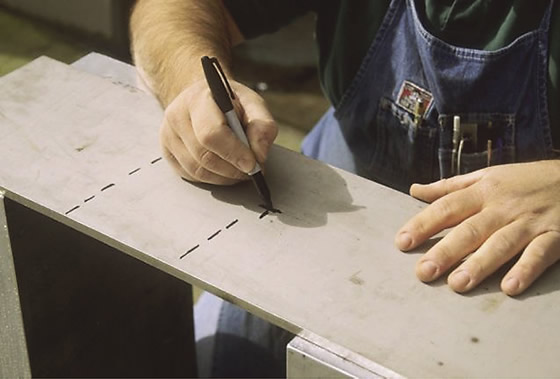
Mark the end point of a distortion to remind yourself to stop straightening at that point.
Start plotting in the direction of the worst distortion. Move the straightedge perpendicular to the edge of the plate. If the plate is round or oddly shaped, pick a direction and stick with it for the entire straightening job. As you compare the straightedge to the plate, place your eye at the same level as the gap between the plate and straightedge. This makes it easier to see the gap.
Move the straightedge along the plate. As you find the high spots, use a Sharpie to mark them in approximately 2 ” increments as you move along the plate. When you find a high spot, rock the straightedge back and forth to locate the apex. The rocking see-saw motion will show exactly where the apex is. Mark these apexes as you move along the plate. If there are two high spots, or the high spot is broad, mark the points where change is greatest.
It is common to encounter distortion that requires you to flip the plate from side to side. Do as much correction on one side as possible before working on the other side. Unless you have something to prove about your abilities as a contortionist, just flip the part—it’s too awkward to try to apply your correction while in the overhead position.
As you make your marks along the plate, use light or heavy dashes to remind you of the approximate amount of distortion. A light dash indicates a minor variation, while a heavy dash indicates a large distortion that requires a full correction. When mapping the distortion, you’ll find it often fades and ends abruptly. Mark the end point to remind yourself to stop straightening at that point. Typically, there will be several wandering dashed lines, some ending and some running the full length or width of the plate.
Now that you’ve marked the variations in the plate you want corrected, you are ready to apply the correction, which I’ll cover in next month’s column. CTE
About the Author: Tom Lipton is a career metalworker who has worked at various job shops and lives in Alamo, Calif. Lipton’s column is adapted from information in his book “Metalworking Sink or Swim: Tips and Tricks for Machinists, Welders, and Fabricators,” published by Industrial Press Inc., South Norwalk, Conn. The publisher can be reached by calling (888) 528-7852 or visiting www.industrialpress.com. By indicating the code CTE-2015 wh
Related Reading
- Related guide: Flame Resources.
Related



Subscribers can use MFGAxis notes, saves and discussion tools with their innoNET account.


