

Cut the chatter: Turning Performance
When chatter chirps, what's your first reaction? Do you quickly grab the spindle speed override, slowing the machine so you can increase the chip load per tooth? If so, you're not alone, but there are better ways to avoid chatter and improve surface finishes.
When chatter chirps, what’s your first reaction? Do you quickly grab the spindle speed override, slowing the machine so you can increase the chip load per tooth? If so, you’re not alone, but there are better ways to avoid chatter and improve surface finishes. In addition to traditional mechanical methods, new control technology can assist the operator in selecting speeds and feeds that help cut the chatter.
Chatter is caused by the inherent natural frequency of a cutting tool. The natural frequency can be affected by many process conditions: the toolholder, cutter tooling, part fixtures and machine condition. Chatter creates surface finish problems, which can be profit-killers because they compromise part quality, create scrap, delay deliveries and destroy perishable tooling. The following are some of the techniques commonly employed to combat chatter. Use these guidelines to establish a firm foundation for optimizing machining processes.
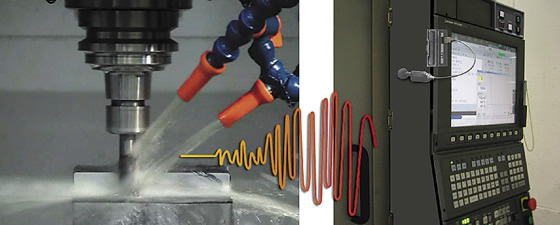
Machining Navi M-i measures chatter vibration using built-in sensors and automatically changes the spindle speed to the optimal rpm. All images courtesy Okuma America.
Common toolholders, such as side-lock holders, double-angle collets and standard ER collets, don’t provide the accuracy or stiffness needed for high-performance machining. A better option is a toolholder shank that incorporates face and taper contact to enhance accuracy and rigidity. This type of holder provides simultaneous contact between the precision ground spindle face and spindle taper, which increases rigidity and aids damping.
All appropriate rotating tools, such as endmills, facemills, drills and boring bars, can be balanced. It’s always best to balance at the highest expected spindle speed. This improves surface finishes even at low spindle speeds.
Because cutting tools can greatly influence chatter generation, a tool should be optimized with the proper substrate, geometry, coating and length-to-diameter ratio for the application. One effective way to reduce vibration is by applying tools with variable-flute geometries. Also be aware that programmers often gravitate to using the largest tool that can “fit,” but that may not be ideal.
In addition, if a part is not properly secured, it can vibrate and induce chatter. When the fixture is not designed to provide natural damping, the frequency from the fixture can trigger a tuning-fork effect. Many excellent workholders are available to clamp workpieces, but the criteria to focus on includes level of precision, clamping force, ease of use and flexibility to allow use across multiple machine tool platforms.
If you’re trying to impart fine finishes and hold tight tolerances on a poorly maintained machine, you’ll need to overcome mechanical challenges well beyond the issues listed here. Therefore, it’s critical to perform regularly scheduled maintenance on equipment to ensure the best performance.
Review the print ads from this magazine to continue
This quick advertiser review unlocks the rest of the article and keeps the full-screen reader focused on the ads instead of the page chrome.
Advertisers included in this article experience
Print placements connected to this article
roundness. www.hornusa.com
Accuracy Taken to the Extreme
An economical reaming solution that is precisely adjustable and highly accurate. Our DR reaming system and compensation chucks, with adjustable concentricity of ≤ 3 microns, allow for the preci- sion machining of bore diameters 11.9 to 140.6 mm (.469 99 to 5.535 99). Narrow inserts with a wide range of geometries, coatings, and substrates offer you immediate advantages in ease of handling.
Accuracy Taken to the Extreme An economical reaming solution that is precisely adjustable and highly accurate. Our DR reaming system and compensation chucks, with adjustable concentricity of ≤ 3 microns, allow for the preci- sion machining of bore diameters 11.9 to 140.6 mm (.469 99 to 5.535 99). Narrow inserts with a wide range of geometries, coatings, and substrates offer you immediate advantages in ease of handling, www.hornusa.com high repeatability, simple run out adjustment, extremely smooth surfaces with high cylindricity and roundness. www.hornusa.com H OR N – E X C ELL E N C E I N T E C H N O L O G Y GROOVING PARTING OFF GROOVE MILLING BROACHING PROFILE MILLING DRILLING REAMING
Visit roundness. www.hornusa.com View this placement in the issue record© 2014 SCHUNK GmbH & Co. KG
Tool extension
-SVL 60 % up to set-up time saving Hydraulic expansion toolholder Nm torque Hydraulic expansion toolholder No. 1 toolholder with more than 35 years of experience Your machining center. It’s time to make use of your machine’s full potential. Jens Lehmann, Brand Ambassador of SCHUNK, the family-owned company.
© 2014 SCHUNK GmbH & Co. KG -SVL 60 % Tool extension up to set-up time saving Hydraulic expansion toolholder Nm torque Hydraulic expansion toolholder No. 1 toolholder with more than
Visit © 2014 SCHUNK GmbH & Co. KG View this placement in the issue recordPrint ads from this magazine
An economical reaming solution that is precisely adjustable and highly accurate. Our DR reaming system and compensation chucks, with adjustable concentricity of ≤ 3 microns, allow for the preci- sion machining of bore diameters 11.9 to 140.6 mm (.469 99 to 5.535 99). Narrow inserts with a wide range of geometries, coatings, and substrates offer you immediate advantages in ease of handling.
Accuracy Taken to the Extreme An economical reaming solution that is precisely adjustable and highly accurate. Our DR reaming system and compensation chucks, with adjustable concentricity of ≤ 3 microns, allow for the preci- sion machining of bore diameters 11.9 to 140.6 mm (.469 99 to 5.535 99). Narrow inserts with a wide range of geometries, coatings, and substrates offer you immediate advantages in ease of handling, www.hornusa.com high repeatability, simple run out adjustment, extremely smooth surfaces with high cylindricity and roundness. www.hornusa.com H OR N – E X C ELL E N C E I N T E C H N O L O G Y GROOVING PARTING OFF GROOVE MILLING BROACHING PROFILE MILLING DRILLING REAMING
Continue reading
April 2015
These methods and practices can correct some causes of chatter, but will only go so far. Machining Navi is a new control technology from Okuma America that goes beyond the basics and can automatically recommend the “sweet spot” rpm for a cut, which might be faster than the one that causes chatter. The goal is to maximize machine tool performance.
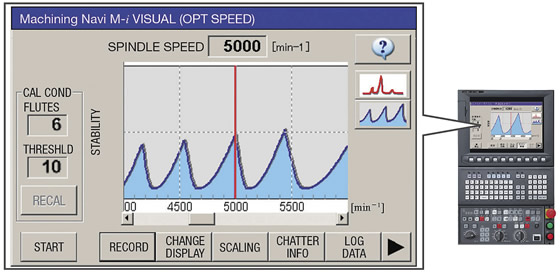
When chatter occurs, this Machining Navi M-i screen is shown on the OSP control, override is used, and the spindle speed is changed to the peak one.
For milling, Machining Navi M-i intelligently optimizes spindle speed control. Chatter vibration is measured by built-in sensors, and spindle speed can be automatically adjusted to the optimal rpm. In addition, advanced graphics of the optimal cutting conditions show effective alternatives to suppress various chatter characteristics throughout the low- to high-speed zones. This auto-mode enables operators to quickly and easily find the ideal cutting conditions.
The control technology also guides an operator to the optimal spindle speed. Using chatter noise detected by a microphone, Machining Navi M-g displays the best options for a chatter-free spindle speed. The operator then selects a recommended speed and immediately confirms the result.
For turning, Machining Navi L-g guides the harmonic spindle speed control. This allows chatter in a lathe to be suppressed by changing the spindle speed to one with the ideal amplitude and wave cycle.
Okuma ran Machining Navi during a test cut with a machine running at 1,200 rpm when chatter was detected. Instead of slowing the spindle, which operators typically do when chatter occurs, Machining Navi determined that 1,266 rpm would be optimal and recommended that speed. If the machine had been slowed, the sweet spot would have been completely missed.
When chatter is suppressed by increasing the spindle speed, throughput increases. Machining Navi enables highly efficient processes, improves surface finishes and can even reduce tool costs. This helps machinists gets the most performance from their machines. CTE
Glossary terms in this article
Related



Subscribers can use MFGAxis notes, saves and discussion tools with their innoNET account.


