

Preset in stone
When tool pre setters are integrated into a shop, a key question is who will take the measurements.
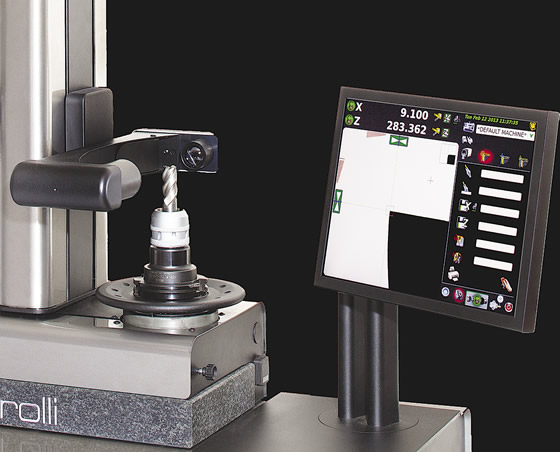
Courtesy of Koma Precision
Koma Precision’s Elbo Controlli presetters offer networked post-processing capability, allowing operators to transfer measurement data directly to the machine control.
When tool presetters are integrated into a shop, a key question is who will take the measurements.
Manual tool setup typically involves jogging the tool down to the workpiece, measuring the offsets and manually entering them into the machine’s offset table. And while some machinists can set up cutting tool assemblies this way in mere minutes, it’s likely that most shops would benefit from tool presetting. A primary benefit of presetting is the ability to run machine tools uninterrupted. But shops need to assess their needs and capabilities to get the most out of any investment in presetters.
One challenge is that some “supermachinists” are indeed as good as many presetters. Doug Sumner, product manager, tool measurement systems for BIG Kaiser Precision Tooling Inc., Hoffman Estates, Ill., noted a machinist with John Henry-caliber skills can indeed match the offsetting capabilities of a presetter tool-for-tool—though this is not often true for an entire shop.
“I’ve encountered setup operators who could load 20 tools into a machine in 20 minutes—put the tool in the spindle, touch it off, mark all the correct measurements, then onto the next one,” Sumner said. “One guy kept saying he didn’t see how a presetter would help him, and, eventually, I told him he was right, that it wouldn’t save him, personally, a bit of time. But then I asked, ‘Is that true of every operator here?’ The shop has been using presetters ever since.”
Once the value is established, the next challenge is to make sure the machinists are comfortable with the technology. Matt Ricotta, director of product marketing for Fairport, N.Y.-based Parlec Inc., said veteran machinists can be reluctant to adopt new technology, which has informed the way the company designed its software interface.
“We talk a lot about smartphones in our business,” he said. “With our software, we’ve tried to craft the interface to be intuitive in the same way that a smartphone is, to take somebody who might be afraid of new technology and make them feel comfortable using our technology.”
That interface includes using icons to represent different functions and avoiding text wherever possible. As a result, Ricotta said little training is typically required to familiarize operators with the interface.
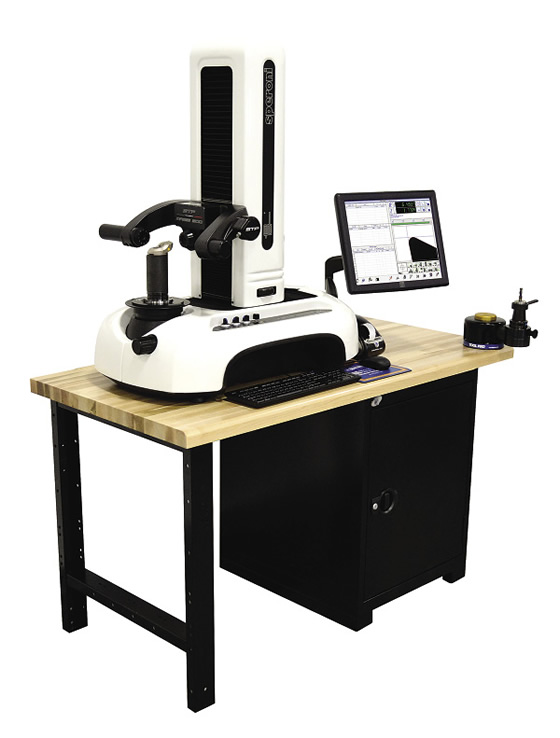
Courtesy of BIG Kaiser Precision Tooling
BIG Kaiser’s Speroni Magis “total tool setting solution” package features the addition of a workbench, storage cabinet, Tool Pro assembly device and a label printer.
Some shops have little difficulty integrating presetters into their daily operations. Toshiba’s Power System Div. in West Allis, Wis., has been using a Koma KHYAN presetter in its power generation equipment manufacturing operation for the past 2 years, according to CNC Machine Shop Supervisor Jeffrey Bradley.
“It didn’t take much to adapt our work flow to include the presetter,” he said. “After we bought it, Koma Precision spent 2 days installing the presetter and training the people in the milling department, including calibration and inspection training. The basic operation of the machine is relatively simple.”
A Touchy Subject
For machinists who are resistant to offline presetting, Haas Automation Inc. offers tool setting probes as a presetting alternative (see photo on below).
“The primary advantage of tool setting probes is the operator doesn’t have to measure the tools offline, then transfer those values into the machine tool,” said John Nelson, applications manager for the Oxnard, Calif.-based machine tool builder. “The time it takes to measure a given tool is relatively small compared to the additional labor that could go into putting each tool into the presetter, measuring it, marking the values and inputting them into the machine control.”
Haas tool probes can measure the length and diameter of the tool mounted in a lathe or mill. After making the initial setup, the automatic measurement cycle can be run at any time on any tool, ensuring tooling is still within tolerance during machining.
However, others are skeptical of using on-machine measurement techniques.
“There are touch probes that can be mounted on the table of the machine, as well as optical laser scanners, but the entire time you are measuring the offsets on the machine, you cannot cut chips,” said Jurgen Bettray, central regional sales manager for Koma Precision Inc., Windsor, Conn., which sells presetters and other machining equipment. “Having a presetter means your $500,000 machining center is not sitting idle—it’s earning its keep.”
The ideal situation may be a combination of the two.
“Some people think they don’t need a presetter because they have a tool probe, but presetters and tool probes are complementary,” said Parlec’s Ricotta. “By using a tool probe, you’re still taking up machine time that could be spent cutting chips. Tool probes can typically only give a length and a diameter, so what they’re great for is verification and qualification for critical parts. A tool presetter can gather much more information to a higher degree of accuracy, while allowing the machine spindle to keep cutting chips. Used together, you’ve got all your bases covered.”
Connect the Dots
Once a shop has decided to incorporate presetting, the question becomes what equipment to buy.
“The first consideration is how the shop wants to process its measurement data,” said Koma’s Bettray. “Once you’ve measured a tool on the presetter, you can either write the information down, print a label or post-process it either to a USB drive or through the shop’s computer network directly to the machine. All of our presetters are networkable, and even the entry-level presetters have the capability to do basic post-processing, but it all depends on how many measurements the customer wants to collect and what they want to do with the data.”
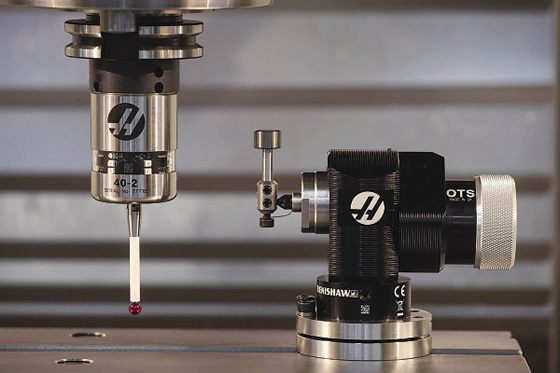
Courtesy of Haas Automation
Haas tool probes can measure the length and diameter of the cutting tool mounted in a lathe or mill.
The direct transfer of measurement data from presetter to machine tool eliminates the risk of operator data-entry error, he continued, because when printing a label, the figures must be entered manually into the machine control and writing the numbers down by hand creates two opportunities for errors. So, while not all shops have networks to support post-processing, Koma advises its customers to consider the benefits of this capability.
Parlec presetters also support connectivity via RS-232 or Ethernet, with more advanced Parlec models that feature more connectivity options and post-processing capabilities. In addition, Ricotta said Parlec sits on the technical advisory group of MTConnect and hopes to eventually support presetter connectivity via the MTConnect standard. BIG Kaiser’s base-level Diaset presetter does not offer post-processing, but the entire Speroni line comes with networking capability.
Review the print ads from this magazine to continue
This quick advertiser review unlocks the rest of the article and keeps the full-screen reader focused on the ads instead of the page chrome.
Advertisers included in this article experience
Print placements connected to this article
Fax+1 817 258 3221, [email protected] www.iscarmetals.com
15,000
) Indexable Solid Carbide Endmill Options 3/13/14 2:25 PM.
) 15,000 Indexable Solid Carbide Endmill Options ISCAR METALS INC. Tel + 1 817 258 3200, Tech Tel 1-877-BY-ISCAR, Fax+1 817 258 3221, [email protected] www.iscarmetals.com 3/13/14 2:25 PM
Visit Fax+1 817 258 3221, [email protected] www.iscarmetals.com View this placement in the issue recordPrint ads from this magazine
) Indexable Solid Carbide Endmill Options 3/13/14 2:25 PM.
) 15,000 Indexable Solid Carbide Endmill Options ISCAR METALS INC. Tel + 1 817 258 3200, Tech Tel 1-877-BY-ISCAR, Fax+1 817 258 3221, [email protected] www.iscarmetals.com 3/13/14 2:25 PM
Continue reading
September 2014
Training Days
Okay, so your shop has seen the value of a presetter … now, how does it work?
Entry-level presetter models tend to be the easiest to use, and operators can grasp the fundamentals quickly (see sidebar on below). For example, BIG Kaiser’s Diaset is simple enough that operators are ready to measure tools after a day of instruction.
As for who should use the presetter, that depends upon the shop’s configuration. “We have some customers who put the presetter in the toolcrib and have a designated tool manager who presets every tool for the entire shop,” Koma’s Bettray said. “We have other customers who assign a presetter to each machine cell so operators can do their own presetting.”
Toshiba’s Power Systems Div. has operators preset their own tools, maintaining individual machine files. However, Bettray and Ricotta said shops tend to get more consistent results with a centralized presetter, with Ricotta adding that a hybrid approach can be best for larger shops.
“In our in-house machine shop, we actually have one central presetter in the toolcrib, with several satellite presetters scattered around the factory,” Ricotta said. “So, a job will be set up in the toolcrib and be kitted for our next changeover, but we have the satellite presetters for when a tool gets dull or breaks and the operator needs to set up a single tool to continue the job.”
Applied Engineering Inc. has been using Parlec presetters for more than 10 years, according to setup lead Trent Schmidt, noting the user-friendly interface makes it easy for new employees to learn basic functions. The Yankton, S.D., machine shop opts for a single, central presetter, with a designated tool manager on each shift. “Each machine gets at least one tool change per day, so being able to preset the tools offline definitely saves time,” he said. “Operator error does happen, but it’s extremely rare.”
The shop utilizes roughly 30 machine tools running 24/7, and, with more than 10,000 tool changes every year, only encounters five or six errors stemming from bad measurement data each year.
But when a shop relies on just one tool manager per shift, putting the right individual in the toolcrib can make or break the entire operation.
“In a shop where you’ve got a lot of experienced machinists, if you put a new guy in the crib to handle the tooling, all he’s got to do is set one tool wrong and nobody will trust him,” said BIG Kaiser’s Sumner. “They’ll be touching off their own tools from then on, because they aren’t confident that the information on the label is right.”
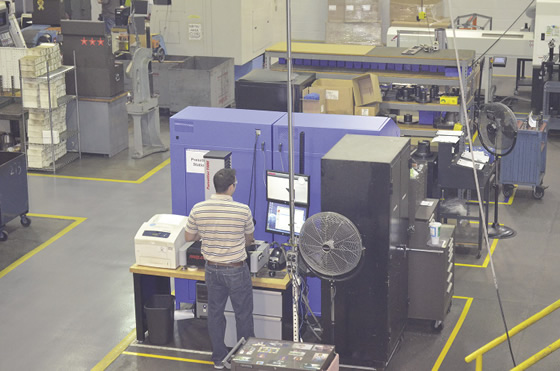
Courtesy of Parlec
A machine operator in Parlec’s in-house machine shop measures a tool on a Parlec series 1550 TMM presetter.
The best choice, he continued, is an experienced operator who’s tired of being an operator and is, perhaps, looking for a change of pace before retirement. “The guys on the floor already trust him, because he’s one of them. Not only are the chances of him setting up a tool incorrectly very slim, but even if he does, he can admit to the mistake and the rest of the shop will accept it and move on.”
Ultimately, however a shop decides to manage setup responsibilities, consistency is key—and the path to consistency is simple, if not easy, according to Parlec’s Ricotta.
“Operators should know as much as they can about their assemblies,” he said. “That means using holders, collets and cutting tools at the same parameters every time, because that consistency provides better results. Tooling needs to be clean and set to the manufacturer’s specifications. By doing that, you can almost eliminate the chance of a bad tool being sent out of the toolcrib and causing a crash or a scrap workpiece.
“We understand that, in our business, it’s not always possible, that sometimes you have to use what you’ve got,” he continued, “but the best practices are to do everything exactly the same way every single time.” CTE
Presetting for newbies
Machine shops that have never used a presetter may want to start slow and build from there. An entry-level system would be a good choice, said Matt Ricotta of Parlec Inc. For example, the company’s Parlevision G3 software package or the Parlec Origin presetter both have single-screen interfaces. “That means there’s no flipping between pages, and everything’s right in front of the operator, so it’s very easy to use.”
However, shops that have never used a presetter might be hesitant to commit to something if they aren’t convinced of the benefit, according to Jurgen Bettray of Koma Precision Inc. As a result, Koma offers shops the opportunity to bring their own tools for measurement in the company’s East Windsor, Conn., showroom, as well as a 30-day free trial period on some presetter models.
“We also offer presetter profitability calculators that allow you to input various factors like number of machines, number of shifts, how many tool changes per shift, work days, cost per hour. At the end, it will give you an estimate of how much money you could save per machine per year by using a presetter,” Bettray said. “So to anyone who has the mindset that a presetter is fine but unnecessary because it doesn’t make chips, we can make the argument that a presetter enables your other machines to make chips at all times.”
—E. Jones Thorne
Contributors
Applied Engineering Inc.
(605) 665-4425
www.appliedeng.com
BIG Kaiser Precision Tooling Inc.
(888) 866-5776
www.bigkaiser.com
Haas Automation Inc.
(800) 331-6746
www.haascnc.com
Koma Precision Inc.
(800) 249-5662
www.komaprecision.com
Parlec Inc.
(800) 866-5872
www.parlec.com
Toshiba Power Systems Div.
(800) 231-1412
www.toshiba.com/tic/power-systems
Glossary terms in this article
Related


Subscribers can use MFGAxis notes, saves and discussion tools with their innoNET account.


