

2 CNC machines, 1 robot, no profits
Here's why it costs less to have a robot covering each CNC machine.
Over the years, many machine shop owners have asked if it is a good idea to automate two CNC machines with a single robot system. Although at first glance it appears to make sense, there are several reasons why it is not a profitable proposition for small and medium production runs:
Flexibility and safety. When you want to load two machines with one robot, you need to crowd the machines and robot together so the robot can reach both CNC machines, as well as install a safety fence around the entire cell to meet OSHA requirements. This arrangement makes it difficult for a machinist to have easy, adequate access to the CNC for setup, programming and adjustments. One other option is to use a larger, more expensive robot with a longer reach, but this robot will take up more room inside the CNC machine and may interfere with the spindle or tools.
Cycle times. To be efficient, cycle times of the CNC machines must be timed perfectly. Otherwise, there is a risk that the robot and a CNC could wait for one part operation to be completed before loading the other CNC, and at most job shops these processes vary significantly.
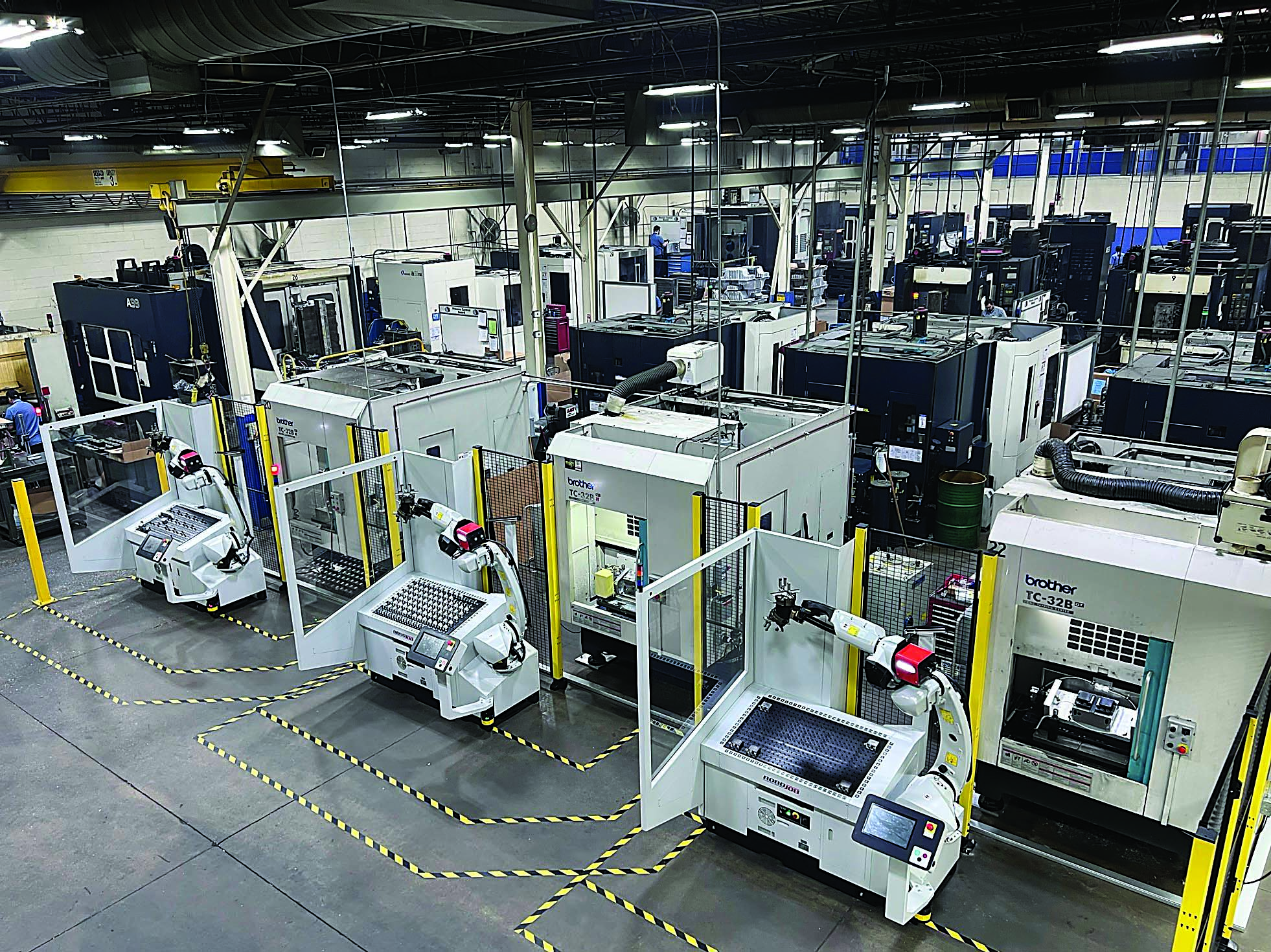
For maximum safety and efficiency, ideally each CNC machine is governed by a dedicated robot. Image courtesy of C. Zoberis
Accessibility. Ideally, machine-tending robots are mounted on an incline to allow the machine opening to stay clear for the machinist to operate manually for first articles and enable tool changing. The angle of the robot is defined in a specific way to easily access the machine clamping device without mounting directly in front of the machine. The consequence is that it is not possible for the robot to reach a second CNC because it is out of the robot’s mechanical limits. This means that if the robot wants to reach two machines, it must be placed right in front of the doors of the machines — thus you will lose operator access to both machines.
Review the print ads from this magazine to continue
This quick advertiser review unlocks the rest of the article and keeps the full-screen reader focused on the ads instead of the page chrome.
Advertisers included in this article experience
Print placements connected to this article
Ceratizit
Search for efficiency, find flexibility
Ceratizit promotes the MaxiMill 271 and its eight usable cutting edges for economical, flexible milling.
Search for efficiency, find flexibility Ceratizit promotes the MaxiMill 271 and its eight usable cutting edges for economical, flexible milling. Visit cuttingtools.ceratizit.com to learn more.
Visit Ceratizit View this placement in the issue recordPrint ads from this magazine
Ceratizit promotes the MaxiMill 271 and its eight usable cutting edges for economical, flexible milling.
Search for efficiency, find flexibility Ceratizit promotes the MaxiMill 271 and its eight usable cutting edges for economical, flexible milling. Visit cuttingtools.ceratizit.com to learn more.
Continue reading
April 2023
Gripping systems. A typical robot end effector has two pneumatic gripping heads with adjustable fingers: one head for rough parts and one for finished parts. If the stroke of the gripper is not the exact size for each part operation, the robot system has to be equipped with a servodriven gripper. This option is expensive and has a limited payload.
Installation and interfacing. Installation requires more engineering and development time to communicate reliably and safely between CNCs. This becomes a very customized integration and leads to higher costs, a longer initial startup and an increase in integration risk.
There are few cases when one robot loads multiple machines as a profitable solution. One example we see often is at automobile factories where there is mass production. However, these are highly customized solutions in which an integrator programs the parts for a couple of months and then production runs for many years without changing the process.
At a machine shop, you can have multiple setups per day and lose out on flexibility and profit. In the end, our customers find that it costs less to have a robot for each CNC than to have a robot capable of handling two machines.
To view a video of this robotic automation, visit qr.ctemag.com/1gu2s
QR codes and videos from this issue
Print QR codes, video callouts, and in-magazine links for this article now point to the CTE video hub in the HTML version.






