

Advanced coating advances tapping: Drilling Performance
Eliminate tool breakage when tapping stainless steel. A tap with a new multiple-layered coating and an advanced chamfer geometry, rake and flute form.
END USER: Mid Valley Industries LLC, (920) 759-0314, www.mvii.com.
CHALLENGE: Eliminate tool breakage when tapping stainless steel.
SOLUTION: A tap with a new multiple-layered coating and an advanced chamfer geometry, rake and flute form.
SOLUTION PROVIDER: Emuge Corp., (800) 323-3013, www.emuge.com.
Because tapping is often one of the final machining operations during part production, a broken tap that causes a part to be scrapped can be costly. Mid Valley Industries LLC found that out when tapping 316-L stainless steel parts for fluid-recovery applications in the oil and gas industry. The Kaukauna, Wis., contract manufacturer specializes in short runs of large parts made of various materials, including Inconel, Monel, Hastelloy, steel and aluminum.
CNC Programming Manager Chad Kluth explained that each of the oil-and-gas parts has a material cost of $1,700, requires threading 48 holes with a ¼-20 tap and features ground surfaces with a 32-rms finish. “If we damage any of those surfaces, we’re out of luck and that part could be unusable,” Kluth said. “There is no way to fix it short of weld repair.”
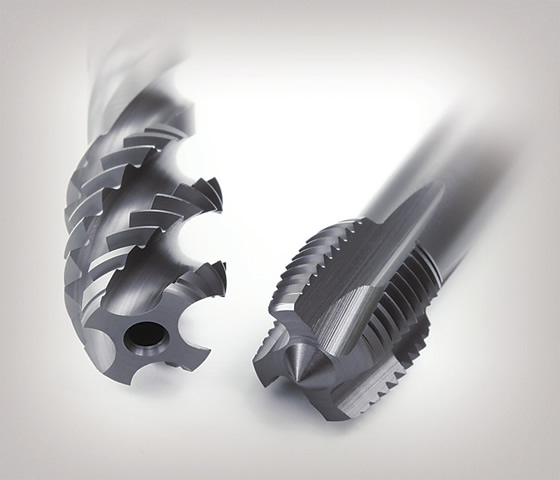
Courtesy of Emuge
Emuge Z-Taps have a multilayer coating, which enables efficient chip evacuation.
In addition to tap breakage, the issue of tool life is often encountered when tapping. Kluth noted one of the taps the shop was applying typically didn’t last 10 holes before breaking while running at 5 to 10 sfm (1.5 to 3.0 m/min.). Also, Mid Valley experienced thread size and tearing issues, which prevented a thread gage from being inserted.
To avoid tap breakage, Mid Valley tried various cutting oils and coolant formulations, but without success. The shop also resorted to starting the tapping process on a vertical machining center, then switching to hand tapping. Manually threading the gummy material, however, consumed 4 to 5 hours per part. “And sometimes we were still breaking the tap,” he said. Besides being time-consuming, hand tapping also means the machine tool sits idle.
Thread milling enables part manufacturers to avoid removing a tool stuck in a hole if the tool breaks, but Mid Valley found carbide thread mills for that size hole were prohibitively expensive and the process consumed too much time compared to tapping on a machine, according to Kluth.
Seeking a solution, Kluth turned to Jason Kasinski, an Emuge Corp. sales representative based in Milwaukee. Kasinski immediately recommended Emuge’s Z-Tap. According to the West Boylston, Mass., high-performance cutting tool manufacturer, the taps have an advanced chamfer geometry and rake and flute form, an increased number of flutes and a shortened thread section to reduce friction and lower torque requirements. This helps reduce tap breakage and enables higher cutting speeds.
Review the print ads from this magazine to continue
This quick advertiser review unlocks the rest of the article and keeps the full-screen reader focused on the ads instead of the page chrome.
Advertisers included in this article experience
Print placements connected to this article
1.855.368.2498 • [email protected]
Technology too small to see.
Results too big to ignore. Leading the Nano-Revolution with inserts that last twice as long as nearest competitor*. Only our patented nano-composite and nano-structured solutions can achieve these results. Visit our booths at IMTS: 1092-W and the Emerging Technology Center Nano-manufactured cutting tool solutions A Creation of.
Technology too small to see. Results too big to ignore. Leading the Nano-Revolution with inserts that last twice as long as nearest competitor*. Only our patented nano-composite and nano-structured solutions can achieve these results. Visit our booths at IMTS: 1092-W and the Emerging Technology Center *Results may vary depending on testing conditions. Go to www.nanomech.com/legal for details Nano-manufactured cutting tool solutions A Creation of 1.855.368.2498 • [email protected]
Visit 1.855.368.2498 • [email protected] View this placement in the issue recordhttp://ow.ly/zbra2
learn more
- IRN • make setups fast & easy • machine 5 sides freely IMTS Booth • satisfaction guaranteed W-1075 All types of magnets for milling & turning Call our Indianapolis office for more information
- IRN http://ow.ly/zbra2 learn more • make setups fast & easy • machine 5 sides freely IMTS Booth • satisfaction guaranteed W-1075 All types of magnets for milling & turning Call our Indianapolis office for more information.
Visit http://ow.ly/zbra2 View this placement in the issue recordPrint ads from this magazine
Results too big to ignore. Leading the Nano-Revolution with inserts that last twice as long as nearest competitor*. Only our patented nano-composite and nano-structured solutions can achieve these results. Visit our booths at IMTS: 1092-W and the Emerging Technology Center Nano-manufactured cutting tool solutions A Creation of.
Technology too small to see. Results too big to ignore. Leading the Nano-Revolution with inserts that last twice as long as nearest competitor*. Only our patented nano-composite and nano-structured solutions can achieve these results. Visit our booths at IMTS: 1092-W and the Emerging Technology Center *Results may vary depending on testing conditions. Go to www.nanomech.com/legal for details Nano-manufactured cutting tool solutions A Creation of 1.855.368.2498 • [email protected]
Continue reading
September 2014
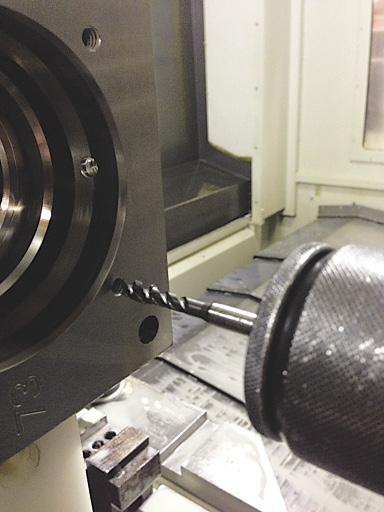
Courtesy of Mid Valley Industries
An Emuge GLT-1-coated Z-Tap finishes threading a 316-L stainless steel part.
In addition, Kluth emphasized that the tap’s GLT-1 multilayer coating is effective for threading challenging workpiece materials, such as 316-L stainless. “The coating is really impressive,” he said.
According to Emuge, this is because the coating has an outer antifriction layer and is structured with characteristics that resist heat and help form a consistent, controllable chip that releases smoothly from the hole.
To ensure the Z-Tap was the right tool for the job, Mid Valley tested it by drilling and tapping 200 holes at 20 sfm (6.1 m/min.) in a test part, Kluth explained. “We tapped all 200 holes and the tap looked like it was not even used.”
For optimal results, Emuge recommends applying Z-taps on CNC machines with synchronous spindles using emulsion coolant and synchronous tap holders, which Mid Valley does.
Since switching to the Z-Tap several months ago, Mid Valley has not broken one tap, though it switches taps after each part to avoid the risk of breaking one and having to use the time- and money-eating tap burner, Kluth said. “If put to the test, I would bet we could get four or five parts out of one tap.”
The shop also applies the tap for three other part families made of stainless steel. “I have not tried it on anything harder, like 4140,” he said, “but, usually, if it works well in stainless, it will work well in anything.”
Kluth added that another 316-L stainless job for a different oil-field application requires a screw thread insert (STI) tap and tool breakage issues caused him to again seek a solution from Emuge. Emuge offers taps for STI applications, which do not come standard with a GLT-1 coating, but Emuge can customize the taps with this coating. Based on Kasinski ‘s recommendation, Mid Valley buys Emuge taps for STI applications that are stocked standard in a bright finish and then upgraded by Emuge with the GLT-1 coating. “They work just wonderfully,” Kluth said.
Glossary terms in this article
Related


 MFGAxis Discussion
Be part of the shop-floor conversation
Like, save, or comment on this CTE story.
MFGAxis Discussion
Be part of the shop-floor conversation
Like, save, or comment on this CTE story.


MFGAxis Discussion