

The contours of a robotic 3D-printing platform
Arevo Labs hopes its new RAMP leads to better 3D-printed componets for the defense and aerospace industries. Arevo touts RAMP (Robot-based Additive Manufacturing Platform) as the first system of its kind optimized for 3D printing of composite thermoplastic parts. The system includes a 6-axis robot arm and end-effector hardware for deposition.
Arevo Labs hopes its new RAMP leads to better 3D-printed componets for the defense and aerospace industries.
Arevo touts RAMP (Robot-based Additive Manufacturing Platform) as the first system of its kind optimized for 3D printing of composite thermoplastic parts. The system includes a 6-axis robot arm and end-effector hardware for deposition. RAMP can accommodate build envelopes from 1,000 cu. mm to 8 cu. m, depending on the size of the robot used. The end effector consists of a deposition head with special thermal management technology for processing carbon-fiber-reinforced thermoplastics.

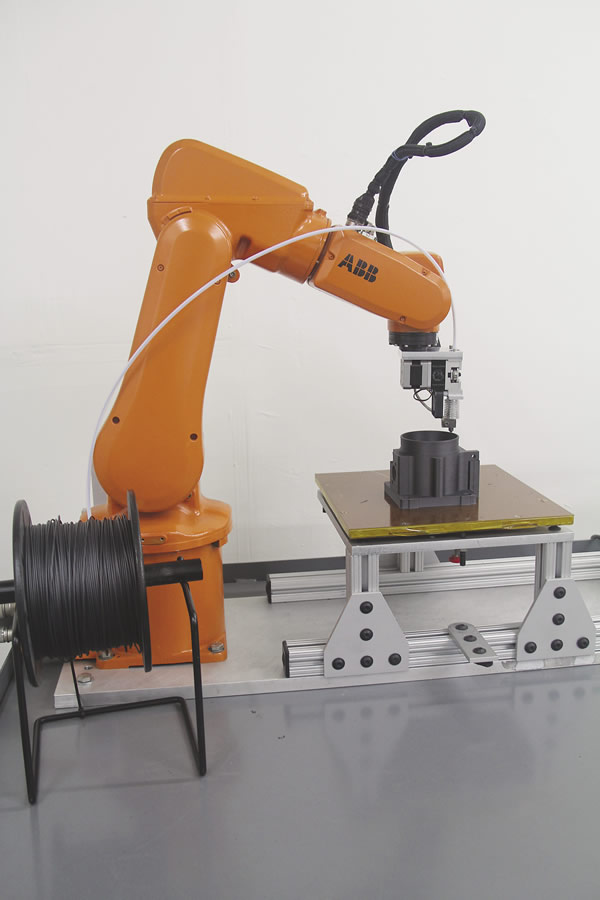
RAMP prints in three dimensions rather than two. Image courtesy Arevo Labs.
RAMP’s CAM software converts CAD models into a set of deposition instructions for the robot. In addition, the software suite includes a kinematics simulator that interprets complex deposition instructions and optimizes part-construction paths.
Review the print ads from this magazine to continue
This quick advertiser review unlocks the rest of the article and keeps the full-screen reader focused on the ads instead of the page chrome.
Advertisers included in this article experience
Print placements connected to this article
Cutting Tool Engineering
Double the size of your ad in
CUTTING TOOL ENGINEERING—ON US! www.ctem RING DELIVE ODS of CTE and—for the same price—buy a second Issue Vol. 68 April 2016 THE GO ling dr ives Schedu ents e shipm ad that’s twice the size. on-tim (Second ad must run by the December 2016 issue.) ity productiv boost VMC Pallets ng ll-hole bori Better sma floor the shop take to.
Double the size of your ad in CUTTING TOOL ENGINEERING—ON US! www.ctem ag.com Purchase a display ad in the July 2016 issue RING DELIVE ODS of CTE and—for the same price—buy a second Issue Vol. 68 April 2016
Visit Cutting Tool Engineering View this placement in the issue recordPrint ads from this magazine
CUTTING TOOL ENGINEERING—ON US! www.ctem RING DELIVE ODS of CTE and—for the same price—buy a second Issue Vol. 68 April 2016 THE GO ling dr ives Schedu ents e shipm ad that’s twice the size. on-tim (Second ad must run by the December 2016 issue.) ity productiv boost VMC Pallets ng ll-hole bori Better sma floor the shop take to.
Double the size of your ad in CUTTING TOOL ENGINEERING—ON US! www.ctem ag.com Purchase a display ad in the July 2016 issue RING DELIVE ODS of CTE and—for the same price—buy a second Issue Vol. 68 April 2016
Continue reading
May 2016
RAMP’s multiple-axis toolpaths give it a dimension that competitive 3D printers lack, according to Hemant Bheda, Arevo’s CEO and cofounder. Previously, Bheda explained, all 3D printing has been done in the Cartesian (X-Y) plane, with one flat layer deposited on top of another. But RAMP does what Bheda described as “true” 3D printing, which means printing 3D contoured surfaces rather than flat layers.
This is important for a couple of reasons. For one, Bheda noted true 3D printing strengthens parts by eliminating the possibility that forces in the Z-axis direction will cause stacked, printed layers to delaminate. With the RAMP process, “you have continuity across Z, while in other cases you would not,” he said.
In addition, Bheda pointed out that RAMP’s brand of 3D printing improves part aesthetics by eliminating the visible striations, or “stair stepping,” that result from stacking flat, printed layers on top of each other.
RAMP is also designed to accommodate secondary processes. For example, some machining is required to remove additive-manufacturing support material once a 3D printing process has concluded. At that point, Bheda said, a toolchanger can be used to make the switch from a deposition tool to one that allows the system to do the necessary machining.
For more information about Arevo Labs, Santa Clara, Calif., visit www.arevolabs.com or call (408) 780-3993.
Glossary terms in this article
Related


Subscribers can use MFGAxis notes, saves and discussion tools with their innoNET account.


