

Development of kilogram and second
Originally called a grave, meaning heavy, learn more about the history of the kilogram.
King of France Louis XVI commissioned a group of scientists, including the prominent Antoine Lavoisier (1743-1794), to create a unit of mass. It originally was called grave, meaning heavy. This name was changed to kilogram in 1795.
On Sept. 28, 1889, the first meeting of the General Conference on Weights and Measures, also known as CGPM, determined that the international and national prototypes of the kilogram would be made of the alloy of platinum with 10% iridium, accurate to within 0.0001%. The difference between the national and international kilogram is within 1 mg (0.00004 oz.).
The prototype of the kilogram is a right-circular bar, in which the height equals the diameter, of 39.17 mm (1.54″). This bar is kept at the International Bureau of Weights and Measures and known as Le Grand K.
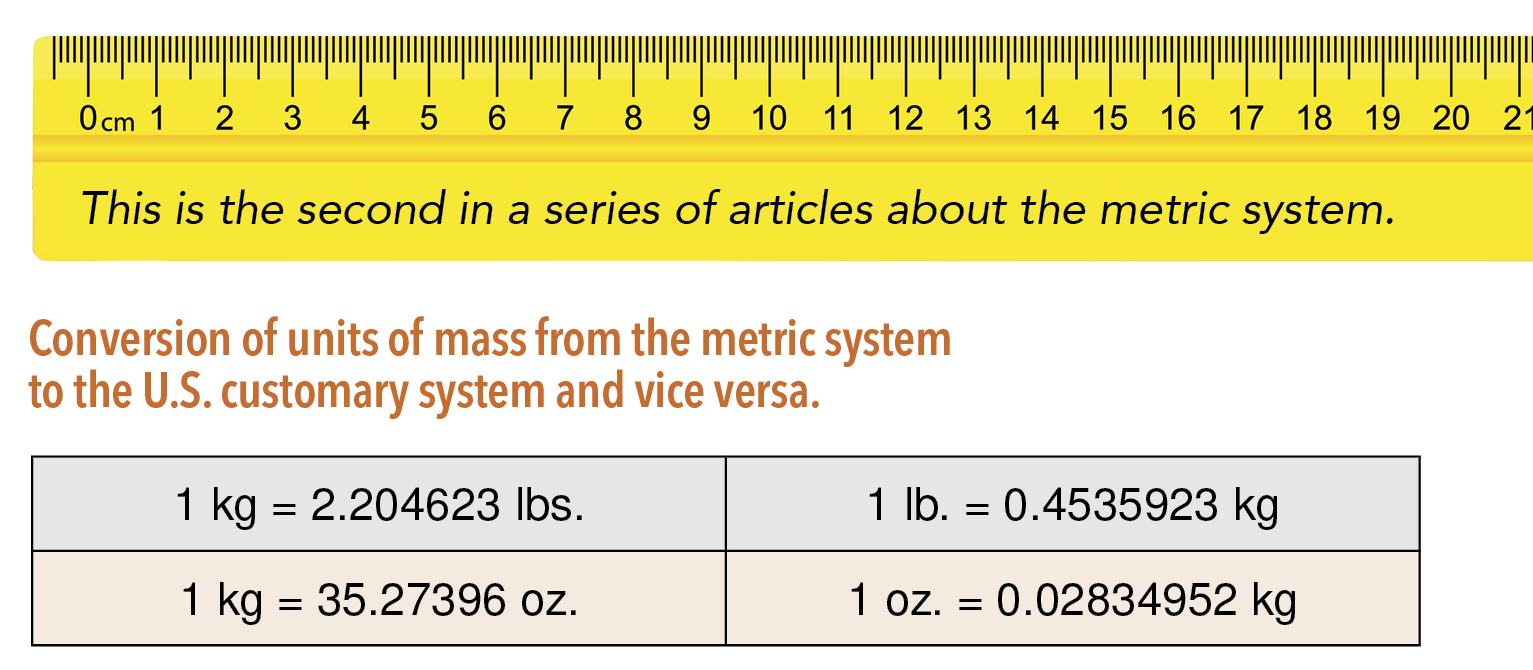
The most accurate measurements revealed that the mass of the international prototype was a bit greater than the mass of 1 dm3 of water (about 0.028 g, or 0.001 oz.). Since it was decided to leave the international prototype unchanged, the holding capacity of 1 L (33.8 fluid oz.), which is equal to the volume of 1 kg (2.2 lbs.) of water at 4° C (39.2° F), became a little greater than 1 dm3 (61.02 cu. in.), where 1 L equals 1.000028 dm3.
On Oct. 13, 1964, the 12th CGPM meeting authorized the equality: 1 L equals exactly 1 dm3.
Review the print ads from this magazine to continue
This quick advertiser review unlocks the rest of the article and keeps the full-screen reader focused on the ads instead of the page chrome.
Advertisers included in this article experience
Print placements connected to this article
Tungaloy America | [email protected] | 888.554.8394
ACCELERATED TURNING
Vibration Free Deep Hole Boring Ultimate solution for tool overhang challenges up to L/D = 10 Wide range of shank diameters from 16 mm to 60 mm Exchangeable boring head compatible with positive and negative insert options.
ACCELERATED TURNING Vibration Free Deep Hole Boring Ultimate solution for tool overhang challenges up to L/D = 10 Wide range of shank diameters from 16 mm to 60 mm Exchangeable boring head compatible with positive and negative insert options Tungaloy America | [email protected] | 888.554.8394 www.tungaloy.com/us
Visit Tungaloy America | [email protected] | 888.554.8394 View this placement in the issue recordNachiamerica
REVO lutionizing
Drilling Double the Amount of Coolant Released Get Better Chip Evacuation and Keep Your Drill Cooler Longer... ...with the All New Aqua REVO from Nachi.
REVO lutionizing Drilling Double the Amount of Coolant Released Get Better Chip Evacuation and Keep Your Drill Cooler Longer... ...with the All New Aqua REVO from Nachi www.nachiamerica.com 888-340-8665
Visit Nachiamerica View this placement in the issue recordPrint ads from this magazine
Vibration Free Deep Hole Boring Ultimate solution for tool overhang challenges up to L/D = 10 Wide range of shank diameters from 16 mm to 60 mm Exchangeable boring head compatible with positive and negative insert options.
ACCELERATED TURNING Vibration Free Deep Hole Boring Ultimate solution for tool overhang challenges up to L/D = 10 Wide range of shank diameters from 16 mm to 60 mm Exchangeable boring head compatible with positive and negative insert options Tungaloy America | [email protected] | 888.554.8394 www.tungaloy.com/us
Continue reading
March 2020
Regarding time, in 1656, Christiaan Huygens (1629-1695), a Dutch physicist, mathematician, astronomer and inventor, made the first pendulum-driven clock. It had an error of less than one minute a day. His later refinements reduced its errors to less than 10 seconds a day.
On Oct. 14, 1954, the 10th CGPM meeting asked the International Committee for Weights and Measures to define the fundamental unit of time.
In 1955, Louis Essen (1908-1997), an English physicist, built the first atomic clock based on transition of the cesium-133 atom at the National Physical Laboratory in London. The clock, accurate to one second in 300 years, was sufficient to detect irregularities in Earth’s spin.
On Oct. 16, 1967, the 13th CGPM meeting decided that the SI unit of time is the second defined as follows: “The second is the duration of 9,192,631,770 periods of the radiation corresponding to the transition between the two hyperfine levels of the ground state of the cesium-133 atom.”
On Oct. 3, 1991, the 19th CGPM meeting noticed that the accuracy of clock comparisons had improved greatly through use of satellite techniques. The conference recommended that the coordinates adopted for antennas used in single-way time comparison by satellite techniques correspond to their real position in the terrestrial reference system of the International Earth Rotation and Reference Systems Service. It is responsible for maintaining global time, providing data on Earth’s orientation and announcing leap seconds — that is, one-second adjustments.
Related




Subscribers can use MFGAxis notes, saves and discussion tools with their innoNET account.


