

Hurricane-resilient wind turbines: Research & Innovation
Wind technology literally is growing. Today's offshore wind turbines can tower about 500', their spinning blades churning out up to 8 MW each — roughly enough to power 4,000 U.S. homes.
Wind technology literally is growing. Today’s offshore wind turbines can tower about 500′, their spinning blades churning out up to 8 MW each — roughly enough to power 4,000 U.S. homes.
But with greater size comes challenges. Off the East Coast, where turbines are in the United States, increasingly powerful Atlantic Ocean hurricanes pose risks to the structures and to the future of wind energy. To make those turbines more hurricane-resilient, a team of University of Colorado, Boulder researchers has taken a cue from nature and turned around turbines.
“We are very much bio-inspired by palm trees, which can survive these hurricane conditions,” said Lucy Pao, Palmer endowed chair in the department of electrical, computer and energy engineering.
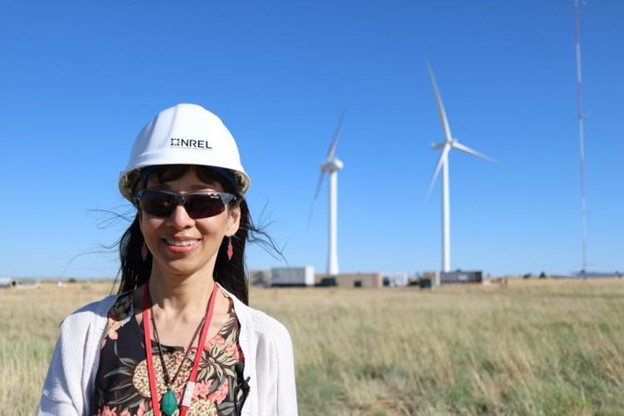
Lucy Pao stands at the National Renewable Energy Laboratory’s Flatirons campus with the 53.38-kW SUMR-D directly to her right. Image courtesy of K. Simpkins/University of Colorado, Boulder
Traditional upwind turbines face incoming wind. To avoid being blown into the tower, a blade must be sufficiently stiff. A lot of material is required to build these relatively thick, massive blades, which drives up their cost. Turbine blades on downwind rotors, however, face away from wind, so there’s less risk of a blade hitting the tower when wind picks up. This means that blades can be lighter and more flexible, which needs less material and therefore less money to make. These downwind blades also can bend instead of break in the face of strong winds, much like palm trees.
Review the print ads from this magazine to continue
This quick advertiser review unlocks the rest of the article and keeps the full-screen reader focused on the ads instead of the page chrome.
Advertisers included in this article experience
Print placements connected to this article
Platinumtooling
THE NAME TO KNOW FOR...
LIVE TOOLS / ANGLE HEADS / SPEED MULTIPLIERS SWISS COMPONENTS / MARKING TOOLS / KNURLING TOOLS Platinum Tooling is the exclusive North American importer of Heimatec Live Tools and Angle Heads, Tecnicrafts Swiss Collets and Guide Bushings, Henninger Spindle Speeders, AMF Cleaners and Markers and Quick Knurling and Marking Tools
THE NAME TO KNOW FOR... LIVE TOOLS / ANGLE HEADS / SPEED MULTIPLIERS SWISS COMPONENTS / MARKING TOOLS / KNURLING TOOLS Platinum Tooling is the exclusive North American importer of Heimatec Live Tools and Angle Heads, Tecnicrafts Swiss Collets and Guide Bushings, Henninger Spindle Speeders, AMF Cleaners and Markers and Quick Knurling and Marking Tools. Platinum Tooling offers a wide selection of machine tool accessories for most machine brands, including standard and custom tools to help with the most challenging applications. If you need live tooling, we’re here to help. 16 E. Piper Lane, Ste.128 | Prospect Heights, IL | 847-749-0633
Visit Platinumtooling View this placement in the issue recordPrint ads from this magazine
LIVE TOOLS / ANGLE HEADS / SPEED MULTIPLIERS SWISS COMPONENTS / MARKING TOOLS / KNURLING TOOLS Platinum Tooling is the exclusive North American importer of Heimatec Live Tools and Angle Heads, Tecnicrafts Swiss Collets and Guide Bushings, Henninger Spindle Speeders, AMF Cleaners and Markers and Quick Knurling and Marking Tools
THE NAME TO KNOW FOR... LIVE TOOLS / ANGLE HEADS / SPEED MULTIPLIERS SWISS COMPONENTS / MARKING TOOLS / KNURLING TOOLS Platinum Tooling is the exclusive North American importer of Heimatec Live Tools and Angle Heads, Tecnicrafts Swiss Collets and Guide Bushings, Henninger Spindle Speeders, AMF Cleaners and Markers and Quick Knurling and Marking Tools. Platinum Tooling offers a wide selection of machine tool accessories for most machine brands, including standard and custom tools to help with the most challenging applications. If you need live tooling, we’re here to help. 16 E. Piper Lane, Ste.128 | Prospect Heights, IL | 847-749-0633
Continue reading
December 2022
For six years, in conjunction with collaborators at University of Virginia, University of Texas at Dallas, Colorado School of Mines and the National Renewable Energy Laboratory, Pao’s team has developed the Segmented Ultralight Morphing Rotor, or SUMR, turbine, a two-bladed, downwind rotor to test the performance of this lightweight concept. On June 10 at the American Control Conference, researchers presented results from a study of four years of real-world data from testing the 53.38-kW demonstrator, aka SUMR-D, at the National Renewable Energy Laboratory’s Flatirons campus just south of Boulder, Colorado.
The researchers found that their turbine performed consistently and efficiently during periods of peak wind gusts — a satisfactory result.
“The blades are manufactured to be lightweight and very flexible so they can align with the wind loads,” said Mandar Phadnis, lead author of the study in Proceedings of the 2022 American Control Conference and graduate student in electrical, computer and energy engineering. “That way, we can reduce the cost of the blades and bring down the cost of energy.”
This innovative work couldn’t come at a better time. Climate change demands a quick scale-up of more cost-effective, reliable renewable energy, and rising global temperatures also likely are causing hurricanes to intensify. — Kelsey Simpkins
For more information about this research on wind turbines, view a video presentation at https://qr.ctemag.com/1dhdm
QR codes and videos from this issue
Print QR codes, video callouts, and in-magazine links for this article now point to the CTE video hub in the HTML version.
Related


Subscribers can use MFGAxis notes, saves and discussion tools with their innoNET account.


