

Manufacturing Internships
Many states are on board, while others can take note and amp up their manufacturing prowess!
During my 45-year career as a machine tool distributor in the Midwest manufacturing sector I have witnessed all sorts of changes throughout the industry. In the early 1980s I watched the apprenticeship model close down as more and more companies began offshoring. High schools with shop classes began to shun shop skills as the shift to “a service-based economy” gained momentum. Having just joined the industry, I naively overlooked the impact that shift would have on the industry. In retrospect, what seemed like a loud cry for more skilled workers back then now seems like a mere whisper compared to the skills gap we face today.
Unfortunately, there is no easy fix for a workforce shortage decades in the making. Resolving the manufacturing labor crunch will require a multi-faceted effort involving industry, government and the educational system. For this article, however, I want to focus on one significant component of that effort: Advanced manufacturing internships and how they help introduce young people to metalworking careers.
Manufacturing Internship Infrastructure Matters
Internships in the Midwest are very popular and very well accepted in the manufacturing sector. Illinois, Wisconsin and Indiana — where I’ve spent most of my career — have embraced manufacturing internships. While that’s great for the Midwest, internship acceptance levels from one state to the next are painfully uneven throughout the rest of the country. There are states that have a huge manufacturing presence, but their internship infrastructure cuts across many industry sectors. Manufacturing is important to the economy in these states, but not the dominant industry.
Meanwhile, states that shine brightly in their implementation of manufacturing internships often happen to be states where the manufacturing sector is the chief GDP breadwinner. In my view, that’s no coincidence.
To gain a better understanding of the factors shaping the U.S. manufacturing internship landscape, I jumped down the rabbit hole known as ChatGPT chasing after information that would help demonstrate how a robust manufacturing internship infrastructure can help manufacturing-centric states take their workforce pipelines to a higher level. My digital journey led to research delving into the following characteristics deemed essential for a state’s manufacturing internship infrastructure:
- the prevalence of statewide work-based learning initiatives,
- the clarity of youth labor and workers’ compensation frameworks,
- the willingness of large manufacturers to offer structured internship programs, and
- the strength of each state’s career and technical education (CTE) pipeline.
The legislative policy and workforce information I found primarily comes from state-level labor and education agencies, the U.S. Department of Labor, and Advance CTE, a national association of CTE professionals. I also gathered recent manufacturing employment and economic data on the chance I might find a connection between advanced manufacturing internship acceptance and manufacturing’s share of total employment and total GDP within each state. For this, I primarily relied on data from the U.S. Bureau of Economic Analysis and the U.S. Bureau of Labor Statistics.
Ultimately, I managed to identify a dozen bellwether states that have achieved a level of advanced manufacturing internship acceptance that is highly normalized and structurally embedded within their statewide workforce systems. The 12 bellwether states include Connecticut, Georgia, Illinois, Indiana, Michigan, Minnesota, Nebraska, North Carolina, Ohio, South Carolina, Tennessee and Wisconsin.
Midwest Neighbors
Illinois, Indiana, Michigan, Ohio and Wisconsin combine strong manufacturing concentration with coordinated education-to-industry pipelines, clearly defined work-based learning frameworks and widespread employer participation. Internships are not isolated initiatives but part of mature, scalable talent development ecosystems.
These states also have demonstrated alignment across manufacturing density clusters, CTE participation, apprenticeship infrastructure and employer adoption. Large manufacturers in these states anchor internship pipelines that extend to small- and mid-sized firms, reinforcing a culture where early exposure to manufacturing careers is standard practice rather than an exception. Major manufacturers offering internship programs in these states include Procter & Gamble (Ohio), GM (Michigan), Ford (Michigan), Cummins (Indiana), GE Aerospace (Ohio), Caterpillar (Illinois), Rockwell Automation (Wisconsin) and Dow (Michigan).
Regional Mix
Meanwhile, Connecticut, Georgia, Minnesota, Nebraska, North Carolina, South Carolina and Tennessee have developed strong and expanding internship ecosystems, though adoption may vary regionally. Manufacturing remains a significant economic driver in these states, and statewide work-based learning initiatives are present and growing. Internship participation is common among major employers and increasingly adopted by mid-sized firms.
These states often combine robust manufacturing business clusters with active workforce policy initiatives. Internship programs are increasingly integrated into CTE pathways and apprenticeship expansion efforts.
Major manufacturers offering internships in these states include Caterpillar (North Carolina), Michelin (South Carolina), Honda Aircraft (North Carolina), Nissan (Tennessee), Volkswagen (Tennessee), Kia (Georgia), Hyundai Metaplant (Georgia), Eastman Chemical (Tennessee), Medtronic (Minnesota) and Honeywell Aerospace (Minnesota).
Review the print ads from this magazine to continue
This quick advertiser review unlocks the rest of the article and keeps the full-screen reader focused on the ads instead of the page chrome.
Advertisers included in this article experience
Print placements connected to this article
Lyndex-Nikken
Maximize Machine Uptime
Lyndex-Nikken promotes Elbo Controlli Nikken presetters for offline tool setup, uptime and machining accuracy.
Presetters can streamline offline tool setup, reduce downtime and improve consistency for mills and lathes.
Visit Lyndex-Nikken View this placement in the issue recordTungaloy-NTK America
TungMeister
Tungaloy promotes TungMeister exchangeable-head end mills for flexible head and shank combinations.
TungMeister exchangeable-head end mills reduce tool change and setup time while supporting flexible end milling combinations.
Visit Tungaloy-NTK America View this placement in the issue recordPrint ads from this magazine
Lyndex-Nikken promotes Elbo Controlli Nikken presetters for offline tool setup, uptime and machining accuracy.
Presetters can streamline offline tool setup, reduce downtime and improve consistency for mills and lathes.
Continue reading
May 2026
Looking for Correlations
Initially, I thought I might find a connection between the strength of a state’s manufacturing internship ecosystem and the share of state GDP contributed by its manufacturing industry. While there seems to be a clear connection in some states, there’s simply too many differences from one state to the next, and from one U.S. region to the next.
However, I did discover an interesting pattern when I examined manufacturing employment data in all 50 states over the past several decades to see how the manufacturing workforce has fared since the loss of more than 5.8 million jobs during the industry’s worst decade in history — the aughts. More than a third of all U.S. manufacturing jobs vanished from 2000 to 2010 — a decade that included the 2009 Great Recession.
That’s not to suggest the weight of that burden was spread equally throughout the country. To be clear, about 1.7 million jobs lost were spread across 31 states, while more than 4.1 million were spread across the remaining 18 states. That means less than half of all U.S. states accounted for about 70% of all lost manufacturing jobs.
Manufacturing Jobs on the Rise
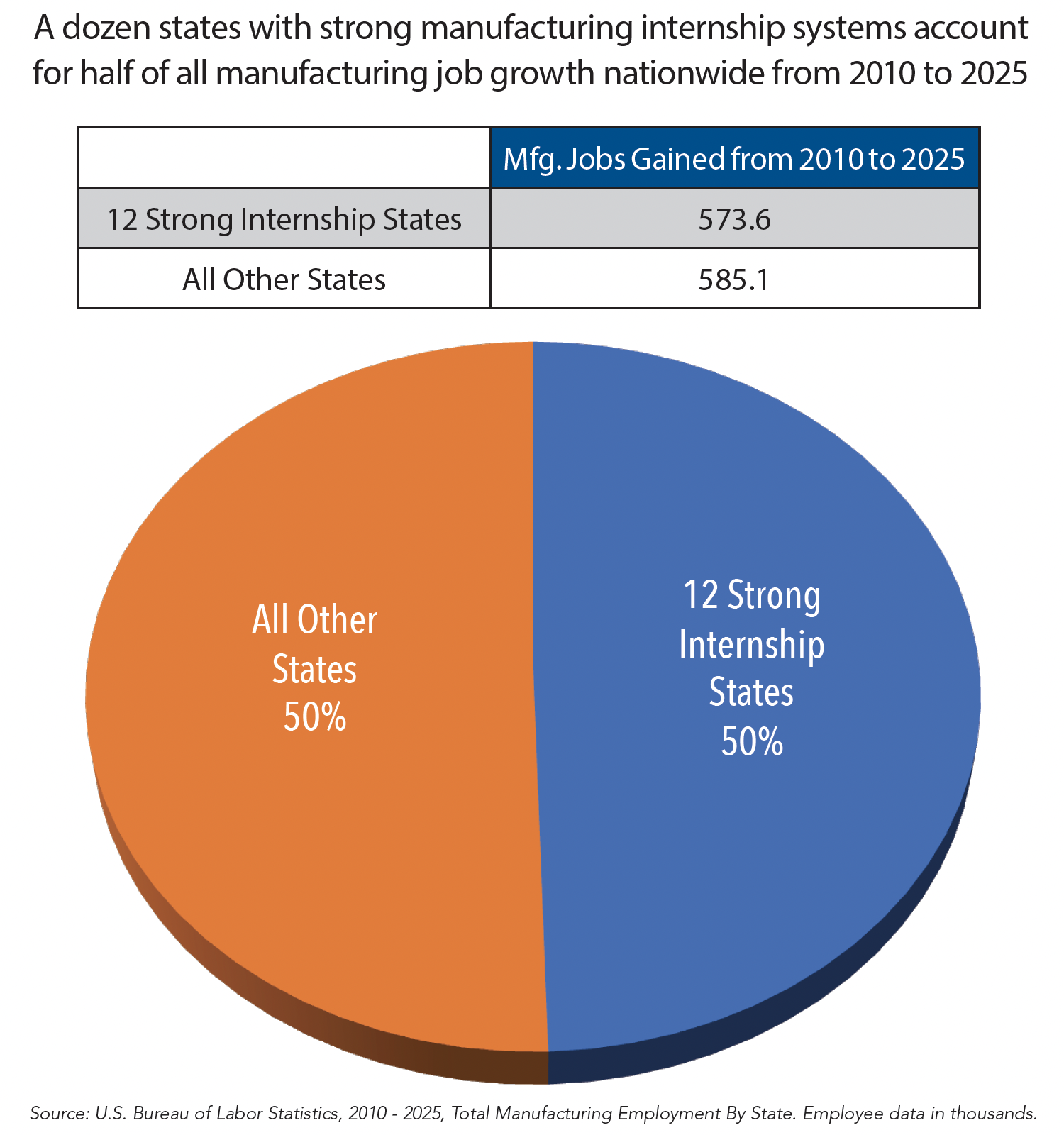
Further analysis, however, revealed that 10 of the 18 states hit hardest by job losses — determined by having lost 100,000 or more manufacturing jobs during the aughts — are today among the bellwether states identified as having well developed manufacturing internship ecosystems. These include Georgia, Illinois, Indiana, Michigan, Minnesota, North Carolina, Ohio, South Carolina, Tennessee and Wisconsin. (Note: That decade job losses reached about 71,400 in Connecticut and about 22,100 in Nebraska.) Industrial regions that experienced the deepest disruption have spent the past 15 years rebuilding their workforce pipelines through apprenticeships, internships and stronger education–industry partnerships.
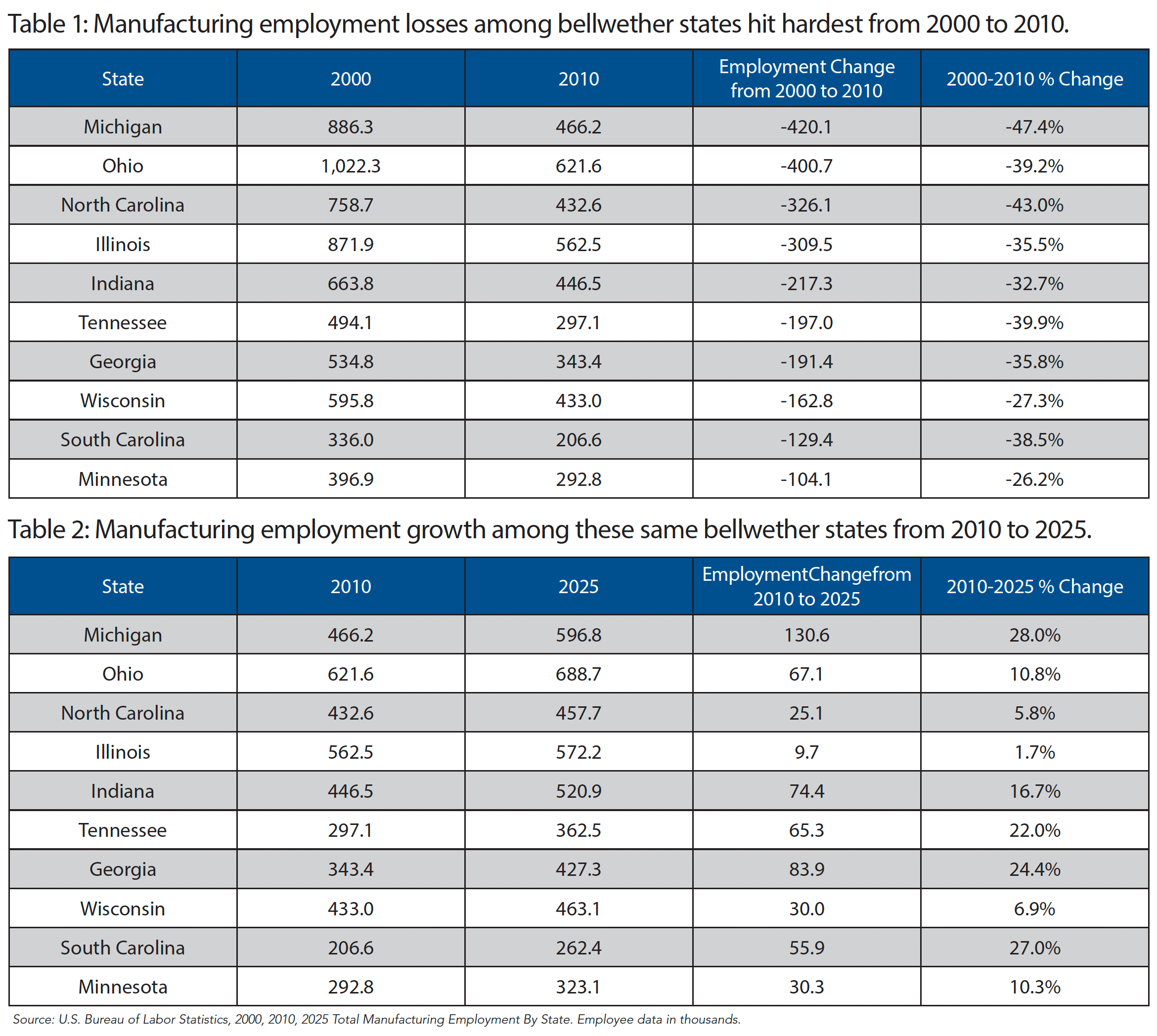
All things considered, the compiled data raises a good question: Is high internship acceptance a product of manufacturing success or is manufacturing success a product of high internship acceptance? Either way, our country needs to double down on internships, and states need to focus on using internships to increase interest in manufacturing careers. Increased emphasis on manufacturing internships will help change the public’s perception of manufacturing careers while simultaneously calling out the economic imbalance that awaits high school graduates who take the traditional college path.
For many high school students, the expectation to pursue a four-year degree immediately after graduation is rarely questioned. Since the 1960s, however, average college and university tuition has more than tripled at public institutions and nearly quadrupled at private nonprofit institutions, according to data from the National Center for Education Statistics. That trend has contributed to a student loan system now totaling more than $1.7 trillion in debt. Despite this, relatively few students are made aware of alternative career pathways — particularly in fields like manufacturing — where they can enter the workforce sooner, earn competitive wages and build valuable skills without taking on significant debt.
This lack of awareness comes at a time when manufacturers are actively seeking the next generation of talent. The National Association of Manufacturers has consistently highlighted a growing workforce shortage, with projections showing millions of positions at risk of going unfilled. Internships are playing a critical role in closing that gap. By giving students early, hands-on exposure to advanced manufacturing environments, companies can help reshape perceptions and demonstrate that a four-year degree is not the only path to a stable, rewarding career.
Just as importantly, the choice between a manufacturing career and a college degree is not necessarily an either-or proposition. Many manufacturers now offer tuition assistance or fully funded education programs as part of their long-term workforce development strategies. Today’s employers are increasingly willing to invest in upskilling their workforce by helping employees pursue degrees in engineering, business or other disciplines while gaining real-world experience. For students, this means the opportunity to earn, learn and advance simultaneously — often reaching the same educational goals without the same financial burden.
What’s Next?
Despite our losses and decades of licking our wounds, the U.S. still has a vibrant manufacturing economy. Our manufacturing sector is still a behemoth in the world, as is evident in the Manufacturing Institute’s latest report showing each country’s total share of worldwide GDP. Looking solely at manufacturing’s share of nationwide GDP, the Manufacturing Institute ranks U.S. manufacturing as the seventh largest economy in the world.
U.S. manufacturing currently employs 12.6 million people nationwide — and another 7 million people if we include indirect labor. Yet, the big story remains focused on the unfilled skilled jobs in the industry.
There is still a long way to go before enough people with advanced manufacturing skills will be able to fill the open positions that exist in companies that build, make and assemble products all over the country. Keep in mind that each new successful manufacturing internship benefits all of us, so climb aboard and help ensure this internship isn’t left at the dock.
Related


 MFGAxis Discussion
Be part of the shop-floor conversation
Like, save, or comment on this CTE story.
MFGAxis Discussion
Be part of the shop-floor conversation
Like, save, or comment on this CTE story.


MFGAxis Discussion