New range for tool change
The current crop of automatic toolchangers offers technological advances and robotic capabilities.
The term “automatic toolchanger” covers more ground than ever these days. The concept includes conventional ATCs, the latest of which offer a variety of novel technologies and features aimed at improving machining operations. In addition, the description can be applied to robotic devices that help out on a shop floor by automatically changing end effectors.
On the conventional side, shops are benefiting from a number of ATC-related developments. One is the rollout of Inertia Active Control on machine tools from Makino Inc. in Mason, Ohio. A standard feature on the ring magazines of Makino’s machines, IAC is targeted at reducing noncutting time.
“If we can do something to eliminate nonproductive time, it opens up capacity on the machines and makes them more valuable to the customer,” said Product Marketing Manager David Ward.
He said IAC automatically senses the total mass in an ATC magazine and adjusts acceleration and deceleration parameters to optimize the speed at which the magazine rotates, thereby reducing tool-changing “seek time.”
“The faster we can get a tool out of the magazine and to the ready station, the better we’re going to be from a cycle time standpoint and the more noncut time we can eliminate,” Ward said.
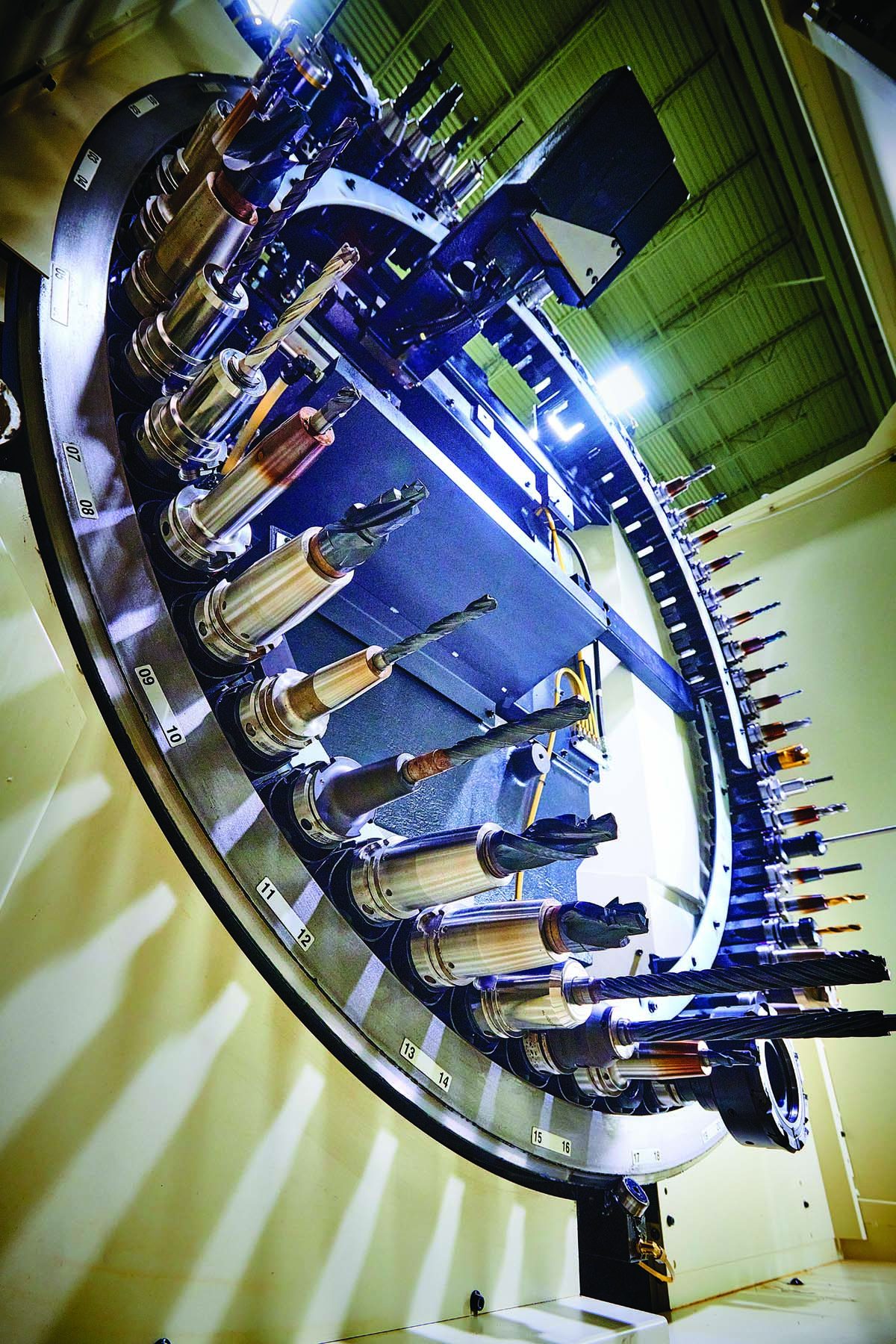
Rotation speed of this 60-tool ring magazine is optimized using Inertia Active Control technology that senses the total mass in the magazine. At the top center is the digital camera for the Vision BTS system, which evaluates pictures from the camera to instantly detect broken tools. Image courtesy of Makino
Another system that now comes standard on Makino’s horizontal machines is Vision BTS, a noncontact tool-breakage detection system. Vision BTS features a high-speed digital camera mounted inside the tool magazine and aimed at the ready station of the tool change system, as well as an LED light source. When a tool removed from the spindle reaches the magazine, the LED flashes like the flash on a camera to produce a silhouette of the tool. The camera takes a picture of that silhouette, which then is measured to determine the condition of the tool. He said Vision BTS can quickly assess the condition of tools down to 3 mm (0.118″) in diameter.
“In a fraction of a second,” Ward said, “you can have 100% confidence that the tool did not break while it was machining.”
Additionally, Vision BTS works with a toolchanger to set the proper speed for each tool change. This is based on a rough determination of the mass of each tool, which is obtained by calculating the cross-sectional area of the tool silhouette and multiplying that by the length of the silhouette and the density of the tool material.
Vision BTS “can automatically set the tool change speed so your operators don’t have to spend a lot of time optimizing the program as they put a new tool in,” Ward said.
Door Developments
With the rough length of a tool obtained from the silhouette image, the system also can automatically customize the distance that the ATC shutter door must open for each tool. Separating the tool magazine from the inside of the machine, the shutter door slides back and forth to allow the passage of tools during the tool change process.
“We can set the shutter door to only open far enough to allow that tool to come through during the tool change,” Ward said. “So if it’s a very short tool, the shutter doesn’t have to open very much.”
This saves a fraction of a second of tool change time, he said, and minimizes exposure of the ATC magazine to the dirty machining environment.
To boost reliability, all Makino horizontal machining centers now are equipped with servo-driven ATC shutter doors. Ward pointed out that the traditional way to actuate these doors is with air cylinders, which function fairly well when new but suffer over time from exposure to unclean manufacturing environments, resulting in slower performance, maintenance problems and downtime.
By contrast, Makino’s system, which includes a ballscrew, as well as a servomotor, provides “very consistent performance from day one to (many) years down the road,” he said. “I think our competitors look at it as an expensive solution. We look at it as what we need to do to provide reliability for our customers.”
In addition to these standard features, Makino now offers MHmax, an optional predictive maintenance software and sensor package designed to eliminate unplanned downtime. Among other things, MHmax can monitor tool change handoff position and ATC timing. Misalignment of handoff position causes a tool to bang into the spindle, so MHmax monitors the forces on the machine during a tool exchange and can alert an operator when handoff position is less than optimal. The system also signals the operator if the time taken to move a tool from the ring to the ready station starts to be longer. This is an indication that the ATC is wearing and needs to be adjusted, Ward said.
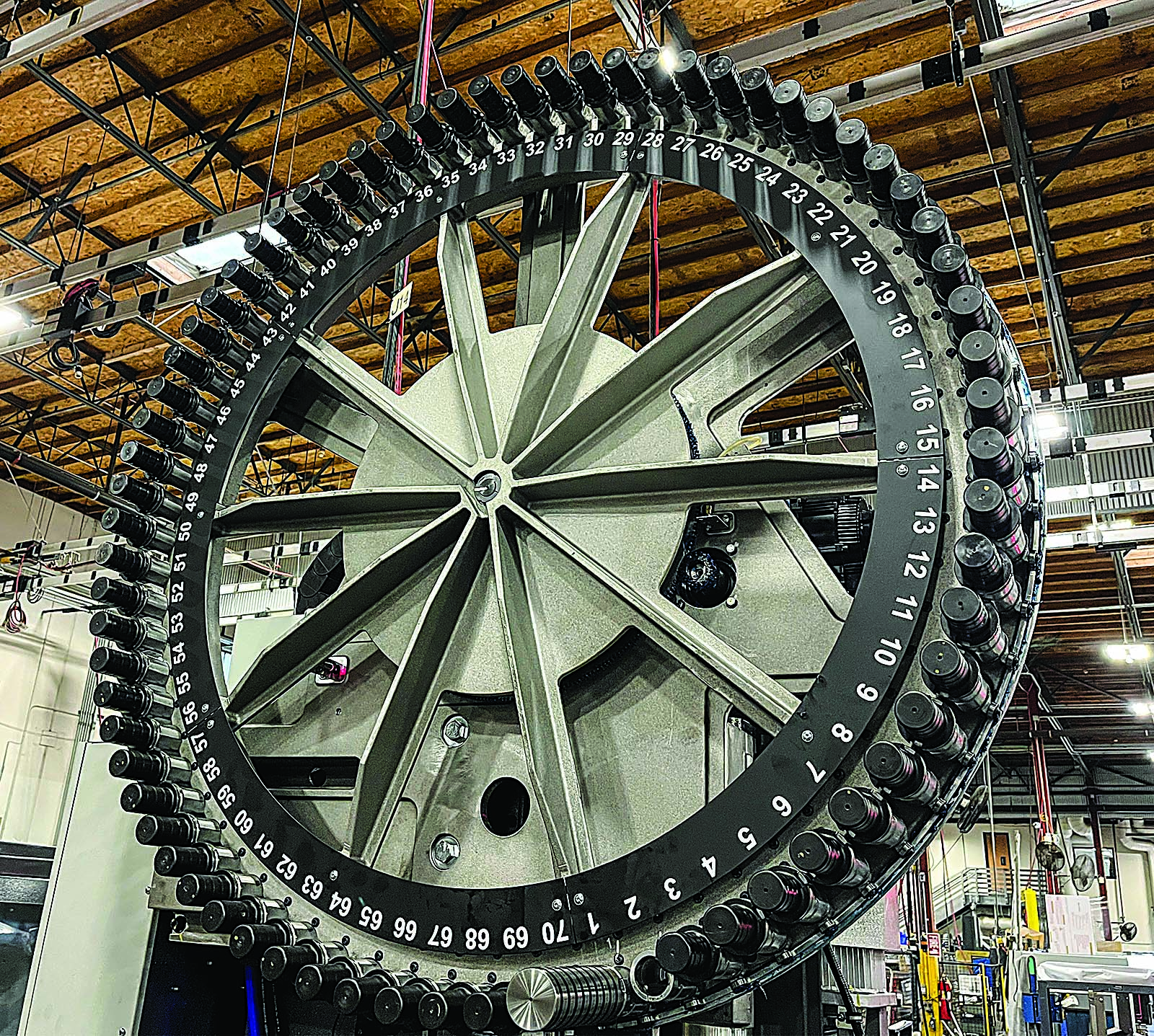
The new 70+1 side-mount toolchanger holds 70 tools, plus one in the spindle. Image courtesy of Haas Automation
Partly to satisfy demands from machining operations in some industries for access to more tools, he is starting to see a move mainly in the European market toward central tool storage and delivery systems. In such systems, several machines are linked to a central magazine that may hold up to 1,000 tools, which are grabbed and delivered to the machines on an as-needed basis by automation equipment.
On the Side
Another option located outside the work envelope of a machine is a side-mount toolchanger. Besides freeing up workspace, side-mount toolchangers keep tools and tool pockets free of contamination, according to Haas Automation Inc. in Oxnard, California.
Review the print ads from this magazine to continue
This quick advertiser review unlocks the rest of the article and keeps the full-screen reader focused on the ads instead of the page chrome.
Advertisers included in this article experience
Print placements connected to this article
Guhring
Carbide milling cutter for soft,
tough and high-alloy materials. Steel P • 12° rake - significantly reduces cutting forces Stainless steel M • AlCrN coating for maximum wear protection • Optimized facet grinding Aluminum N • Ultra tough carbide grade Special alloys S One milling cutter, full flexibility for all milling operations Helical Slotting Roughing Finishing Ramping interpolation.
Carbide milling cutter for soft, tough and high-alloy materials. Steel P • 12° rake - significantly reduces cutting forces Stainless steel M • AlCrN coating for maximum wear protection • Optimized facet grinding Aluminum N • Ultra tough carbide grade Special alloys S
Visit Guhring View this placement in the issue recordPrint ads from this magazine
tough and high-alloy materials. Steel P • 12° rake - significantly reduces cutting forces Stainless steel M • AlCrN coating for maximum wear protection • Optimized facet grinding Aluminum N • Ultra tough carbide grade Special alloys S One milling cutter, full flexibility for all milling operations Helical Slotting Roughing Finishing Ramping interpolation.
Carbide milling cutter for soft, tough and high-alloy materials. Steel P • 12° rake - significantly reduces cutting forces Stainless steel M • AlCrN coating for maximum wear protection • Optimized facet grinding Aluminum N • Ultra tough carbide grade Special alloys S
Continue reading
March 2022
The company uses the same side-mount toolchanger design for the majority of its machining center lines.
“This common-component approach simplifies production and allows us to take advantage of economies of scale to reduce costs,” said Bill Tandrow, vice president of mechanical engineering.
Haas Automation’s side-mount toolchangers use a ring-gear/drive-motor system to move the carousel to a specified pocket. The toolchangers also feature a cam-driven double-arm gripper
designed to make fast tool swaps that minimize noncutting time.
The company makes both 40- and 50-taper versions of its side-mount toolchangers. To accommodate more tools, the carousel is enlarged and the ring gear and drive motor are scaled accordingly. The double-arm length also can be adjusted to fit specific machine models.
Haas Automation recently introduced a 70+1 side-mount toolchanger for its universal machining centers and some of its 40-taper vertical machining centers. As the name suggests, this toolchanger holds 70 tools, plus one in the spindle, more than double the capacity of the standard 30+1 side-mount toolchanger, Tandrow said. He said the extra pockets can be used to load redundant tools for extended part runs or to load tool sets for multiple jobs in high-mix/low-volume production environments. The company makes both standard models and super-speed versions that offer faster tool swaps.
He said additional tool capacity is needed to get the most out of automation systems for unattended operation, which is in greater demand these days due to the continuing shortage of skilled labor. Haas Automation offers a number of fully integrated automation systems for its machines, including automatic part loaders, pallet pool systems and robot packages.
Robots Rising
Machine shops increasingly are employing collaborative robots, also known as cobots, because “the price point is coming down and the ease of use for novice customers is going way up,” said Baron Kendrick, standard toolchanger product manager at ATI Industrial Automation Inc. in Apex, North Carolina.
Different from the ATCs commonly found on shop floors, ATI Industrial Automation’s automatic toolchangers allow users to swap tools at the end of robot arms, eliminating the need to have a dedicated robot for each process that gets a robotic assist.
Instead, “you can have a single robot do different processes by changing tools,” Kendrick said. “So now the robot is staying busier and paying off the investment faster.”
Essentially a mechanical coupling device, a robotic toolchanger consists of an A half, which is permanently attached to the robot, and a B half, an adapter plate that mounts to whatever tool is needed for a particular process. Examples of these include grippers, spot welders and deburring spindles. A toolchanger simply uncouples a B half from one tool and couples the half to another tool.
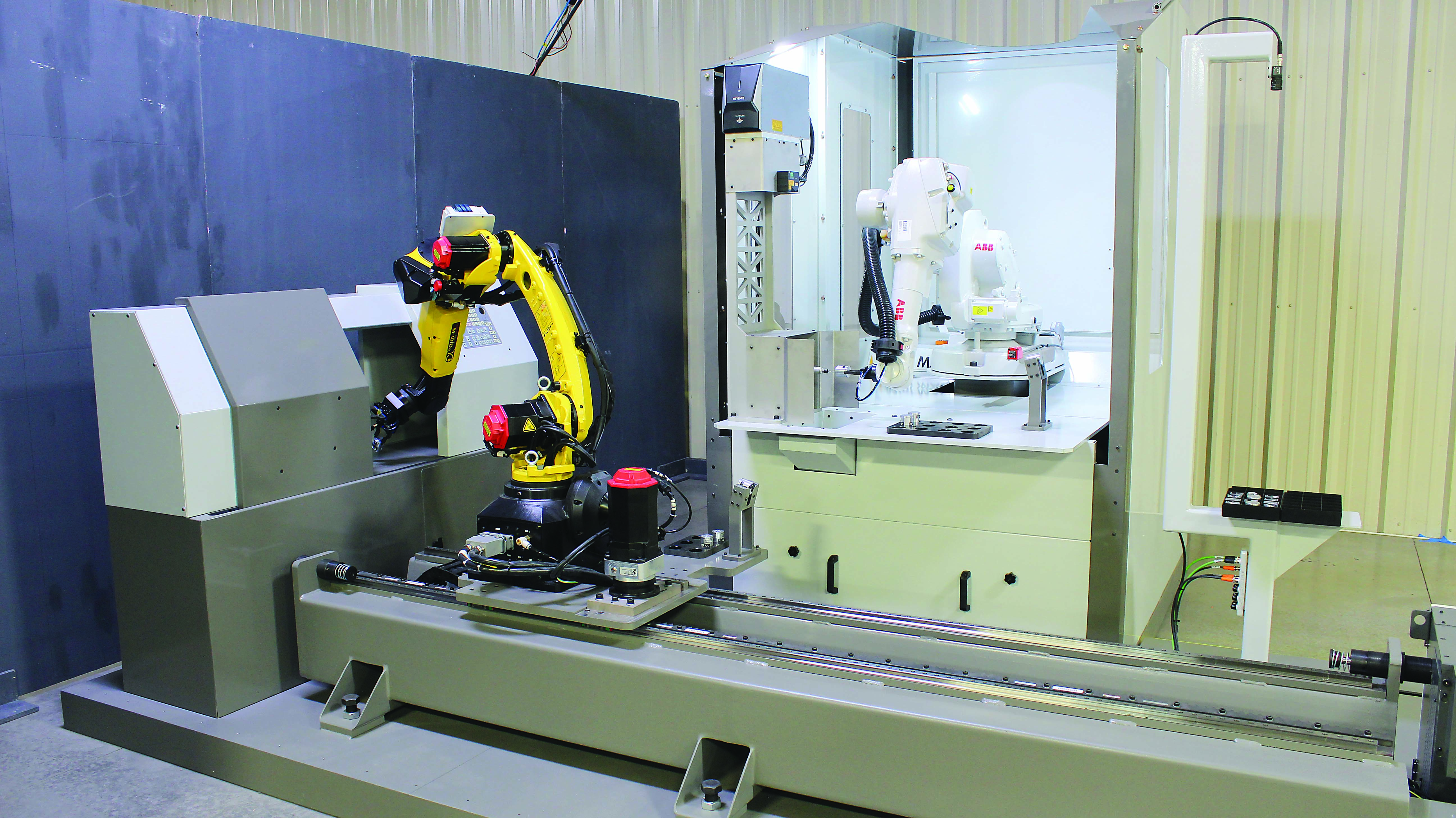
This cell includes a CNC machine, two robot arms, an ATI Industrial Automation deburring tool and a gripper tool. Image courtesy of ATI Industrial Automation
Kendrick said two primary applications are drawing ATI Industrial Automation’s toolchangers into machining operations. The main one is machine tending done by cobots. When a cobot loads and unloads part pallets during an overnight shift, for instance, a toolchanger allows the use of different gripper types to handle different pallets.
The other major application for ATI Industrial Automation’s robotic toolchangers in machining settings is to facilitate secondary operations done outside a machine.
“You can have a robot that’s using an automatic toolchanger to change between material removal devices and/or grippers to accomplish any number of secondary operations,” Kendrick said.
At a shop that wants to use its CNC machine to do most of the work and a robot to handle less precise secondary tasks in parallel, a robot fitted with a gripper can take a machined part out of the machine and carry the part to another chuck or fixture. Then the toolchanger can replace the gripper with a deburring bit or sanding tool so the robot can perform additional material removal that’s necessary for the part to meet specifications.
Although it’s still rare, Kendrick also pointed out that interest is growing in using robots rather than CNC machines for primary machining.
“Instead of being locked in to a three-, four- or even a five-axis CNC machine, you basically have infinite flexibility if you’re using a six-axis robot as your motion platform,” he explained, adding that some customers attempting this are using toolchangers to switch between different cutting tools or spindles on the end of a robot arm.
The problem, however, is that robots aren’t designed for high-precision work.
“There’s a lot of flex in the castings of the robot arm,” Kendrick said. “This is completely inconsequential for the things that robots have traditionally been asked to do, like pick-and-place and spot welding. But for customers in the CNC space that are trying to hit ±0.001″ (tolerances) across a large surface, that is more difficult to achieve with a robot. Doesn’t stop people from experimenting, though.”
Glossary terms in this article