

Next-gen Automation
Machine shops adopt intelligent, flexible systems to overcome labor gaps and streamline production.
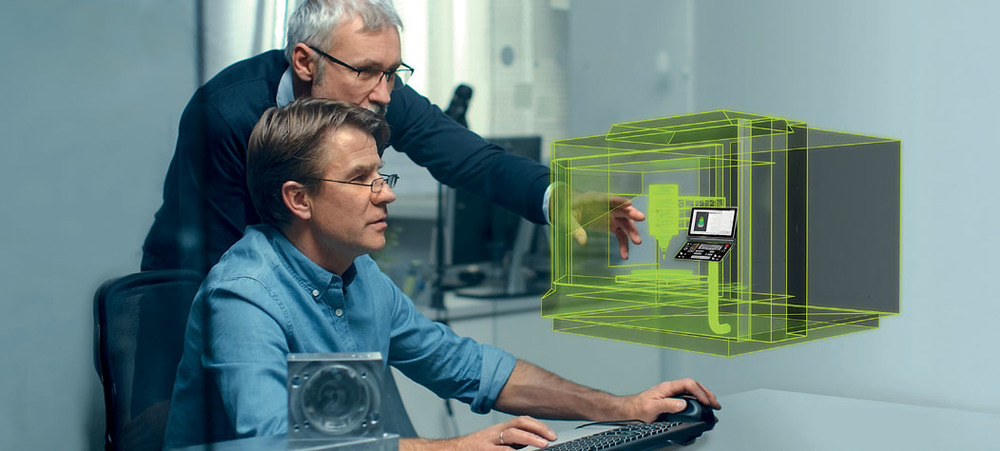
Heidenhain’s digital twin technology uses encoder data to simulate real-time performance. Heidenhain
Material handling is the No. 1 application for robotics, according to Alex Shikany, executive vice president of the Association for Advancing Automation (A3) in Ann Arbor, Michigan. Material removal is one of the smaller but fastest-growing applications, including grinding and polishing.
“There’s a growing focus on automating finishing applications like grinding and polishing because they’re physically demanding, repetitive and require precision,” Shikany said. “With advancements in force control, vision and AI-driven programming, robots are now handling these tasks more effectively than ever.”
He added that small and medium- sized manufacturers, including job shops, represent the largest untapped market for automation. “These companies are increasingly recognizing that automation isn’t just for high-volume production — it’s a competitive necessity,” he said. “The key is helping them take that first step with the right solution.”
Unlike the fixed automation solutions of the past, which were costly and difficult to reconfigure, today’s manufacturers prioritize flexibility. “Scalability and redeployment are critical,” Shikany said. “Companies need automation solutions that adapt as production demands change.”
Hermle is one machine tool builder that understands that end users producing parts in a low-volume, high-mix environment require automation that can accommodate planned and unplanned changes, said Frank Keller, sales director of automation and technology for HLS Hermle Systemtechnik GmbH in Gosheim, Germany. Hermle USA Inc. is in Franklin, Wisconsin. “We supply flexible clamping systems, flexible vises, flexible robot gripping systems — and all are controlled with very easy-to-use software.”
Having spoken with customers across North America, Europe, Asia and South Africa, Keller noted that the common theme driving automation is the lack of skilled labor. “As a side product, which is of course very nice to have, you are much more efficient and have a much lower cost per part at the end of the day.”
For workers relieved of dull, dirty and dangerous tasks, automation creates a more interesting and less exhausting work environment that is flexible and family-friendly, he added. “Basically, you are able to fulfill your commitment to your family, and everyone is happy.”
When launching a machine automation project, Keller recommends selecting enthusiastic people and involving them early. Frequently, other workers who were hesitant at first see the benefits automation brings. “All of a sudden, the whole atmosphere changes, and these people want more and more automation.”
The improvements can be significant. For example, a customer running one shift achieved 800 spindle hours annually on a machine out of potentially more than 8,700. With flexible automation, spindle hours increased to 4,000 or more, Keller said, noting that Hermle has customers achieving 7,000 spindle hours. “The whole system is sometimes amortized in less than a year.”
On average, he added, customers achieve a return on investment in two years.
Once automation is in place, Keller added, there’s no returning to the old way. “Not a single customer,” he stressed, “has ever gone back after they started with automation” — no matter the industry, company size or number of employees.
First Things First
Before automating a machine tool, Gisbert Ledvon, vice president of marketing for Heidenhain Corp. in Schaumburg, Illinois, recommends ensuring a machine can achieve a specified part accuracy. This requires reliable, thermally stable machines that hold tolerances throughout the day. If you can make one part and that’s accurate, then you can be confident the machine will reproduce those parts day and night, and that automation makes sense, he said.
In other words, the machine must be capable of accurate and repeatable results. “That’s what we see from the Heidenhain side,” Ledvon said, noting that encoder technology provided to robots is becoming increasingly important to ensure motion within all axes is repeatable and accurate.
With a reliable automation process in place, the need to double- check elements of production is eliminated, he added. “The technology in the Heidenhain CNC will do that for you.”
To help the next generation of operators gain efficiency and run more machines, Heidenhain replaced its traditional CNC panel with one that allows touchscreen customization, similar to a smartphone or tablet. And multiple operators can customize the screen to their individual preferences. “That helps attract new people into the field,” Ledvon said, while also providing them “much higher confidence and a shorter learning curve to operate in an automation environment.”
For that matter, he noted, “even an experienced operator wants much more help from the control technology.”
Other Heidenhain enhancements to the control include:
- The introduction of video tutorials. “The operator can say, ‘I want to do a setup on this part, and I want to touch probe this part — how do I do that?’ You click on that video, and it gives you a quick overview.”
- The addition of more dynamic collision monitoring to avoid crashes by simulating the part, fixture, toolholder and cutting tool in a test run before production.
Engaging Atmosphere
The skilled labor shortage aside, automation helps manufacturers find, hire and retain employees in general, according to Jeff Bennett, senior automation and control engineer of the A+ Automation team at Absolute Machine Tools Inc. in Lorain, Ohio. “They’re forced to automate because the process is so mundane and repetitive that operators don’t want to stand there and do it.”
Bennett noted that A+ Automation covers robot integration, programming, training, automatic doors and safety — everything in the automated work cell. Many customers don’t need all the bells and whistles, such as a cobot opening and closing a machine door instead of an automatic door. “We go through and give them an option, sometimes multiple options.”
Jonathan Sbert, vice president, Americas, for Universal Robots USA Inc. in Novi, Michigan, is familiar with the potential for cobots in machine tool automation. Universal Robots has sold more than 90,000 cobots for various applications, from machine tending and welding to serving lattes and food.
“We make a product that can be told to do a million different things, but it doesn’t do anything out of the box,” Sbert said, noting that Universal Robots relies on more than 1,200 partner companies to develop the end equipment.
Welding automation, Sbert said, for example, has experienced tremendous growth thanks to exceptional offerings from Universal Robots partners, as well as a severe labor shortage “that’s going to hit us like a ton of bricks.”
Review the print ads from this magazine to continue
This quick advertiser review unlocks the rest of the article and keeps the full-screen reader focused on the ads instead of the page chrome.
Advertisers included in this article experience
Print placements connected to this article
Fred Stlouisfed
Reserve Bank of St. Louis; https://fred.stlouisfed.org/series/VAPGDPMA, April 2, 2025.
U.S. Bureau of Economic Analysis, Value Added by Industry: Manufacturing as a Percentage of GDP [VAPGDPMA], retrieved from FRED, Federal NEW SOLID END MILLS CARBIDE END MILLS • Provides 25-50% higher performance in most applications, from full slotting to heavy profiling to fine finishing • Its sub-micron carbide offers toughness combined with high.
U.S. Bureau of Economic Analysis, Value Added by Industry: Manufacturing as a Percentage of GDP [VAPGDPMA], retrieved from FRED, Federal Reserve Bank of St. Louis; https://fred.stlouisfed.org/series/VAPGDPMA, April 2, 2025. NEW SOLID END MILLS CARBIDE END MILLS • Provides 25-50% higher performance in most applications, from full slotting to heavy profiling to fine finishing • Its sub-micron carbide offers toughness combined with high wear resistance to allow for longer tool life • The PVD coating provides capability for higher speeds, especially in HRSA materials
Visit Fred Stlouisfed View this placement in the issue recordPrint ads from this magazine
U.S. Bureau of Economic Analysis, Value Added by Industry: Manufacturing as a Percentage of GDP [VAPGDPMA], retrieved from FRED, Federal NEW SOLID END MILLS CARBIDE END MILLS • Provides 25-50% higher performance in most applications, from full slotting to heavy profiling to fine finishing • Its sub-micron carbide offers toughness combined with high.
U.S. Bureau of Economic Analysis, Value Added by Industry: Manufacturing as a Percentage of GDP [VAPGDPMA], retrieved from FRED, Federal Reserve Bank of St. Louis; https://fred.stlouisfed.org/series/VAPGDPMA, April 2, 2025. NEW SOLID END MILLS CARBIDE END MILLS • Provides 25-50% higher performance in most applications, from full slotting to heavy profiling to fine finishing • Its sub-micron carbide offers toughness combined with high wear resistance to allow for longer tool life • The PVD coating provides capability for higher speeds, especially in HRSA materials
Continue reading
May 2025
Although manufacturers typically target a return on investement (ROI) of less than 18 months when purchasing a cobot, the payback can be quicker for welding applications, particularly those previously performed by skilled welders. “Technical welders are well paid and hard to find,” Sbert noted.
However, convincing companies to make the initial purchase can be challenging. “Once they buy the first one, they tend to buy the second and third pretty quickly thereafter,” he said.
Selling a Cell
Robots are often integrated into work cells, Bennett said. For example, an operator might work on two machines while a robot tends one, or two to three robots might run four to six machines while an operator feeds workpieces and checks quality.
Manufacturers with a high mix of parts are ideal candidates for automation because robots are easy to program and setup time is minimal. However, automation is difficult to justify for lot sizes below a certain quantity. “Three hundred parts is the threshold where the setup time is worth it,” Bennett said.
Absolute Machine Tools typically serves as a one-stop shop unless a specialized machine control is involved. “The vast majority are controls we’re used to seeing, so we’re the only contact a customer needs,” Bennett added.
Most customers target an ROI of 12 to 18 months, he said, noting that even a couple of extra hours of unattended production each day can speed up payback. “When the robot is running and the operator goes to lunch or break, the operator is still getting parts out.”
Automation and AI
As with many areas of technology, artificial intelligence (AI) plays an evolving role in machine tool automation. “AI will, in the next 10 years, completely change our industry,” said Hermle’s Keller.
One area where AI can help is capturing the know-how of retiring workers and transferring it to the next generation, Keller explained.
Next-Gen Automation
Retaining such expertise is vital, concurred Shikany of the Association for Advancing Automation. “You need to somehow capture or transition that knowledge within your organization. Otherwise, you lose a big piece of what made you successful.”
AI can also help optimize tool life by removing the guesswork from decisions about when to change a worn cutting tool, Keller said. There’s no reason to burden skilled people with such decisions, he added, when AI can be trained to optimize the use of expensive cutting tools.
Additionally, AI is being explored to write CNC programs because many end users struggle to create enough programs quickly. “There’s huge potential,” Keller said.
Heidenhain’s Ledvon cautioned that users shouldn’t fully trust AI-generated programs without verification. “Maybe AI can give you basic programming, and you put it into the machine and run it through a verification process to make sure the code is right.”
Shikany noted that large language models can generate robot programs with impressive accuracy. “AI-assisted programming is accelerating deployment, but you still need human oversight to refine and optimize for real-world production.”
Universal Robots is also developing AI applications in partnership with chip manufacturer Nvidia, with the first focusing on vision sensing and more promising ones on the horizon. “You can imagine the Holy Grail would be you just put a cobot next to an employee and it can just watch and learn what he does every day. Then all of a sudden — boom — your program is created. I don’t think we’re that far away.”
A common pitfall, Ledvon said, is attempting to automate everything at once. He recommended ensuring machines are solid and rigid enough, with accurate kinematics and the ability to be recalibrated. A tool presetter should be used to transfer tool data and maintain a complete tool library in the machine.
“The first step into automation is 3+2 machining in one setup and machining five sides of a part, which will significantly improve quality and productivity — even without adding a robot or pallet changer,” Ledvon said.
Shikany emphasized the importance of working with an experienced automation integrator. “Start smart — focus on the application that will create the most value,” he said. “Some deceptively simple tasks present the biggest challenges, so selecting the right starting point is critical.”Glossary terms in this article
Related


Subscribers can use MFGAxis notes, saves and discussion tools with their innoNET account.


