

Nital etching, setting up a lab
Dear Doc: We do nital etching of the entire workpiece after grinding. There's constant bickering about whether a part is burned. What can we do?
Dear Doc: We do nital etching of the entire workpiece after grinding. There’s constant bickering about whether a part is burned. What can we do?
The Doc replies: Accept it. The bickering will continue. Indefinitely. Why? Because nital etching (where you dip the entire part in acid) is a very subjective test. One operator says it’s not burned; a different operator says it’s burned. And if somebody dims the lights slightly, the first operator changes his mind — now it’s burned.
But there are things you can do to reduce the uncertainty of the test so that the bickering is less often and less severe.
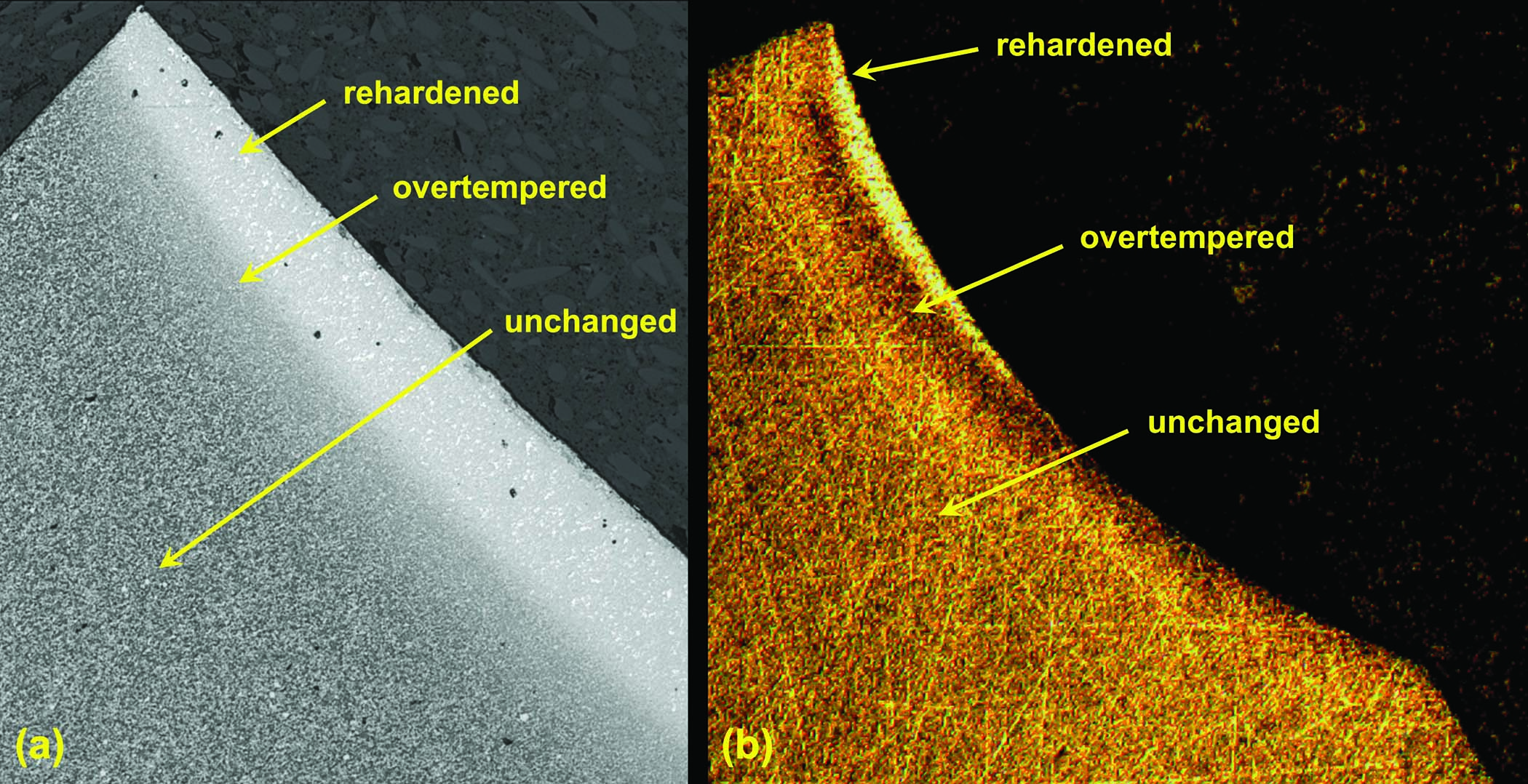
An expensive lab will give you a pretty picture (a). A cheap lab will give you a scratchy picture (b). But sometimes, a scratchy picture is just fine for finding out the depth of rehardening. Image courtesy of J. Badger
Here’s one thing I encourage my customers to do: “Calibrate” your nital etch so you feel more confident in the 50 inconsistent shades of gray that the test produces. The best way to “calibrate” it? Purposely burn a few parts to various degrees. Do your regular nital-bathing test and take photos (in the same room under the same light where they are typically examined). Then send the workpieces out for either (1) residual-stress measurements (via X-ray diffraction) or (2) cutting, mounting, polishing and nital etching (where you can see the depth of the burn).
Review the print ads from this magazine to continue
This quick advertiser review unlocks the rest of the article and keeps the full-screen reader focused on the ads instead of the page chrome.
Advertisers included in this article experience
Print placements connected to this article
Platinumtooling
THE NAME TO KNOW FOR...
LIVE TOOLS / ANGLE HEADS / SPEED MULTIPLIERS / SWISS COMPONENTS MARKING TOOLS / KNURLING TOOLS / BROACHING TOOLS / SHRINK FIT TOOLS Platinum Tooling is proud to be the importer of Heimatec Live Tools and Angle Heads, Tecnicrafts Swiss Collets and Guide Bushings, Henninger Spindle Speeders, Quick Knurling and Marking Tools, Rineck Shrink Fit Tool Holders and REV Broaching Tools
THE NAME TO KNOW FOR... LIVE TOOLS / ANGLE HEADS / SPEED MULTIPLIERS / SWISS COMPONENTS MARKING TOOLS / KNURLING TOOLS / BROACHING TOOLS / SHRINK FIT TOOLS Platinum Tooling is proud to be the importer of Heimatec Live Tools and Angle Heads, Tecnicrafts Swiss Collets and Guide Bushings, Henninger Spindle Speeders, Quick Knurling and Marking Tools, Rineck Shrink Fit Tool Holders and REV Broaching Tools. Platinum Tooling offers a wide selection of machine tool accessories for most machine brands, including standard and custom tools to help with the most challenging applications. If you need live tooling, we’re here to help. 16 E. Piper Lane, Ste.128 | Prospect Heights, IL | 847-749-0633
Visit Platinumtooling View this placement in the issue recordPrint ads from this magazine
LIVE TOOLS / ANGLE HEADS / SPEED MULTIPLIERS / SWISS COMPONENTS MARKING TOOLS / KNURLING TOOLS / BROACHING TOOLS / SHRINK FIT TOOLS Platinum Tooling is proud to be the importer of Heimatec Live Tools and Angle Heads, Tecnicrafts Swiss Collets and Guide Bushings, Henninger Spindle Speeders, Quick Knurling and Marking Tools, Rineck Shrink Fit Tool Holders and REV Broaching Tools
THE NAME TO KNOW FOR... LIVE TOOLS / ANGLE HEADS / SPEED MULTIPLIERS / SWISS COMPONENTS MARKING TOOLS / KNURLING TOOLS / BROACHING TOOLS / SHRINK FIT TOOLS Platinum Tooling is proud to be the importer of Heimatec Live Tools and Angle Heads, Tecnicrafts Swiss Collets and Guide Bushings, Henninger Spindle Speeders, Quick Knurling and Marking Tools, Rineck Shrink Fit Tool Holders and REV Broaching Tools. Platinum Tooling offers a wide selection of machine tool accessories for most machine brands, including standard and custom tools to help with the most challenging applications. If you need live tooling, we’re here to help. 16 E. Piper Lane, Ste.128 | Prospect Heights, IL | 847-749-0633
Continue reading
December 2023
With these methods, you can see the degree of the thermal damage and the depth of the thermal damage. You’ll probably have to send the workpiece out for X-ray diffraction. Cutting, mounting and polishing can be done in-house, if you have the equipment. Both are destructive. The workpieces will be chopped up into pieces.
I’ve helped companies get themselves set up with a cheap lab for cutting, mounting and polishing. New equipment can get pricey, but what we’re doing is not fancy and we don’t need pretty pictures. You can find a used cutting-off machine, mounting equipment, polishing machine and a cheap microscope (preferably with a digital camera) on Ebay or any of the used-equipment sites online. A few thousand bucks later, you’re looking at the depth of your thermal damage. Now we know if the rehardening is 3 µm deep, or 25 µm or 1,000 µm. Also, interpreting the picture of damage-versus-depth is less fickle than dipping the entire part in acid.
Now you can compare those depths with the pictures of the workpiece from nital bathing.
The graphic shows nital etching results using (a) fancy equipment; and (b) cheap, used equipment on Ebay. They didn’t do a great job polishing. They didn’t get a pretty picture. The workpiece is very scratchy. But it didn’t matter. They can see the depth of the burn.
Nital bathing of the entire workpiece is a fickle test. But, if you want something non-destructive, it’s either nital bathing or Barkhausen. And Barkhausen brings different complications. So nital-bathing may be what we have to work with. If you’re going to do it, spend a few days doing a rough calibration. It’s not the be-all-end-all, but it helps reduce uncertainty and bickering.
Related Reading
- Related guide: Why Resources.
Related

Subscribers can use MFGAxis notes, saves and discussion tools with their innoNET account.


